Could they be social minus the media? Dire mental health finding

If you have teenagers, you know the dilemma. How do we get them to make connections without a device?

A subset of this includes:

  • How do we keep the phone away from the dinner table?
  • At what time should all devices be off in the home?
  • Is there a good reason to allow my daughter to use Snapchat? Or Instagram?*

As someone who once conducted workshops on how to adopt social media, I feel it is my responsibility to now warn young people about the unintended consequences of trying to be ‘social’ via a screen. We don’t need research to tell us that a generation could be experiencing serious issues very soon if we thrust smart phones into their hands, and hope for the best.

This research just in: Mental health and Instagram. 

Conducted by the Royal Society for Public Health in the UK, it has young people using words like ‘fake,’ ‘intimidating,’ and ‘superficial’ to describe platforms such as Instagram and Snapchat. The report explains how:

  • Young people say that 4 of the 5 social media channels make their feelings of anxiety worse!
  • A phenomenon called ‘Facebook Depression‘ which involves being ‘constantly contactable’ and having unrealistic expectations of reality. I had never heard of such a phenomenon, though suspected this existed.
  • FoMo (Fear of missing out) is also a thing, and is another cause of distress, something adults are just getting to know about.
  • There are indeed opportunities, despite the dire warning this report sends out.

Not many young people realize that Facebook owns Instagram and WhatsApp. 

Solar oven Chili Cook-off returns as school winds down

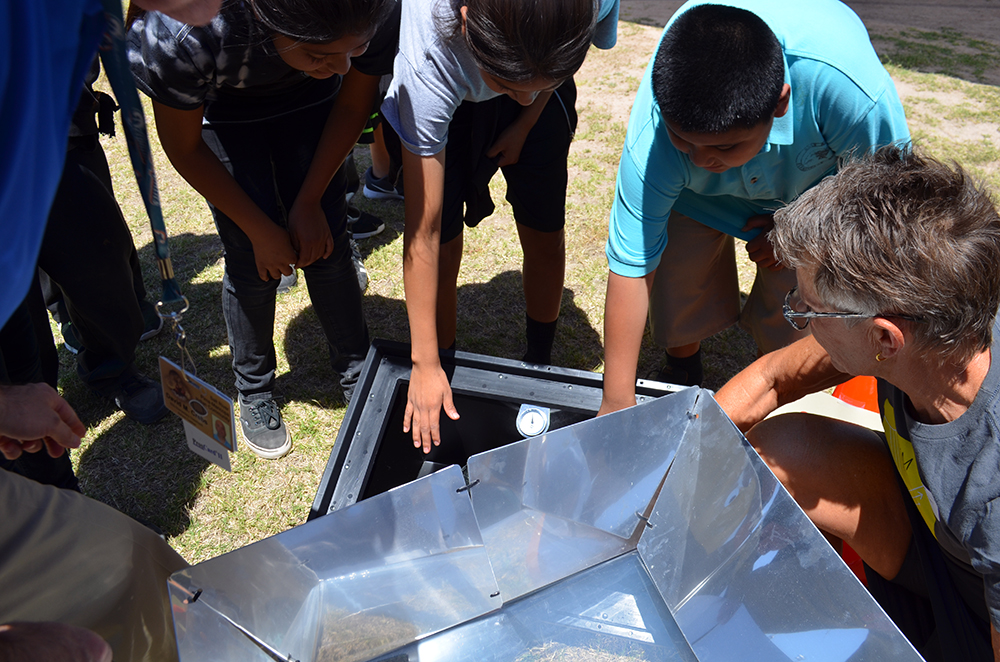
For the second year, I’m holding the Solar Oven Chili Cook-off.

Nothing like bringing the school year to a close at the computer & tech lab, than something that does not involve batteries, software or screens. I think we have all had enough of that!

So let’s chow down and enjoy some class recipes!

  • Three 5th grade classes and three 6th grades will bring their own recipes and compete.
  • Next Tuesday’s temps should reach 105 degrees. The oven usually gets to 275 – 300 degrees, even without reflectors.
  • I’m bringing a Sri Lankan killer chili for those who dare!

Though this is the second annual Chili Cookoff, this is the third year of incorporating a solar oven project into my STEM curriculum, thanks to Solavore. We use the Solavore Sport ovens. In the picture, extreme right is Solavore founder and CEO, Ann Patterson.

Why good writing matters. Even in the PowerPoint obsessed business world

The reason we teach writing is to get students to illuminate their ideas. The craft of writing is indeed on the decline, a topic I have dealt with in many posts before.

So I was heartened when I came across how Jeff Bezos, CEO of Amazon insists that his staff write memos with a ‘narrative structure.’ (See Fortune magazine article on this.) The reason? He requires someone to communicate clear thinking. Unfortunately, we let bullet points take the place of rationales, criticism, and memos. Or even advertisements.

I see an ad for a charter school that’s the biggest mish-mash of bullet points and headlines I’ve ever seen. It comes up as a slide in a cinema I visit. Every ‘important’ point has been thrown in for the audience to consume in about 4 seconds.

I do hope they teach writing, though. The Elements of (Jeff Bezos) style, at least.

Aaron’s take on “How to humanize digital marketplaces.”

As many of you know, my son, Aaron often writes on matters pertaining to markets, the economy, and alternative currencies.

I found this topic on ‘humanizing digital marketplaces‘ very relevant to lifestyles we now take for granted, ‘shopping’ for airfares, taxis, books, and even knowledge –all of it online. The article is at Medium.com. If you read it (it is a long read!) I’d be interested to know what you think. He will too.

How to Humanize Digital Marketplaces

Spin doctors and the ‘Ministry of Truth’ go back a long way

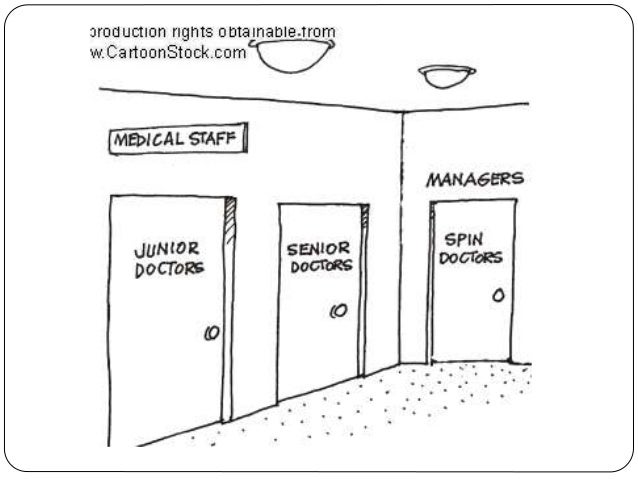
There’s a new way to do spin, and it comes packaged from the Ministry of Truth. (Poor Edward Bernays. The so-called father of spin, must be doing somersaults in his grave.) Modern day spin is much more insidious that doublespeak, or ‘Newspeak.’

We the hoipolloi have a ‘scientific’ way to deal with spin. It involves making air-quotes whenever we use a word or a term generated by the Ministry.

I take on this delicious topic in my May column in LMD Magazine, titled, Alternative facts from the Ministry of Truth

Read it here.

Robotics challenge 2017 to focus on water

I’m really looking forward to the next robotics season in Fall, given the theme – H20!

For our students, Hydro Dynamics is something they’ve been passionate about this whole year, especially the Dakota Access Pipeline issue they took up, supporting the Standing Rock Sioux tribe, and their water conservation efforts. They have made presentations to the community, and had many brainstorming sessions on water challenges. The theme, also harks back to an earlier environmental challenge in 2015, Trash Trek.

So when they come back in Fall, many of them who rejoin robotics will be primed to think like engineers, designers, and scientists, and problem-solve a water issue facing a community.

Here’s more about Hydro Dynamics in the 2017 season. And the teaser video.

Spinners – Stress reduction fad or potential STEM tool?

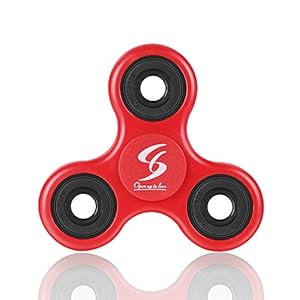
Gadgets fascinate me, especially those that have levers, sensors or even gyros. So the Spinner, a ‘momentum toy’ also known as a ‘fidget toy‘ looks promising.
If not for the fad factor.

Every kid finds it irresistible, no different from how yoyos, or Rubik’s cubes were hard to put away. But the Spinner is also seriously hyped, being claimed to solve many problems. Stress, ADD, and whatever seems to fit. But we better make a distinction between a sensory aid and a gadget that could be used just to show off. Not to mention it becoming a distraction device, rather than solving an ‘attention’ problem.

Having said that, I could envisage how with a few add-ons and variations of the Spinner design, it might be used in a STEM lesson. I’ve seen at least one teacher use the rotations and spin time as variables for math challenges. My colleague and I just discussed how this could become part of a robotics-related lesson, being a mechanical device, after all. No apps required, please!

The field is wide open. Let’s hope we don’t get steamrolled by the fad, and it doesn’t evaporate like…. last Summer’s Pokemon Go.


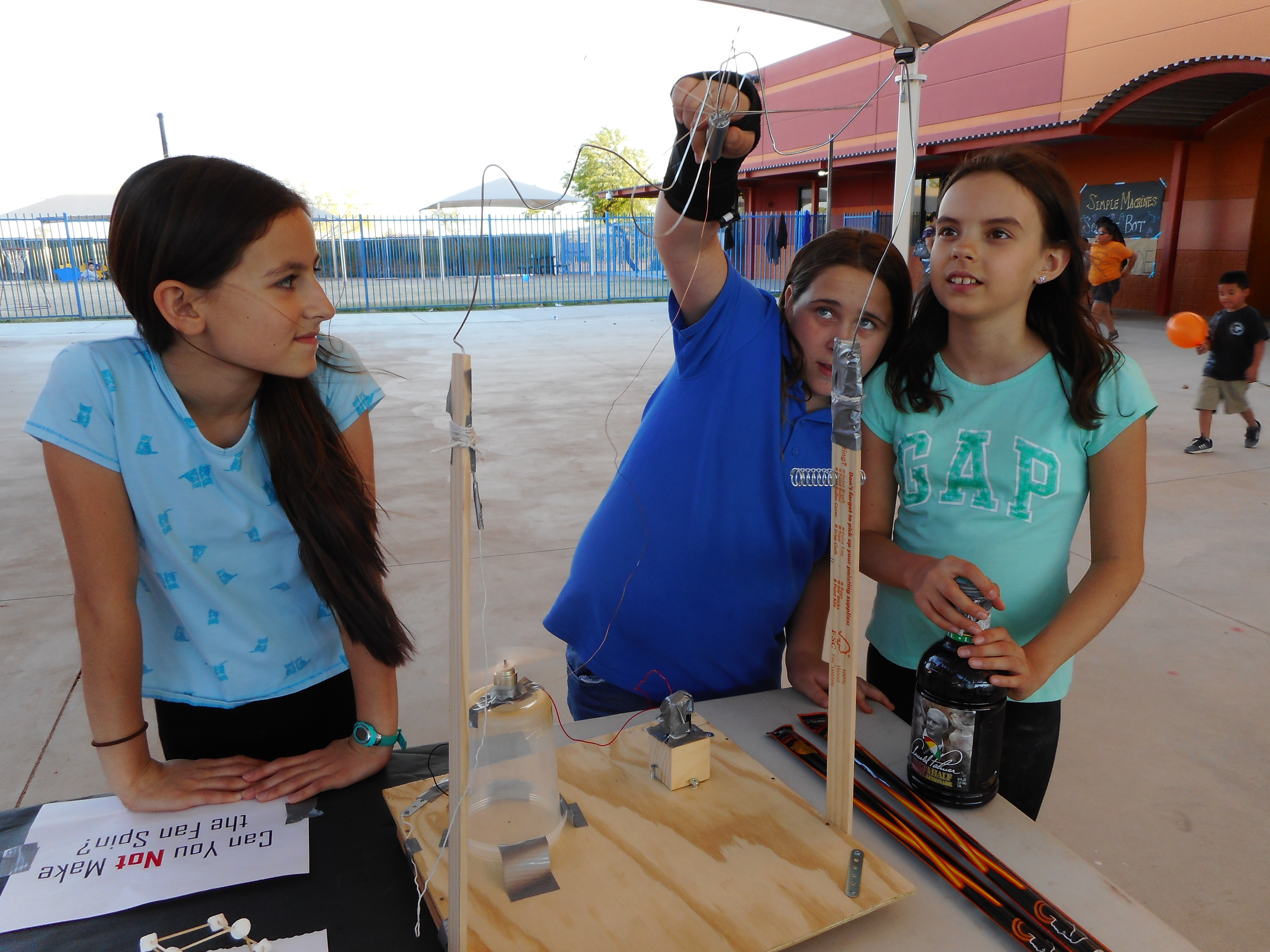
Build a ‘Steady-hand Game’ for under $3

Here’s the device I constructed from mostly scrap material. It’s been called the ‘steady-hand game.’ The goal in this challenge is for the player to not to complete the circuit!

If any part of the metal wand touches the wire, it completes the circuit, which is connected to a rudimentary ‘fan’. Took me about 45 minutes to assemble the contraption.

I admit, the challenge was a tad too difficult. I could have made it easier, but it tends to be more fun if it triggers the fan. Perhaps for a younger group I could have straightened the wire, or bent back the metal ‘wings’.

Material: wood, scrap wire, duct tape, old plastic container, 9-volt battery, copper wire.

  • The Wand: Metal egg beater from the Dollar Store. Bend back some of the loops to create wing-like protrusions.
  • Fan: Made from an old CD, with a piece of Duct tape to cover the center hole. Pierce the tape with the top of the motor. Connect the positive and negative terminals of the motor to the battery
  • The motor. Available at any hobby store, Radio Shack, or online
  • Battery: Ideally a 9-volt battery. D-size battery will also work fine.

Expand the idea! While this is a great way to incorporate it into a unit about electricity and circuits, you could get some students to design an elaborate set up: More complex coils of wire, different size wands, and different circuits that set off off a bell, a light bulb, a buzzer, and a fan, depending on which circuit the wand touches.

‘Electric Avenue’ lights up STEAM Night at Salt River Elementary

This year’s theme gave us plenty space for creativity at our 5th annual STEAM Night celebrating science, technology, engineering, art and math at our school.

The cross-streets of Electric Avenue were filled with parents and children engaged in activities from ‘art bots’ to solar power; from unusual ‘machines’ to circuits. Then there were the bridge builders! The competition this year was to build a bridge with no more than 50 Popsicle sticks. The structure had to carry a load of up to 10 pounds.

  • Students could not use: Metal, plastic, wood, nails, screws, super glue, staples or string.
  • They could use: Paper, Elmers glue, a glue gun, and 4 clothespins

As you will see design, and not just heavier or more expensive material, is key. A big thank you all the teachers and support staff who participated. Also to three organizations I had invited:

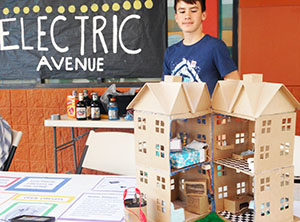
Montessori International School – Brown Road campus. Students and their science teacher, Scott Logan had an interactive table display of batteries (the fruit kind!), motors built with copper wire and a battery. They also brought a student-made ‘Electric House’ designed just for this event. It was a cardboard cutout with working models of home appliances that could be operated via a series of switches.

HeatSync Labs – Mesa, Arizona. Eric Ose brought something that required a hands-on effort of many students to make the device work. It was a cutout of Saturn, and students were given a soldering iron with which they had to connect a string of individual LEDs, to the ring of Saturn.

By the end of the evening, we could light up the ring, taking Electric Avenue to a different level! HeatSync Labs, a Maker Space run by volunteers, is definitely worth a visit. I took my robotics team there a few years back.

Martin Art Center. Martin Wesolowski and his wife displayed a Chaldni Plate. Martin runs a hands-on STEM center in Glendale Arizona. The experiment was about using sound waves to create artistic patterns when particles on the plate (salt, typically) resonate.

My ‘Specials’ team manned a  ‘MakerSpace’ table on circuits, batteries and motors. I even built something I had wanted to do for a long time – build the so-called ‘Steady-hand Game’. This used to be a staple game of skill in our youth.  The concept being, a wand that you had to move along a twisted wire, without touching it and completing the circuit.

Below is an art project that glowed under a black light, and some of the bridge entries.


‘Customers Not Cargo’ act thanks to United Airlines

You’ve heard of ‘cattle class‘ – the seating area most of us are herded into?

After last week’s horrible incident in which a doctor was dragged, bloodied and asked to get off a United Airlines flight, congresswoman Jan Schakowsky plans to introduce legislation “that would end the practice of involuntarily ‘bumping’ passengers from oversold aircrafts once and for all.” Likewise in the senate, Chris Van Hollen is introducing a similar ‘Customers Not Cargo’ bill.

The gist of it is that an airline which oversells a flight for business reasons has to come up with a business solution (not a law-enforcement one) to make sure the flight is emptied of the excess passengers who paid for that spot, anyway.

Now I’m not sure we need to have laws to ensure businesses treat customers with respect. But if you’re like me having been adequately bruised, and given the cattle prod, you’d agree they had this coming. Especially the folks who wax about the ‘friendly skies.’ (The Leo Burnett-inspired slogan dates back to 1965, and was brought back in 2013.)

Note the ad on the right. About embarking at Chicago. As the 1960s headline promised, the airline would later ‘catch’ Dr. Dao not far from the gate at Chicago O’Hare. The body copy goes further to suggest being friendly is catching. Hmmm)

Bonus Reading: Read the business evolved between United’s and Continental Airlines merger Wired Magazine