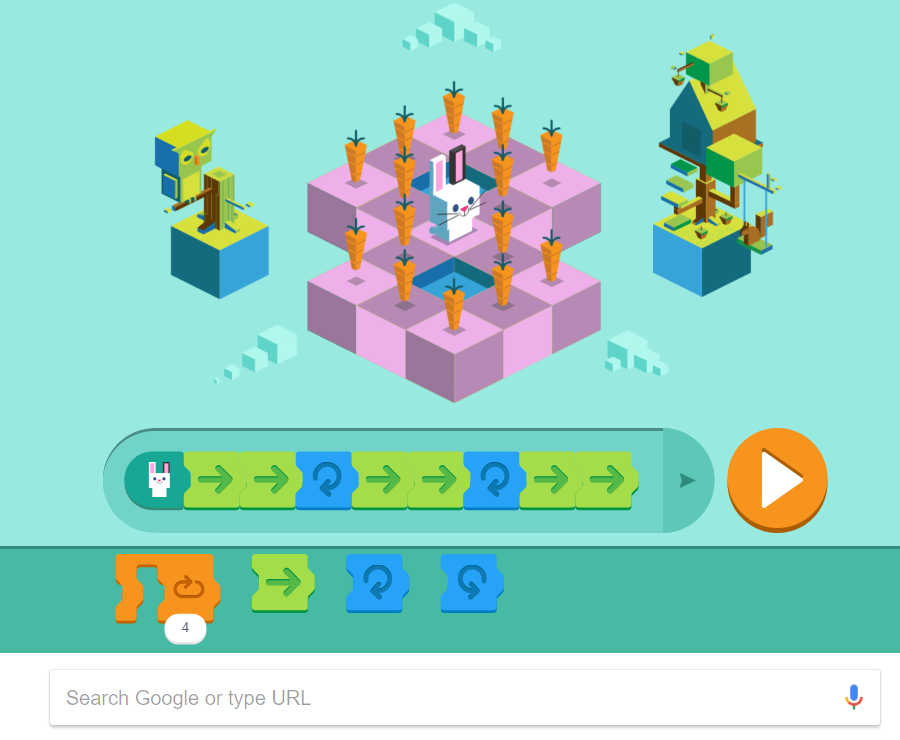
Google’s drag-and-drop ‘Scratch’ doodle

As Google doodles become more interactive it’s fitting to see it launch Hour of Code with a drag-and-drop doodle. It’s their first Coding-based doodle. Have you tried it? It’s on today’s Google landing page.

Worth reading: A description by MIT’s Champika Fernando, who was on one of the 3 teams that built this doodle.

Hour of Code runs through this week, which is also Computer Science Education week, and the anniversary of 50 years of programming languages. Scratch was developed at MIT.

Typos aside, should they ignore his tweets?

Have you wondered if the media is unable or unwilling to ignore Donald Trump’s puerile tweets?

I’m willing to bet that if the major news organizations had stopped covering the ridiculous things he unloads in a Twitter storm, he wouldn’t have got to this point. Of course he’s gaming the system, knowing they are gleefully waiting each morning for a ‘story’ or controversy.

His latest blunder, addressing the wrong Twitter handle of Theresa May is just another one that will be drowned by others in a few weeks.

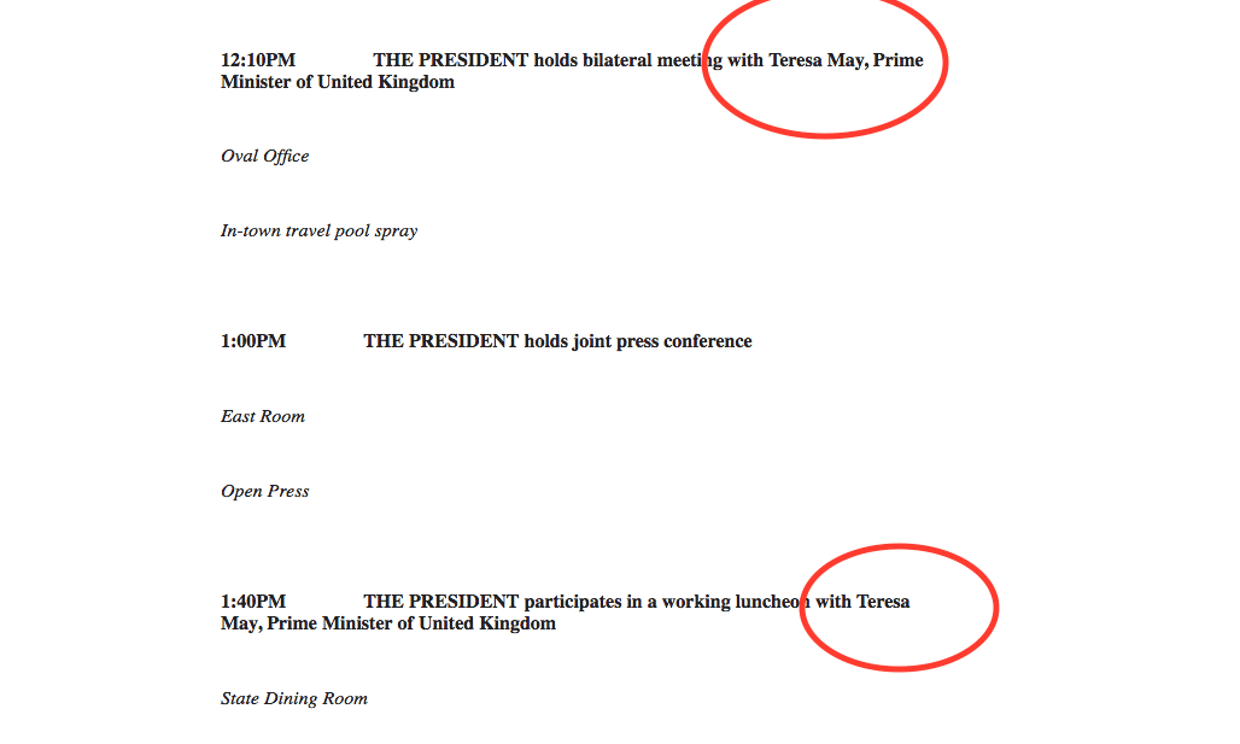
Remember the last time they messed up the British PM’s name? Thought so! In January when she visited the US, the White House misspelled her name as ‘Teresa’ several times – it was spelled without the ‘h’ in the introduction to the daily guidance.

I suppose it’s impossible to not find a story in his tweets, when it causes a diplomatic flare-up. In response to his broadside against her, the right Theresa was blunt in her rebuke. (Jeremy Corbyn, Britain’s Labour leader put it best, when he advised Trump to “hold yourself back” and “restrict yourself to two or three tweets a day”.)

Many years ago, probably before the president stumbled upon micro-blogging, people actually conducted training programs for those in governance and management. It’s too late to send someone back to social media 101 classes. Itchy fingers will continue to produce clumsy tweets  as I have said before.

But perhaps a temporary blackout might help the poor chap. And our republic.

Cut through the spin on Net Neutrality

I don’t blame you if the term ‘Net neutrality‘ make your eyes glaze. However as a battle royale is being waged these weeks, it’s good for us to all get to know the definition of Net neutrality, and what’s at stake.

Before bureaucrats put their spin on it.

Definition – by the ACLU.

Network neutrality means applying well-established “common carrier” rules to the internet in order to preserve its freedom and openness. In other words, the network should discriminating against information by halting, slowing, or otherwise tampering with the transfer of any data

(Older) Definitionby WIRED

Today, privileged companies—including Google, Facebook, and Netflix—already benefit from what are essentially internet fast lanes, and this has been the case for years. Such web giants—and others—now have direct connections to big ISPs like Comcast and Verizon, and they run dedicated computer servers deep inside these ISPs.

FCC Chairman Ajit Pai’s Statement

He proposes a return to a Telco as a Title I information service. One with “light-touch regulation”  The wording of the rest of the document looks specious, since it supports the rolling back of regulation with the talk of jobs, competition and privacy.

Firefox (Mozilla) cuts through the legaleseWorth a Read

Under Pai’s proposal, ISPs would be allowed to block, throttle and prioritize (or deprioritize) internet access for Americans. Companies like Comcast and AT&T could selectively slow down or speed up access to online journalism, blogs, films, apps, and other services. This would undo 2015’s hard-won net neutrality protections that took years of hard work.

Dire warning: Teens and Smart Phones

This recent study reports on something that anyone with a teenager ought to read.

It’s odd for me to be sounding the alarm bells about social media, following my optimistic book on the subject. (Hey, that was 4 years ago!)

Jean M. Twenge, writing in The Atlantic sounds a dire warning to parents. It’s worth a read. She says that there’s “compelling evidence that the devices we’ve placed in young people’s hands are… making them seriously unhappy. “

Seriously unhappy? Coming from a researcher that must mean a lot. She says:

 “The arrival of the smartphone has radically changed every aspect of teenagers’ lives.”

She refers to changes in their social interactions, and also, their mental health.

Read it here.

Nalaka’s take on responding to ‘fake news’

At a forum on Media and Development in Berlin yesterday, my friend Nalaka Gunewardena (who moderated a discussion) brought on a fresh perspective to the problem. It’s not about the tools per se that we could use to fight Fake News. It’s also about education, alliances and policy reform, .

We must also look for the symptoms in the loss of trust in journalism, he said. The need is to build structures that enhance and nurture quality journalism. In other words, create trustworthy messengers before trying to fix (or block) the pipes through which the messages flow. Plus the need to influence policy and literacy.

This is a lot more nuanced than just clamping down on media platforms or discrediting the sources – reactive steps.

So let’s get pro-active about a problem that didn’t arrive yesterday, and won’t go away soon.

I encourage you to read Nalaka’s post about this.


A need to ‘register’ your face –and other tech silliness

As if we don’t have enough to be concerned about! Users of the iPhone X must ‘register’ their faces so that facial recognition –a feature that everyone seems to be fawning over– works.

I am not making this up. This was reported where an iPhone user had to repeatedly ‘register’ her face because her 10-year old son unwittingly unlocked her phone. The story cites Wired reporter Andy Greenberg who :

suggested that Sherwani re-register her face to see what would happen. Upon doing so, the iPhone X no longer allowed Ammar access. Interestingly, after Sherwani tried registering her face again a few hours later in the same indoor, nighttime lighting conditions in which she first set up her iPhone X, the son was able to regain access with his face.

Does this mean that:

  • Some day there will be a facial registry, somewhere in the Cloud? For now, it’s on the device.
  • There might be an after-market for 3-D printed facial masks to crack iPhones? Apple is skeptical. Of course!

Using robots to teach PowerPoint animation

Around this time of year when I introduce animation in PowerPoint, I try to find something topical to animate.

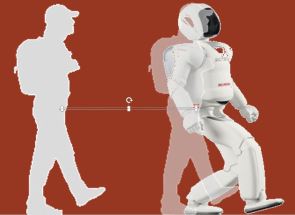
So I’ve got my 4th graders to think about ‘Man and Machine‘ -specifically how a human could evolve into a humanoid. We use the custom animation tool to draw a path to make the human glide across the screen to turn into a robot.

To preface it, I showed them a clip of Asimo, the Honda humanoid project. Asimo is the acronym for Advanced Step in Innovative Mobility. It is a 4-foot 3-inch character that can run, climb steps, and play a bit of football (soccer). Even those who aren’t into robotics get instantly engaged.

I asked the class what they thought of man and machine after watching this; some thought it was a bit weird and creepy, but pretty cool.

Once the unit is completed, I figure this will be a good way to re-introduce Coding for the Hour of Code project. How do they build a set of instructions to make an inanimate object move? Coding and animation have a lot in common!

Trolls, bots, and memes become parents’ new nightmare. So what’s the solution?

A friend recently asked me if someone should be putting together a source for parents who have to address so much in the lives of their digital natives. I have a few go-to websites that we use as teachers, but was struggling to find a good hand book.

First two of the best web-based resources I recommend.

COMMON SENSE MEDIA – This is a wonderful, deep trove of information that is updated with plenty of topics (plus short videos) on such from phone addiction, and fake news, to privacy tips and how to navigate the difficult world of plagiarism, copyright, password protection, oversharing etc.

EDUTOPIAAnother great place for articles on technology skills such as coding, academic skills being taught such as note-taking, problem-solving, state standards, digital citizenship etc.

But the reality is that almost every week, children are bombarded and confused by new issues. One week it’s plagiarism, the next it is memes, and add to that the constant misinformation through bots and trolls, followed by the news related to cyber-bullying or inappropriate behavior that pops up on TV or their social media feeds. The search engines and social media platforms are often gamed by bots, and tricked by pranksters, but who has time to inform the kids about these fast-moving events?

So the sad thing, as I had to tell my friend, was there is no handbook. Just like there was no user-guide when we first got onto the early Internet. However that Internet was a place we went to, consciously logging in to it, or “dialing up” to it. Today, that place isn’t somewhere we visit – it visits us. Students who grow up with it have to navigate it on their own. It’s like giving them the keys to the car, before they go to driving school, expecting things to be alright on the road.

But of course there is one user-guide. It’s unpublished. It’s called Parenting.