Networks and social networks push China strategy

I wonder why it took Facebook so long to launch in China. With the summer Olympics almost upon us, all nodes of communication will be pointed at and out of China.

Some highlights:

  • In a few week’s China will be home to 21,600 accredited journalists. Of these, some16,000 will be broadcasters, 5,600 writers and photographers, 200 broadcast groups and 10,000 non-accredited journalists.
  • 1 in 1.3 of those online in China use online video, representing 160 million people.
  • Instant messaging is hugely popular. One company, QQ Labs has 752.3 million registered users.

In other news, “Chinglish” a hybrid language that some say will emerge, is featured in this last month’s Wired.

Media measurement: a ‘good pulse check’ for communicators

How do you reach someone who’s fixated on print publications, and a digital nomad who’ll only scan the headline and the first few sentences of your story, online? What happens when both these people constitute your target demographic?

Johna Burke, VP of BurrellesLuce pried open that black box at the IABC Phoenix lunch seminar this afternoon. The “Four Generations” approach to media measurement means the Gen Xers and Millennials have to be reached –and tracked– in the same sweep as the Traditional and the Boomers.

It means PR practitioners and communicators should start paying attention to the core values, and what make these audiences tick. It’s not just about targeting (for marketing) but engaging them (for internal communications.) Media measurement is a “good pulse check” to understand how to best reach and manage these diverse generations, said Burke. For Millennials for instance, she recommends managers personalize their work and even their benefits package because one size does not fit all in their world. There were lots of other insights about measuring the outcomes based on this approach and the metrics.

Sidebar: There were echoes of the ‘social technographic profile‘ made popular by Forrester analysts Charlene Li and Josh Bernoff in their blog, and their book, Groundswell.

If you are interested, a condensed version of Johna’s presentation, “Four Generations of Audience, Four Generations of Media–One Approach to Media Measurement,” can be found at Bulldog Reporter.

Interview with BlogTalkRadio

I was interviewed at the IABC conference by BlogTalkRadio. It was a great privilege to be on the show with Meryl David of Zurich Insurance.

What’s BlogTalkRadio? The name is probably the best explanation of what it stands for. It also says that it’s where “freedom of speech meets social networking.” From a production point of view, it’s easy to use. No microphone, no software. Just a phone and a computer. For listeners, there’s a wealth of programs such as art, religion, comedy, marketing, to technology and writing. Business has more than 4,000 programs, health more than 2,000.

Listen to IABC on internet talk radio

The segment I was interviewed on could be found here.

Using John McCain as a punching bag

The media buzz around The New Yorker’s satirical cover of the Obamas, has crowded out another story.

John McCain’s the punching bag of a political action group of the labor union, the SEIU. The cheesy godzilla-themed web site links to a YouTube video about “closing tax loopholes for buyout monsters.” Evidently McCain is not the story, but seems to be a convenient icon.

It’s part of a campaign in support of a tax bill going through the senate tomorrow. Like the metaphor itself, the ‘global campaign’ seems hugely overblown. The video and a web site seem incredibly tame. Other groups such as the AFT, engage their potential audience in much more creative ways, including –but not being obsessed by –social media.

My point? It’s way to easy to whip up a campaign with one or two social media embellishments and a web site when there’s a lot more grunt work to be done. Thank goodness there’s no godzilla-related twittering!

Lenovo’s bloggers: Olympics’ inside voice

Social media and Olympics introduces a new angle — and a new headache — for organizers, sponsors, fans and control freaks.

Like anything else into which a dollop of social media is introduced (politics, international relations, war etc) the authenticity and immediacy of those in the field upstage traditional media. The field can include the battlefield as in this tank commander’s blog, or diplomacy. It’s Kevin Sites in the hot zones as opposed to Katie Couric in Iraq.

So the move by Lenovo to empower athletes to blog from the 2008 Olympics is an interesting experiment that others will quickly follow. The program called The Voices of The Olympics empowers insiders to give the world a glimpse of the Olympics, while bypassing the mainstream media as the conduits of information. The blogs, some of them in their native language (Italian, French, Dutch, Spanish and English) will not be produced or edited.

Lenovo has defined the blogging parameters well so as to skirt any sponsorship snafus and branding skirmishes. It notes that:

“Lenovo does not regard the blogs of the participating athletes to be Lenovo blogs – nor will Lenovo ever ask for any overt advertising or sponsorship acknowledgement on the athlete’s blogs.”

Jennifer Nichols (US archer), and Chilean Pabo McCandless are part of the blogging team covering the games for us. AS NBC and other media outlets parachute into the Olympic village to transmit the best camera angles and terrific close ups, expect to see the human side of the games from the Lenovo-backed bloggers reporting from the other hot zone.

What a magazine’s colophon tells you

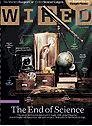
WIRED

If you are in any way involved in writing –and who isn’t?– and you have not thumbed through a copy of Wired, stop reading blogs, and get thee to a book store. The online version of the magazine will not suffice, either.

Why? The very act of turning the page, absorbing the impact of the typography, and juxtaposition of content will teach you something. The contents page looks different every time, the photo-illustrations are quirky, risque, challenging; the sections (like Artifacts from the future) and color really push the boundaries of print. And as for audience engagement, try putting it down after two minutes. I dare you!

Wired also does a few neat things you won’t see in many other publications:

  • Place cryptic words or phrases next to the publication date on the cover that relate to the cover story. July 2006 featured the letters ‘TMI’ because the story was about data. March ’08 was ‘Nothing is sacred.’ For the April ’08 cover story, Evil Genius, it was “original Sin.’ The story was about Apple.
  • Use photo illustrations that are basically articles condensed into illustrated stories and maps –a different way to tell a story.
  • Use a colophon. A what? Somewhere at the back of the book is a column set in all caps titled ‘Colophon.’ It’s one of those obscure words that derive from a much earlier print industry -tablets and manuscripts. It describes odd little details about the making of that issue including the blood sweat and bloody mary’s involved.

I’ve been reading Wired for about ten years now. It’s one of those pubs you know will not go away no matter where digital content is moving into, despite the dire predictions of the ‘Print is toast‘ crowd. Why? Because they pay attention to excruciating details.

Watching Wimbledon … on web radio!

The old truism, that the best pictures are on radio, passed the test last weekend watching Wimbledon.

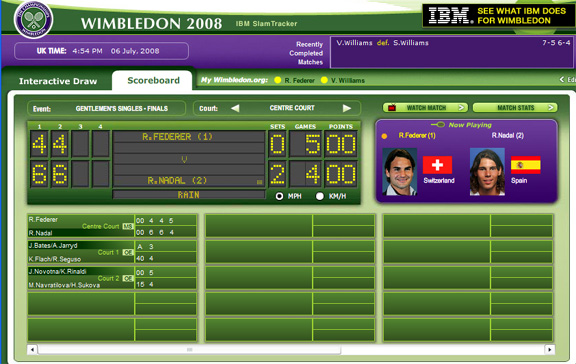
While watching the nail-biting Federer-Nadal men’s final last Sunday on NBC, I couldn’t stand the advertising breaks. So I did what many people do, played a game of ‘media tennis’ –toggling between TV and a laptop, TV and radio. The official web site of Wimbledon had a great digital scoreboard that beat the one on TV.

I am referring to what they call the ‘Slam Tracker‘ (left), a dynamic scoreboard with the interactivity we have come to expect. I could, for instance, click on icons to get details of the Swiss and Spaniard, and switch to scores on a different court in another window.

I then settled for muting the TV and logging on to Radio Wimbledon, that changed the game, so to speak. Especially when the game was stalled due to rain in the 3rd set. Later I discovered the commentary was a few seconds shy of being ‘live,’ but two things made me stay tuned: passion and interactivity.

As with the real game, media tennis has its tie-breaker moments. TV serves up high def pictures, multiple cameras angles, terrific slo-mo replays, and close-ups of royalty in the stands. Radio then slams a return with the commentators tripping over their vocabulary unable to describe the volleys and the 119 mile per-hour aces. It sure gets your adrenalin going.

As Federer succomed to Nadal I wasn’t sure whom to cheer for, the box that made me lean forward, or the box that made me lean back.

In the end I chose a hybrid medium called Web-Radio-TV, and it made this historic finale a rich media experience.

Quotes for the week ending 12 July, 2008

“He brought wit, grace and a great love of country to his work.”

President Bush, on Tony Snow, former White House press secretary who died today.

“But Obama is not just tacking gently toward the center. He’s lurching right when it suits him, and he’s zigging with the kind of reckless abandon that’s guaranteed to cause disillusion, if not whiplash.”

Bob Herbert, syndicated columnist for The New York Times

“Wake up and smell the rice Mr. Ploom! Im tired of Americans who don’t know a thing about the beauty, complexity or richness of Chinese culture.”

Online reader comment to a story about Ambush Marketing at the Olympics, by Businessweek. The story turned into an ugly exchange between readers from Japan and China.

“…it’s not the story about of the burglar who fell asleep on the resident’s couch that matters. Instead, it’s the everyday news affecting everyday life that we hope keep you coming back.”

Jacqueline Shoyeb, Online Editor, Mesa Republic

“As a metaphor, it’s strained. As a narrative –well, it has none.”

Bob Garfield, in Advertising Age, on the ad for HP’s TouchSmart PC, that he calls a large step ahead of the Mac.

“Together, they represent the real stories of the Games.”

Lenovo launching a web site called “Voices of the Olympic Games” featuring 100 athletes, from more than 25 countries.

Ambushing the 2008 Olympics, too irresistible

Beijing, 2008

Beijing, 2008

Someone’s going to pull off an ambush next month in Beijing. It may be a brand ambush, but it could also be a story ambush. There’s going to be a PR controversy over a brand defending the tactic, or someone attacking the ambusher.

I say this because of two trends that have collided:

  • The capacity to blur the lines between mainstream and viral, and
  • The field of diamonds that awaits the publicity seeker because of so much media attention on China

It could happen in a variety of ways, such as the old methods of sneaking in a T-shirt with a logo, a sign with an caustic slogan, or accidental product placement. But there are more sophisticated ways of beating the logo police. The whole idea of ambush marketing is to get attention not inside the Olympic village, but outside it. To you and me.

And that means defying not the logo police but the publishing police. Portable media such as smart phones and cameras can do that all too easily. Naturally the authorities have been cagy.

Rings around social media. And how about video sharing, live streaming, blogging? It’s so easy to stand up in front of an Olympic landmark -even a competitor’s sign –shoot a video and post it in a few clicks. The Official TV sponsor, NBC, may have the rights to all the venues, but rights means nothing to someone who has audience.

Rush to blog. Blog policy is being debated for obvious reasons. NBC has made sure it won’t be usurped by some media upstart, and is embedding its own journalist-blogger, Alan Abrahamson, at the games. Other blogs have cropped up fast, such as the New York TimesRings, and The China Beat written by a group largely comprised of academics. Not media people, mind you! If I remember correct, athletes are still allowed to blog.

At the time of writing, there are 23,800 YouTube videos that come up for the keywords “2008 Olympics.” This includes a BBC clip using a ‘pollution detector‘ that tells a damaging story. In sixty days you can bet that number will be a lot higher, and quite possibly include a few that document tales of ambush.

Groundswell to Obama: “we own your brand!”

Maybe someone should mail the Barack Obama campaign a copy of Groundswell.

I had just interviewed Josh Bernoff last week, and one piece of news began hitting me: a group organizing itself in the groundswell around the name Get FISA Right, and was using the Obama blog to tell the senator he is wrong!

Not that they would, but in case the Obama campaign takes the blog off its servers, the folks also have a Facebook group, with 1,910 members. And yes, there is content on YouTube explaining the bill they are opposing.

Get FISA Right is about Obama’s soft peddling on the issue of giving Telecom companies immunity. He had opposed it but has since revised his position.

As the book puts it, once you engage the groundswell be prepared to listen because you get “answers in high def.”