Visual browsing of World News

I have been looking into how a GUI ( geekspeak for ‘graphic user interface’) could enhance a message, and am considering doing some cool interactive, kiosk-type visualizations in our lobby at the Decision Theater. Interactive displays such as the Campus Metabolism project from the Global Institute of Sustainability is one way to do this. It’s a web-based but is much more interesting on a touch-screen in their lobby.

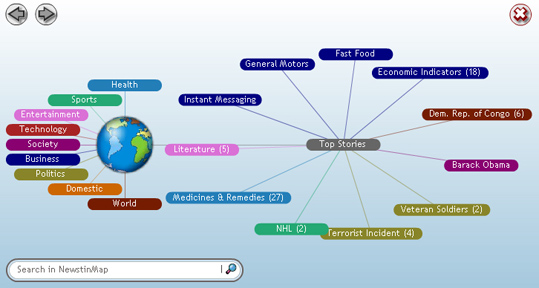
newstinBut apart from aggregating data, a GUI could simplify the user experience, for news, as this site called Newstin demonstrates.

Click on the Newstin map, and it basically organizes world news from 166,000 sources, organized into about 1 million topics. Mind you, Newstin was created before the iPhone, so it’s easy to see how a widget could transfer this kind of experience to a mobile device.

Bernie Goldbach’s vidcast experiments with new format

Bernie Goldbach may not be a household name, but for listeners of the podcast FIR (For Immediate Release) he’s the Irish correspondent who delivers an interesting perspective.

So I was really curious as to what got him started on a format like this, pointing a video camera at a newspaper, flipping the pages, and discussing stories. It reminded me of a radio segment on BBC radio (BBC World Service, if I am not mistaken) where the host/anchor gave listeners a summary of the news every day.

Some podcasts do this, but a video podcast has an additional benefit of pointing to the story itself, and being able to comment on parts of it.

Industrial design could send a message

How could a building or  structural feature send a stronger message about what you stand for than other design elements –web site, brochures, annual reports– you put out on a regular basis?

Not everyone could build a spectacular ‘shrine’ like Apple has, in Manhattan.

At ASU, the Global Institute of Sustainability takes a more pragmatic approach, with wind turbines on the roof generating power, even while solar panels are being installed in other parts of the campuses so as to take care of 20 percent of the total energy.

And speaking of wind power, this story out of London, of designers creating a column of light using wind power is more than a fancy energy project. It demos the capacity of creativity that could be unleashed within the urban planing when you let energy send a message.

jason-brugesIn this ‘tower of power’ as it is being called, there are 120 LED’s being powered by a “gentle” wind. Nothing fancy in the set up. A laptop is the only piece of technology behind it, apart from these 1,200 tiny fans. The designer, Jason Bruges Studio, calls it a wind-light.

Maybe someday outdoor signs will be lit this way.

So that, beyond growing lettuce (watch this video!) on the vertical face of a billboard, as McDonald’s did in this very daring/cool design, existing structures could send a passive message, with some “gentle” asistance from the sun, water and wind.

Cronkite Week starts today!

The journalism school at Arizona State University celebrates 50 years this month.

A whole range of events, here. Topics cover Free Press in the Digital Age, A First Amendment Forum, TV Journalism, Business Journalism etc.

This month, the Cronkite school will also award Jim Lehrer and Robert MacNeil, the PBS news anchors, the prestigious 2008 Cronkite Award. Past winners have included Tom Brokaw, Hane Pauley and Helen Thomas

Powerful feedback loops, and why should you care

The challenge of facing the media cannot be solved by studying our talking points, and coming up with zingers. As the media morphs into a real-time machine with a Google-enhanced memory, there are forces to be aware of.

Dan Gillmor, who now heads the Knight Center for Digital Media Entrepreneurship at Arizona State University, recounts an incident that took place in 2002 that is even more relevant today. He was reporting in near real time via his blog about a panel discussion where then Qwest CEO Joe Naccio “whined” about the difficulty of raising capital.

The conference was in Arizona, but within minutes of his posting the story, someone in Florida emailed him a link to a story about Naccio cashing $200 in stock even as his company stock prices dropped. Gillmor posted that link in his next post, and almost instantly, the audience began to turn hostile against Naccio.

The feedback loop had unexpectedly given the audience –not the audience Gillmor thought he was writing for, but which happened to be sitting sight next to him– a new perspective. That audience-with-an-audience was also something the speaker never thought he would be facing.

Why should you care as a communicator or marketer?

  • The audience tends to be smarter than you think. Its demographics and psychographics can shift radically, even though no one may have left the room.
  • The back-channel is always at work. In grade school it was a piece of paper that was surreptitiously circulated among the class oblivious to the teacher. Today all it takes is a tweet, an IM, a text message…
  • Creating and encouraging feedback loops tip you off to something you may have never seen coming. People will come up with amazing ideas, if they are asked.
  • Your customers/audience could come to your rescue. Before his last podcast, Mitch Joel put out a tweet saying he had a bad cold and was ‘crowdsourcing’ his next show. The response was amazing! The audience practically ran the show.

“Martin Eisenstadt doesn’t exist” and what passes for news

News is under attack from many sides. There are digital missiles, financial grenades, dwindling readership and viewership, and the there’s the credibility factor.

So a story like this of a fabricated, unverified “source” brings up serious issues. Says The New York Times, peeling back the curtain:

“Trouble is, Martin Eisenstadt doesn’t exist. His blog does, but it’s a put-on. The think tank where he is a senior fellow — the Harding Institute for Freedom and Democracy — is just a Web site. The TV clips of him on YouTube are fakes.”

Which is to say, not just old media but new media and hybrid media tend to get taken for a ride very easily.

OK, so this was just a prank –a film maker trying to make a name, no different from say, Lonely Girl trying to make a career. But we have seen this script before haven’t we, and they have had serious consequences. Remember SwiftBoat, and Dan Rather’s “gate“, and Jason Blair, and … the list could go on.

Let’s face it. Trust, has been shifting from authority figures and truth verifiers to (drum roll…) “people like me.” But even we are easily influenced (duped?) by some digital presence from people like us. When we do our due diligence as communicators we tend to assume that:

  • Anyone with a web site is probably above board
  • An organization with a blog is actually quite real, if not transparent. Until it the blog is outed.
  • And anyone who uses Twitter, is transparency personified -until people like “Janet‘ show up

In a recent Harvard study, people trusted Cable news twice as much as Broadcast news. For print, credibility was nearly a quarter of Cable news. None of this is comforting. The Martin Eisenstadt story broke on Cable news first. But the scary part? Even bloggers were linking to the fake Mr. Eisenstadt!

fakenytFun Sidebar: If you think most of the news is made up, take a look at at this edition of the New York Times. From the cover story, you might gues it is a fake New York Times.
Quotes for the week ending 15 November, 2008

“We are now offering a 25% Discount on all Collectable McCain/Palin08 products left in inventory”

Fire sale notice from the McCain-Palin campaign store.

“Simply put, things are already close enough between Change.gov and the Google Gang.”

Chris Soghoian, at CNetNews, commenting on Google’s relationship to the incoming White House administration. He also recommends BitTorrent for Pres. Obam’s fireside chats.

massive employee raiding.”

Agency.com’s complaint that Scottsdale-AZ based agency, specifically Don Scales, a former Agency.com staffer, has been poaching its employees and clients.

“I go dark some weekends and evenings until 8 p.m. because my kids come first. It’s not easy, but I don’t need to be big on Digg.”

Jason Falls, Head of social media at Doe-Anderson, interviewd by Jason Baer

“Martin Eisenstadt doesn’t exist. His blog does, but it’s a put-on. The think tank where he is a senior fellow — the Harding Institute for Freedom and Democracy — is just a Web site. The TV clips of him on YouTube are fakes.”

The not so shocking news that an unnamed source for the Sarah-doesn’t-know-Africa-is-a-continent story a fabricated person, carefully set up by two film-makers. Many media outlets were duped.

“Create a video hub for the executive branch – call it GovTube – that aggregates all video content throughout the government in a searchable, user friendly video portal.”

One of the recomemndations by Dan Mannet, at TechPresident, for how the new administration could use multi-media.

Community funded journalism. If you write it will they come?

The concept of crowdsourcing and community funded media has always interested me. Maybe it is my roots. I grew up in an environment where community-based projects were quite the norm, long before people got wired.

So SpotUs, a community-funded journalism project by David Cohn (of NewsAssignment.net) is one of the trends I think we will be seeing a lot of, as news media cut corners and outsource the story to people closest to it. For now, those pitching stories to us (basically asking for donations or micro-funding) are few, and limited to the Bay area.

Like this one, by Aaron Crowe, who plans to investigate the cost and benefit of installing solar power in a home. The site has raised $315, with goal of $1,000 to get the reporter off and running.

You could argue that times are tough, and people won’t pay for something they could get (or at least think they could) for free, anyway. But I am optimistic. We may cut back on our lattes, and even newspaper subscriptions, but as soon as a news aggregator of relevant, timely, local news is able to deliver it in a way we cannot get anywhere else, the price may be right. Just you watch!

Times are tough. Compete, don’t complain

Yawn. There’s a lawsuit being filed by Agency.com against Scottsdale-Arizona based iCrossing.

Having been within earshot of the folks as they trotted out the Agency.com hires (and this was more than two years ago) one has to wonder: Was Agency in a coma all these years? On the other hand, what is it complaining about. If you can’t hold onto your employees by providing the proper incentives, would a court order do the trick?

Let me sidestep a personal angle here and comment on what’s at stake in a tight economy.

  • Eat your own dog food. Marketing agencies seem to be great at coming up with solutions for their clients, but are embarrassingly bad when it comes to applying some of it to themselves.
  • Empower your employees. Employees beat brochures. And trade shows. And junkets. The iCrossing I remember ran ran a top-down operation that was ridiculously incongruent with the bottom-up world it operated in.
  • Reputation is (that awful word again) sticky. Companies get too busy propping up a reputation with press releases and forget to monitor and respond to chatter. Agency.com has some great bylines in major trade pubs, but some bad google juice it warned after a YouTube incident that still hangs around.