Adding new layers to Digital Learning Day 2017

Once again I’m planning some activities around the upcoming Digital Learning Day.

dlday2017Having participated since 2013, the plan is to add more than just lessons and best practices.

I’ve invited some tech practitioners, and we may even consider a community event that addresses topics that parents lose sleep over: over sharing, cyber-bullying, and the correlation between screens and grades.

Plus, I am considering an essay competition on a social media topic, and getting some students to create their own podcasts.

Digital Learning Day is on Feb. 23rd.

Here is what we did for 2016 Digital Learning Day

Robotics team researches Dakota Access Pipeline for FLL project

When our robotics team picked the controversial Dakota Access Pipeline (‘DAPL’) for their research this year, they never imagined a solution to the standoff would come days before they presented it.

It did.

Yet the insight they bring is even more powerful. But how does an oil pipeline relate to this year’s theme, Animal Allies?

Click to Enlarge

A quick thumbnailThe controversy began over a 1,170-mile  underground oil pipeline crossing 4 states (N. Dakota, S. Dakota, Iowa and Illinois). It had been approved by the U.S. Army Corps of Engineers, but as Native American opposition gathered momentum (with activists from several tribes, including a group from the Salt River Pima-Maricopa Indian Reservation) president Obama stepped in, and the pipeline was stopped.

As for the robotics project: It is on the impact of the ‘dirty pipeline’ on animal life. They will present a case for how water and the land are sacred to the Native American people. And how it could adversely impact animal life.

The ‘problem’ may have a political solution. But their project board looks at deeper issues than that, as you could see in their brainstorming session earlier in October.

img_0972


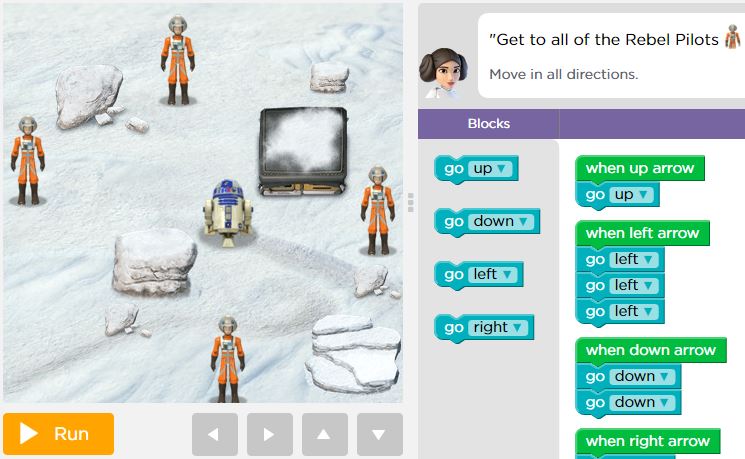
Planning for Star Wars class for ‘Hour of Code’ next week

I wish I had had the opportunity to learn JavaScript. But it’s never too late, since I can learn it while teaching some programming next week. You know, ‘He who teaches, learns twice‘ and all that!

hour-of-code-star-wars

I’m doing this because it is Computer Science Education Week from Dec 5 – 11 with a focus on the ‘Hour of Code‘. (It is also the week when I have to take my ‘Lab’ to the classrooms, while the computer lab is being used for NWEA evaluations.)

The ‘Hour of Code’ folk have added new tutorials featuring, Star Wars. Something my students are focusing on for an Image Manipulation class this week. It helps to have Kathleen Kennedy (seen in the video below), producer of The Force Awakens explain how programming is very much a part of movie production today.

Students will specifically learn to program a game in which BB8 must be sent on missions to recover objects and deliver messages.

In case you are interested, Hour of Code has several social media outlets, including

Twitter https://twitter.com/codeorg
Facebook https://www.facebook.com/Code.org
Instagram https://instagram.com/codeorg
Tumblr https://blog.code.org

Young web ‘designers’ in 5th and 6th Grade


website2
It’s exciting to be able to teach kids what it means to ‘design’ a web site, and see what they come up with.

I’m not talking about the coding part of the site, but the navigation, layout and content. So much has changed since I worked  on web sites and web content ten years ago. Especially with site builders at Wix and Weebly, or even GoDaddy.

So before website3I introduce students to online site builders, I let them play with design components, using PowerPoint. Yes, PowerPoint!
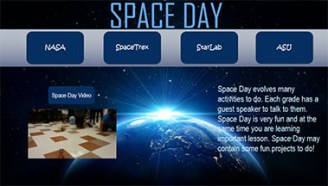
It’s a quick way to build navigation tabs, work on color and fonts, and eventually embed hyperlinks and video.

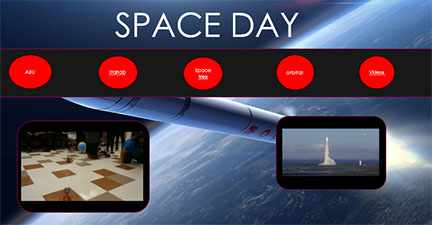
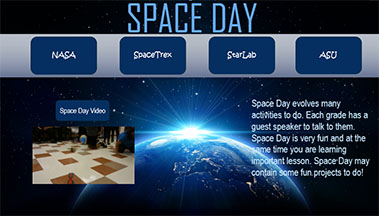
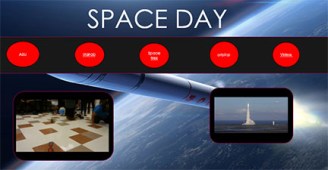
Here is some of the work of 6th grade, building a site for Space Day, the school event we just concluded.

Likewise the 5th grade is working on a website for Freedom Tower, a project they began in September. website4

Later they would be using Photoshop for image manipulation, and create and edit shapes and buttons etc. Much later, when we move into audio recordings, and podcasts, I may have them return to their web sites and add voice files using Audacity.

But for now they experiment with bevels, shadows, and other effects that enable navigation.

UPDATED:
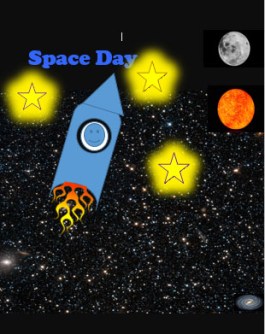
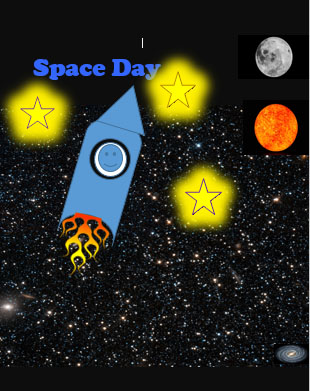
spaceday2Design is not just for 5th and 6th Grade. To address the Arizona CCRS Standard, S1.C4.PO 1: “Use digital creativity tools to create original works” I let 2nd grade students work with shapes, colors and also contrast and perspective.

Here is one student’s poster for the same event, using Microsoft Word.

 

Skype with Jet propulsion Lab’s Dr. Ashwin Vasavada

Last evening, Orbital’s Antares rocket lifted off for the International Space Station. Today the Chinese launched their own ‘March 2F’ rocket with two astronauts headed to their own separate Space Station.

So it is fitting that tomorrow for Space Day, our 4th grade students will Skype with Dr. Ashwin Vasavada, project scientist at the Jet Propulsion Lab in Pasadena, CA. He will talk about engineering design, as a preface to their making and deploying a model of the Phoenix lander.

The Lander looks something like this, but will be made to scale including the parachute, and several models will be tested outside!


All set for SPACE DAY this week with rockets, rovers and StarLab

Getting back after Fall break with a big event this Wednesday, SPACE DAY. It’s my 5th year of bringing space science to our students from Kindergarten to 6th grade. Fascinating how things fall into place, thanks to the amazing support I get from the scientific community around us.

I am delighted to have Orbital ATK, a global leader in aerospace, conduct sessions for us, with many other groups. Today was supposed to be the launch of Orbital’s Antares rocket carrying cargo up to the International Space Station. The launch has been postponed for tomorrow, and should dock at the space station on SPACE Day – Wed Oct 19th!

Our keynote speaker will be Dr. Jim Rice, a NASA astrogeologist.

Sessions will cover these topics:


SPACE DAY – Our 5th year of ‘slipping the surly bonds of earth’

In 2012, when I put together Mars Day at our school, I could tell there was a huge appetite for all things space-related. After all, the Mars rover ‘Curiosity’ had landed on the red planet a few months before.

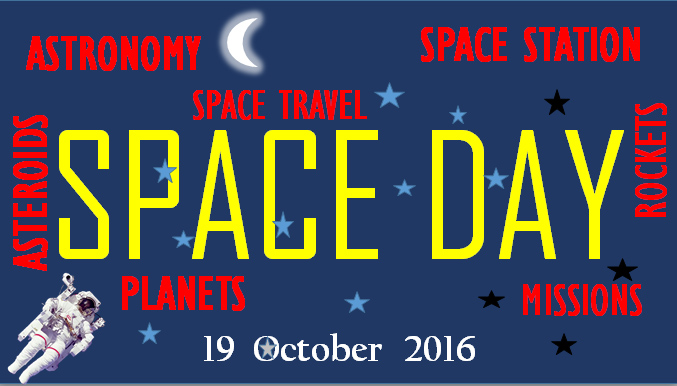
space-dayThis year, our 5th year, we are broadening our lens, so to speak. We are calling it SPACE DAY. It is on Oct. 19th at Salt River Elementary.

I am so fortunate to have so many groups supporting me. From a NASA scientist, to Orbital ATK (formerly Orbital Science), and several groups from the School of Earth and Space at Arizona State University. Also a team who keeps bringing back StarLab, the inflatable planetarium. But wait, there’s more – a surprise guest from the Jet Propulsion Lab (JPL), the NASA group prepping for Mars.

There are several break-out sessions, some that will happen concurrently. We may even have a few real rocket launches outside! This year two of my colleagues will  conduct hands-on sessions that add art and design to the mix. My goal has always been to add more of the ‘A’ to the S.T.E.A.M programs.

Almost every week it’s hard to escape news of audacious new programs pertaining to vehicular designs, space colonies, cosmonauts, or discoveries about comets, asteroids, and planets –the ones we know, and those that are still to be named.

One day of the year just scratches the surface, don’t you think?

In Robotics, investigating, journaling, and ‘core values’ matter

This week, we selected members who applied to our Robotics club. That’s right, we have an application process which involves a short test, an interview and a contract (the code of conduct) they sign and agree to practice.

Why such a process? Robotics is an after-school club at my school but I wanted members to realize what they were getting into. It’s not just building and playing with Legos. I have done this for 5 years now, and found out that the real value for students is when they get their hands around the broader scope of robotics. They learn to be researchers, problem-solvers, journal-keepers, programmers, and ‘mission specialists.’ They must also become good presenters of their work.

This year, the focus (‘Animal Allies‘) is on Animal-Human interaction. What happens when animals and people interact? Are there problems they could identify, and solve? As FLL recommends, could the solution be beneficial to animals and humans?

If you’re starting out with a team it’s important to know that many of the previous themes have nudged students towards a ‘win-win’ solution.

At the tournaments, teams will be judged on three areas

  • Core Values
  • Project
  • Robot Design

rubric-project

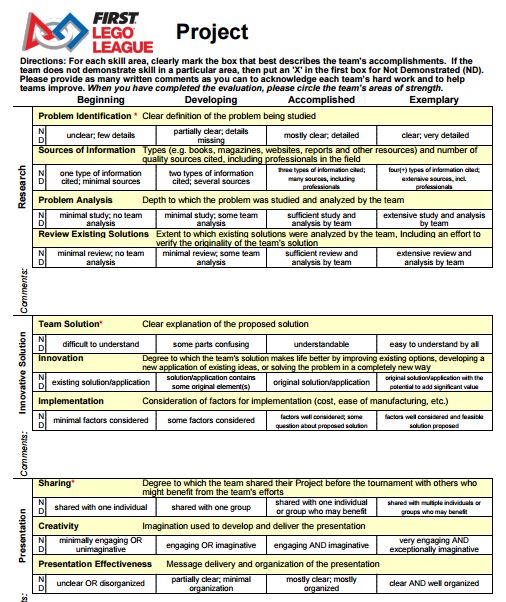
A little neglected fact is that winning the Robot game will not earn the most points. But as we coaches all realize, the robot game is what eats up most of the meeting time. It’s also worth looking at the rubrics for each of these three categories:

Just the Rubric for the Project (right) involves:

  • Problem Identification, Sources of information, Problem Analysis, Review of Existing Solutions.
  • Team Solution, Innovation, Implementation.
  • Sharing, Creativity, Presentation Effectiveness.

In other words, getting into robotics means learning to become an investigator, a problem-solver, learn to be an effective communicator of the science you worked on. It’s exciting to see 5th and 6th graders step out of their comfort zones to do this!

Smarter than Google? The hunt for a ‘research’ engine

In my attempt to differentiate between Search and Research (a topic that I return to around this time in the semester) I found a current event with a point of focus: ‘Chasing an asteroid!’

As luck would have it, NASA just launched a mission, Osiris Rex, that is basically a space explorer that will be chasing an asteroid for two years, before it grabs a piece of it and hustles back to earth. Students love events like this, and quickly dig deep into finding information around it.

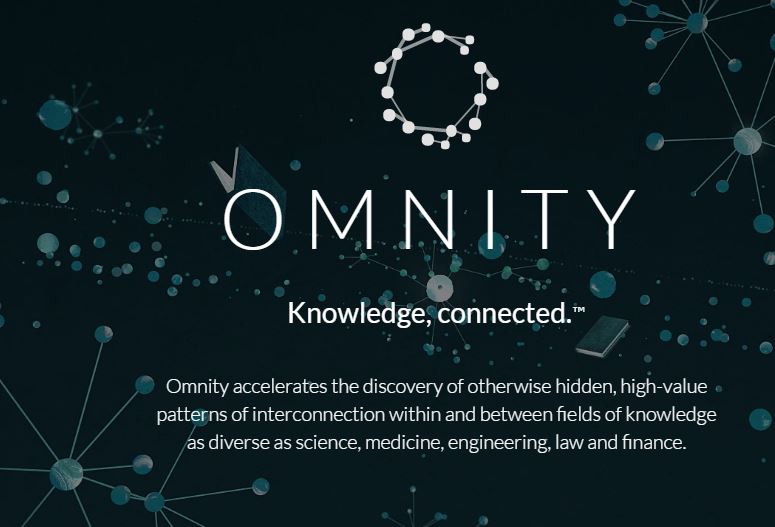
omnityAnd as luck would also have it, there’s a new Search engine called Omnity that promises to do better, providing ‘constellations of meaning.’ Smarter than Google, even! I wish it was true, and plan to find out shortly.

Sometimes ‘research’ involves going down that rabbit hole and unearthing nuggets of information that seldom shows up on a simple search query. Students will find out that although the mission will take 7 years the return trip will take longer than getting there. Why? What determines the timeline? Google sometimes lulls us into being content with unspectacular answers. It makes us unwilling to do probe deeper.


After all, it’s not enough to teach today’s students how to use Google and Bing, or even Wolfram Alpha, but emerging tools, as we go chasing after asteroids in class.