Robotics team researches Dakota Access Pipeline for FLL project

When our robotics team picked the controversial Dakota Access Pipeline (‘DAPL’) for their research this year, they never imagined a solution to the standoff would come days before they presented it.

It did.

Yet the insight they bring is even more powerful. But how does an oil pipeline relate to this year’s theme, Animal Allies?

Click to Enlarge

A quick thumbnailThe controversy began over a 1,170-mile  underground oil pipeline crossing 4 states (N. Dakota, S. Dakota, Iowa and Illinois). It had been approved by the U.S. Army Corps of Engineers, but as Native American opposition gathered momentum (with activists from several tribes, including a group from the Salt River Pima-Maricopa Indian Reservation) president Obama stepped in, and the pipeline was stopped.

As for the robotics project: It is on the impact of the ‘dirty pipeline’ on animal life. They will present a case for how water and the land are sacred to the Native American people. And how it could adversely impact animal life.

The ‘problem’ may have a political solution. But their project board looks at deeper issues than that, as you could see in their brainstorming session earlier in October.

img_0972


Invent, create and have fun with BirdBrain robotics

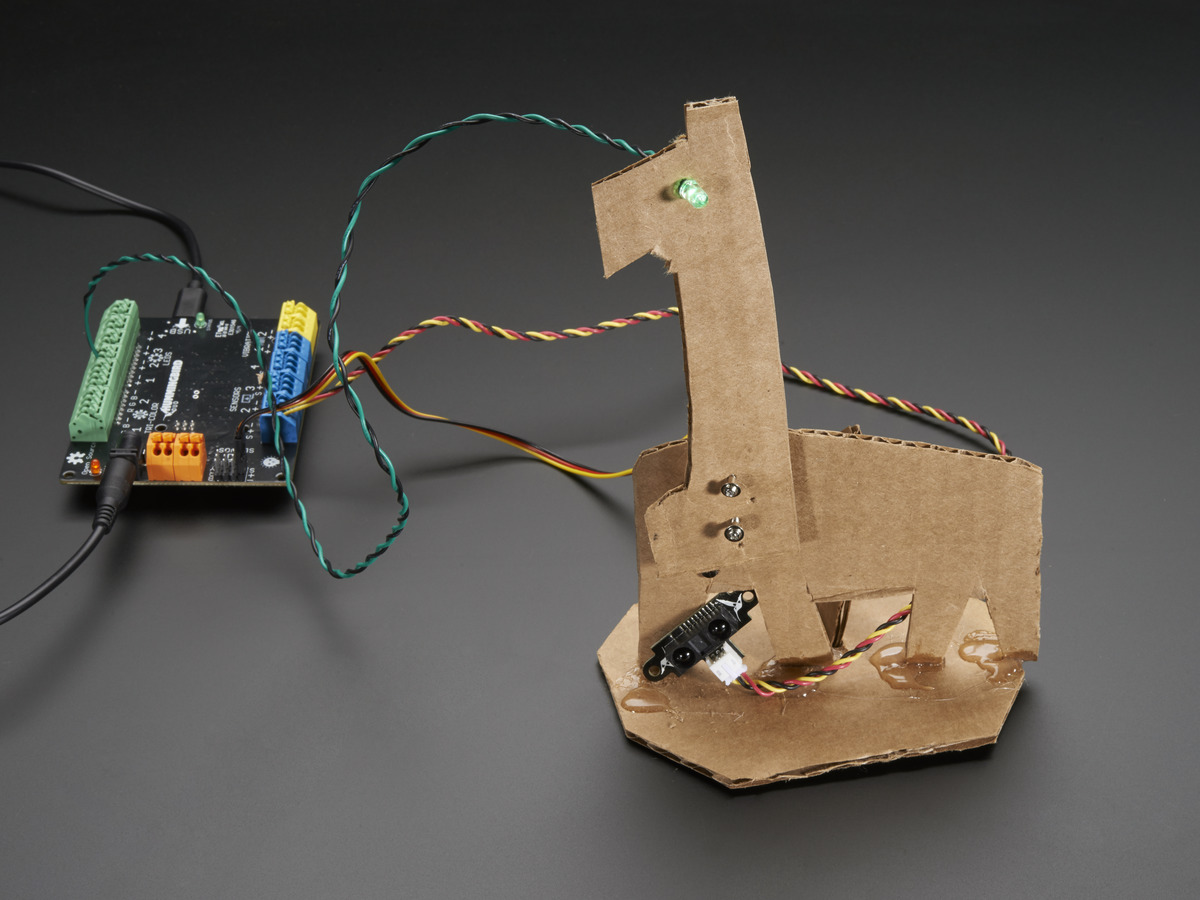
Micro-controllers are at the heart of many of today’s robotics kits.

This one, called the Hummingbird (with a pedigree derived from Carnegie Mellon labs), is designed for engineering and robotics activities for students from ages 13 and up.

I wish I could afford one of these for my computer lab, since it is an on-ramp to teaching students programming languages such as Python and Java. Or as CMU describes it, the micro-controller turns ‘crafts’ into bots.

And what’s a micro-controller for the uninitiated?

It is the decision-making part of a device, and could control sound, light, movement, and work with Bluetooth and WiFi. Our microwaves and phones have micro-controllers. We had a session on micro-controllers earlier this year.

Teaching young people to understand and tweak these devices could lead them toward higher problem-solving disciplines.

Going bats! How robotics makes science exciting

When I am asked what we do in robotics, I tend to answer it with something about ‘making science relevant and exciting.’ Not the about how it is fun to build, or why programming is a 21st century skill etc. which is also accurate.

ruben-gameros-visit-4

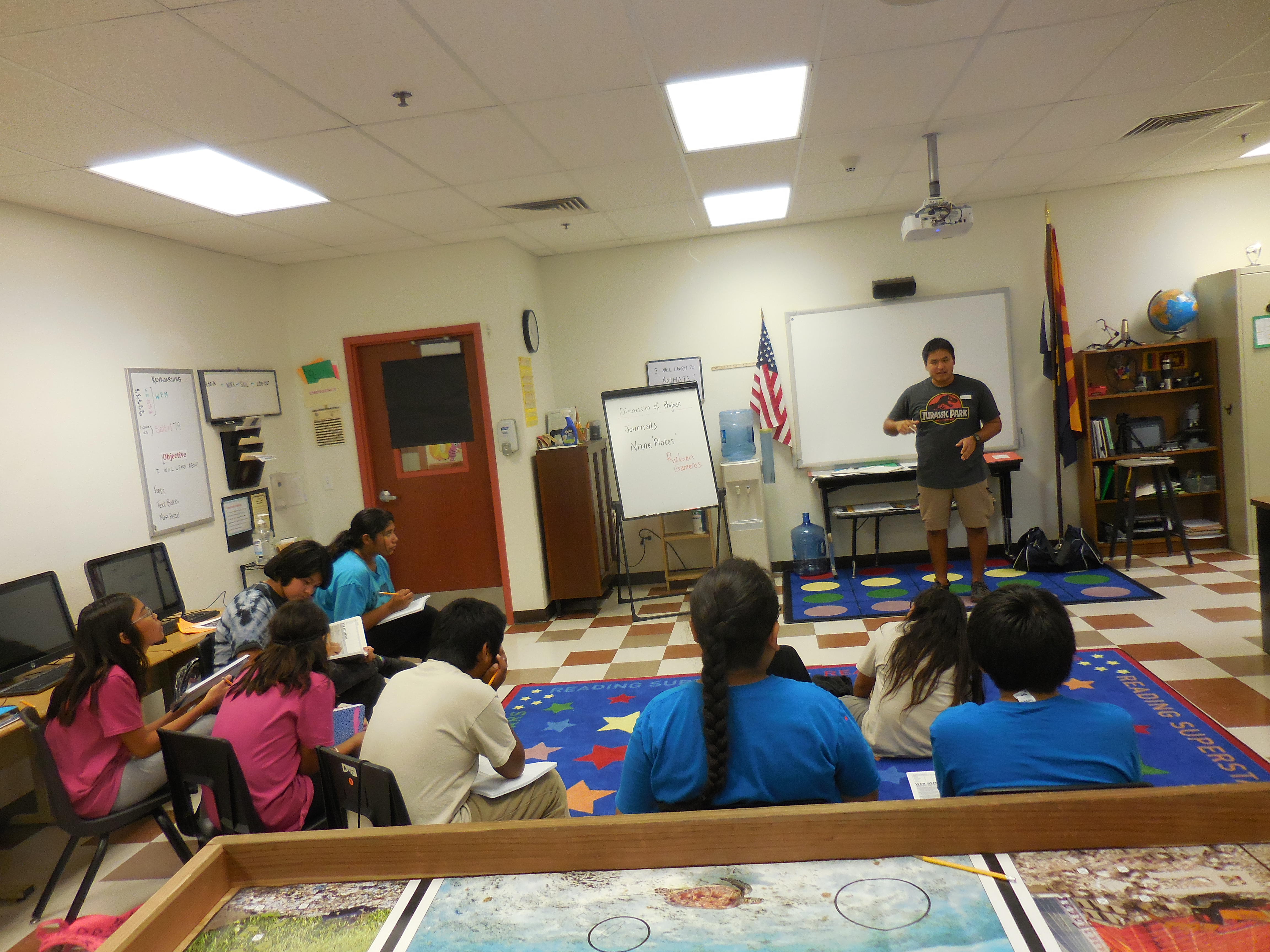
This Tuesday, I had ASU researcher and robotics mentor Ruben Gameros kick off a brainstorming session with my robotics team. The topic was ‘animal-human interaction.’ I loved how Ruben got the students thinking of ‘animal’s that are often not on their radar: bats, bees and insects.

Bat’s after all are mammals, with amazing navigation skills. They also help our survival in ways that often go unnoticed. Ruben is familiar with ‘critters’ for another reason. He works in a field of bio-mimicry, and swarm robotics!

In Robotics, investigating, journaling, and ‘core values’ matter

This week, we selected members who applied to our Robotics club. That’s right, we have an application process which involves a short test, an interview and a contract (the code of conduct) they sign and agree to practice.

Why such a process? Robotics is an after-school club at my school but I wanted members to realize what they were getting into. It’s not just building and playing with Legos. I have done this for 5 years now, and found out that the real value for students is when they get their hands around the broader scope of robotics. They learn to be researchers, problem-solvers, journal-keepers, programmers, and ‘mission specialists.’ They must also become good presenters of their work.

This year, the focus (‘Animal Allies‘) is on Animal-Human interaction. What happens when animals and people interact? Are there problems they could identify, and solve? As FLL recommends, could the solution be beneficial to animals and humans?

If you’re starting out with a team it’s important to know that many of the previous themes have nudged students towards a ‘win-win’ solution.

At the tournaments, teams will be judged on three areas

  • Core Values
  • Project
  • Robot Design

rubric-project

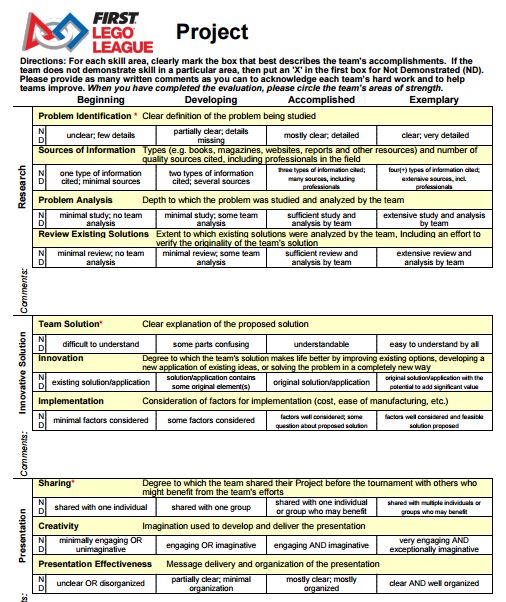
A little neglected fact is that winning the Robot game will not earn the most points. But as we coaches all realize, the robot game is what eats up most of the meeting time. It’s also worth looking at the rubrics for each of these three categories:

Just the Rubric for the Project (right) involves:

  • Problem Identification, Sources of information, Problem Analysis, Review of Existing Solutions.
  • Team Solution, Innovation, Implementation.
  • Sharing, Creativity, Presentation Effectiveness.

In other words, getting into robotics means learning to become an investigator, a problem-solver, learn to be an effective communicator of the science you worked on. It’s exciting to see 5th and 6th graders step out of their comfort zones to do this!

Robotics 2016 challenge guessing game begins

Each year, as we wait for details of the FLL Robotics challenge, some teams begin speculating what the specific challenges might be on the tournament table.

FLL had announced the theme, ANIMAL ALLIES. If we were to look into the crystal ball, there could be ‘missions’ around animal rescues, conservation and human-animal bonding.

Previous themes have been: Conservation, Education, Health, Ageing populations, Food, and Catastrophic Events.

Animals will certainly fire up elementary school students, especially in the research project. As for the missions, here is how one team speculates what the table-top missions could be, with detailed builds!

AS the FLL puts it, ANIMAL ALLIES season will be all about young people collaborating to solve a real-world problems. That’s the part I like about the FLL. It creates a rich, evolving context for students who could see bots as part of society they inherit and –most importantly, will influence.

What’s a humanoid robot doing in a STEM class?

Intrigued by robots that look less like appliances and more like humans?  Even I sometimes get a bit creeped out.

But this little guy, NAO, changed my perspective. It is a learning tool, no different from any other bot, such as a spherical bot, a drone, or an Lego NXT brick. It’s got a friendlier interface, too.

I met the company that showcased it, RobotLAB, and this week spoke to their team members about how it can help students learn programming. It’s possible to even incorporate it into some aspects of a STEAM program.

ISTE 2016 Denver (17)I found out that some schools in the San Francisco Bay area are using this NAO to support reading and writing modules. As you might imagine, the program – a software and hardware package- is a bit pricey. But they are big on year-round support for teachers. Meaning it’s not like buying some hardware and being left to figure things out, or fix something that breaks.

Fours years ago, I spoke to someone who worked on the first humanized a robot to be sent up to the International Space Station. It was clear even then that such a humanoid  ‘device’ (which could be folded into a suitcase!) was designed to work alongside a real engineer or scientist –rather than make humans redundant.

ISTE Ed-Tech Conference Wrap-up: Part 1

Just got back from the ISTE 2016 conference in Denver, and it’s hard to decide what stood out more: The technology, or the practices.

HARDWARE: Being a tech teacher, indeed the tools were mind-blowing. From the simple Digital Storytelling hacks, and wide range ofgaming technologies, to Makerspace ideas such as conductive material, to Virtual Reality, and Robotics. (More on robotics in a later post.) VR seems to have matured since 2014, and mini robots –like the Sphero, here — were practically running over our feet. OK, I actually took the challenge and drove one of these across the floor. They’re practically unbreakable, too!

SOFTWAREThe software definitely made me do a double take, when it came to programming languages, and ‘kits’ to simplify the learning curve. It’s finally come to this: software doesn’t exist in some abstract dimension, but comes coupled with devices that a student could learn to program – and see the effects in real-time. Google and Microsoft appeared to be fighting for attention. If you had the stamina and enough coffee, you could go through an entire day toggling between a Google classroom and that of Microsoft’s. Both have well defined Education divisions. (The former made 5 education product announcements at the conference.)

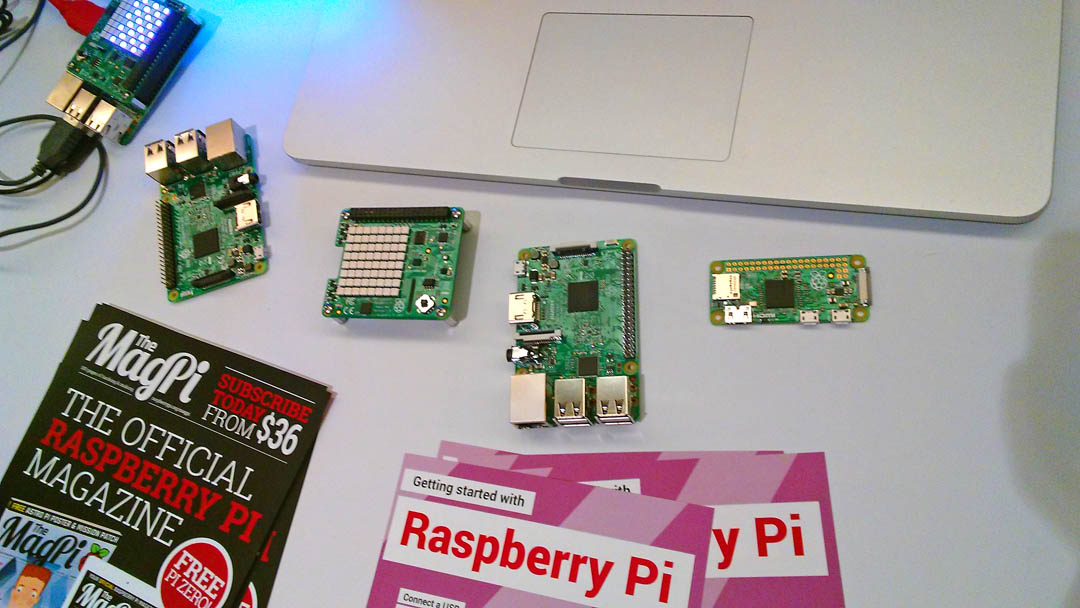
The sessions I liked most, were the Education Playgrounds. These were informal on-on-one or group sessions. I picked several that combined hardware and software. I met with a few Raspberry pi experts, basically teachers who worked with kits that were built around this mini computer.

I was fascinated by the no-frills entry-level kits (starting at the princely sum of $35 an unit!). Why?

RaspberryPi-tn

First because this hardware was not housed in some beautiful laminated case but was transparent enough or a 3rd grader to understand what a computer was all about. I often need to remind students that ‘computing’ is not some mysterious art form.

Second, computer literacy and digital literacy are joined at the hip today, in the same way that Robotics and the Maker movement can be two sides of the same coin. We need to merge our lesson plans, and get our young Digital Citizens to be Makers, engineers, designers, tinkerers, problem solvers and storytellers to recognize they can each take a piece of this action, and run with it.

FINALLY: I attended a few mind-expanding poster sessions, where the presenters were students. I’ve said it before that no teacher conference would be complete until you have met with students who are after all the reason our schools go to great lengths to send us out to these professional development events. It’s inspiring to see the end product of great teaching, and how underpaid teachers in bootstrapped school districts get students to soar. Many takeaways from these sessions.

So we are OK with robots, but scared by clocks!

Paranoia is a marvelous thing. It alters our brain chemistry.

So a boy could get handcuffed for bringing an electronic ‘clock’ to school, when it is perfectly OK to bring in, say, a robot? This turned out to be an embarrassing story for the school, and a wonderful one for NASA and robotics.

Are we sending mixed messages here? We urge kids to think outside the proverbial box aka a classroom, but we like them keep their inventions at home.

I’m not sure how to handle this. I’m in half a mind to have a “Bring your clockwork mechanism to school” day. Many students tell me about the experiments they do –from a simple Rube Goldberg contraption, to a Lego robot. Or should I tell them that guess what, you just might be invited to the White House…

Which is what editorial cartoonist, Steve Benson lampooned in today’s Arizona Republic. It’s hilarious.