Two flavors of ‘Ice Cream’ to the Space Station!

The Dragon capsule delivered several technologies and experiments (6,4000 pounds of it) to the International Space Station. But it also delivered ice cream to the astronauts on board. So what’s a few scoops, for those folks who travel at 17,000 miles an hour for several months!

Also, in a geeky twist, it is also delivering another flavor, so to speak: ‘ISS-CREAM‘ – the acronym for ISS Cosmic Ray Energetics And Mass. It is a balloon-borne instrument that “measures the charges of cosmic rays ranging from hydrogen up through iron nuclei, over a broad energy range.” Clear as mud. (a balloon carrying ISS-CREAM) But very cool, huh?

As for the docking, as I mentioned in a previous post about the robotic arm and the maneuver, it is pretty cool! Humans need robots – and some ice cream now and then.
Farewell to our quintessential Rocket Man, John Glenn

John Glenn was quite a guy. You don’t find many role models like him these days. The ones you could hold up for kids as examples of someone pushing the boundaries of science. He was the first American to orbit the Earth. To me he stood out as someone who put in the grunt work most people miss.

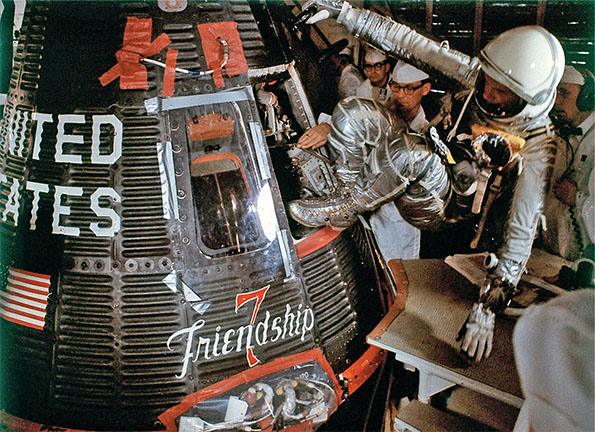
It’s easy to forget that before he climbed aboard ‘Friendship 7′ spacecraft on Feb 20th 1962 for his short (4 hrs, 55 mins, and 23 secs) flight, John Glenn was a fighter pilot.*

The story not often told is that before re-entry, NASA’s Mission Control told Glenn “not to jettison the retro-rocket package after firing” in order to better hold the heat shield in place. In other words, “Wait and see – you are part of the experiment!”

At the Smithsonian’s Air and Space Museum, standing beside Friendship 7, one marvels at the courage it took to climb into this over-sized tin-can in the interest of science, not knowing what might happen when being hurled into an orbit around the Earth at 17,000 mph.

john-glenn

John Glenn passed away today. He was 95.

* He flew missions in World War II, Guam, and Korea, and later served his country as a senator for 25 years. He even got back to space, briefly for a flight on the Space Shuttle.

SPACE DAY – Our 5th year of ‘slipping the surly bonds of earth’

In 2012, when I put together Mars Day at our school, I could tell there was a huge appetite for all things space-related. After all, the Mars rover ‘Curiosity’ had landed on the red planet a few months before.

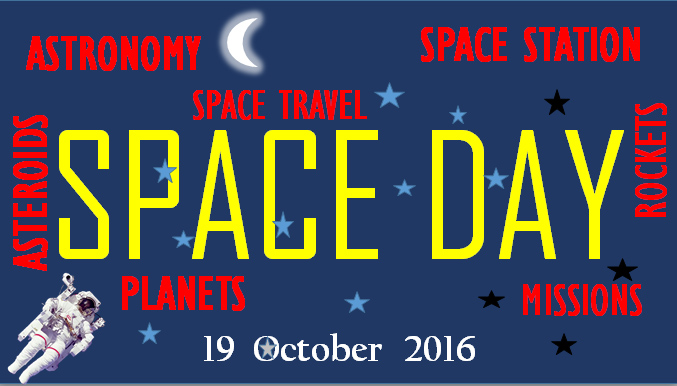
space-dayThis year, our 5th year, we are broadening our lens, so to speak. We are calling it SPACE DAY. It is on Oct. 19th at Salt River Elementary.

I am so fortunate to have so many groups supporting me. From a NASA scientist, to Orbital ATK (formerly Orbital Science), and several groups from the School of Earth and Space at Arizona State University. Also a team who keeps bringing back StarLab, the inflatable planetarium. But wait, there’s more – a surprise guest from the Jet Propulsion Lab (JPL), the NASA group prepping for Mars.

There are several break-out sessions, some that will happen concurrently. We may even have a few real rocket launches outside! This year two of my colleagues will  conduct hands-on sessions that add art and design to the mix. My goal has always been to add more of the ‘A’ to the S.T.E.A.M programs.

Almost every week it’s hard to escape news of audacious new programs pertaining to vehicular designs, space colonies, cosmonauts, or discoveries about comets, asteroids, and planets –the ones we know, and those that are still to be named.

One day of the year just scratches the surface, don’t you think?

Earth to Scott Kelly: Welcome home!

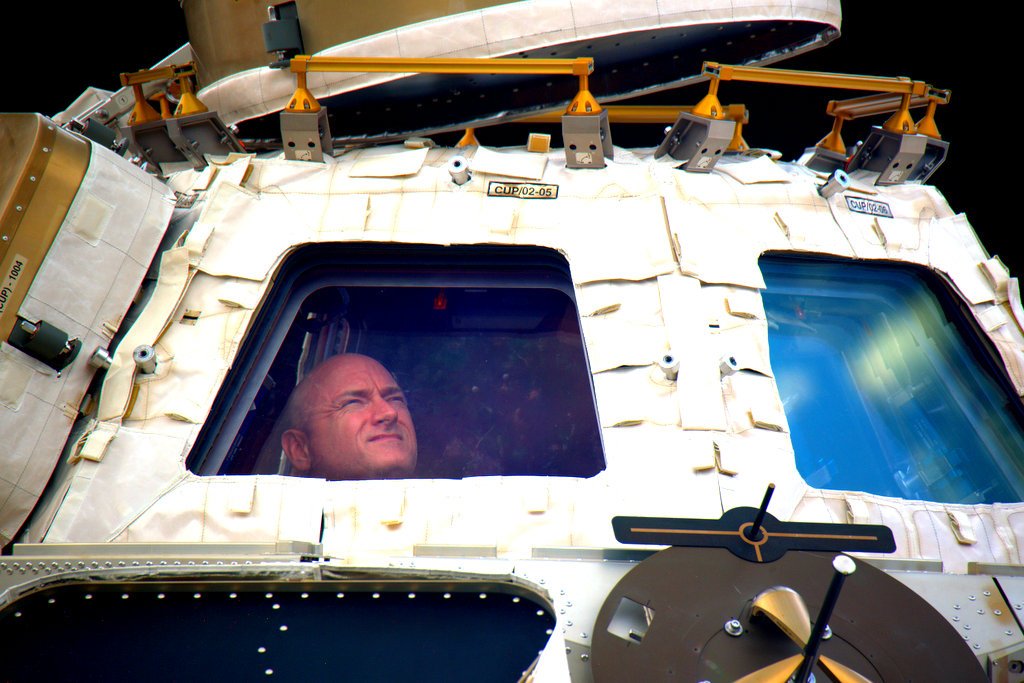
Watching Scott Kelly, and his ongoing work on the International Space Station for the past year has been like following a live-action science-and-technology class.

Many of the NASA-related activities in our school this past year (talking with an engineer at JPL, and the crew of a Mars mission simulation etc) have directly or indirectly addressed to the big question “What will it be like to live on Mars?” Astro-twins Scott and Mark Kelly, have become the human faces of astronomy, aerospace, and space exploration.

Students keep asking questions such as:

What kind of ‘work’ do engineers and astronauts do, besides floating around doing ‘space gardening’ and 3D mapping? Some amazing work is described here. We watched some incredible views taken by GoPro cameras aboard the ISS, including one involving inserting the GoPro into a water bubble.

On the fun side, I’ve even used Scott’s Time Magazine cover photo to teach a class on Photoshop (replacing Kelly with a 6th grade teacher who’s got a similar look.)

Here’s hoping we see more of Kelly brothers, and get to hear from Scott. Perhaps in a future Mars Day!

He should be back on earth tonight – NASA says touchdown is scheduled for 11:27 pm Eastern Time. As he put it in 140 characters before he left the ISS, “the journey isn’t over.”

International Ping-Pong Space Station

Space could be fun (OK, except for dehydrated food) especially if they let you play a few games. All in the line of testing out how some materials behave in micro-gravity.

One of my colleagues lets students work on NASA projects, such as making a glider out of a shoe-box, or growing vegetables in space-like conditions. Her students are currently working on how ‘toys in space’ might perform.

So in this line of thinking, there’s Scott Kelly, who’s spending a year in space, playing ping-pong with a water droplet. If only he played against, say Sergey Volkov or Timothy Peake (UK). That would make it a more realistic international playoff.

NASA ‘flowing’ water on Mars newsflash, messes the plot

I’m sure many wanna-be Martians (and there is a training program for this) are breathing a sigh of relief to know that one does not have to go the Matt Damon route to stay alive on Mars.

Today NASA announced that H2O from hydration salts means that it is flowing –as evidenced by image analysis from the Reconnaissance Orbiter. It also thickens the plot for may *young* scientists to whom we put this question: What would you take on a long trip to the Red Planet.

Mars Day is around the corner at my school. This will certainly be a topic that comes up. Maybe we ought to contact MarsOne. Bas Lansdorp, if you get a chance to see this, I’d love to chat with you about speaking to my students.


So we are OK with robots, but scared by clocks!

Paranoia is a marvelous thing. It alters our brain chemistry.

So a boy could get handcuffed for bringing an electronic ‘clock’ to school, when it is perfectly OK to bring in, say, a robot? This turned out to be an embarrassing story for the school, and a wonderful one for NASA and robotics.

Are we sending mixed messages here? We urge kids to think outside the proverbial box aka a classroom, but we like them keep their inventions at home.

I’m not sure how to handle this. I’m in half a mind to have a “Bring your clockwork mechanism to school” day. Many students tell me about the experiments they do –from a simple Rube Goldberg contraption, to a Lego robot. Or should I tell them that guess what, you just might be invited to the White House…

Which is what editorial cartoonist, Steve Benson lampooned in today’s Arizona Republic. It’s hilarious.


Skype with a rocket scientist – Today’s STEM Talk at Salt River Elementary

It’s funny how an ‘old’ technology comes to the rescue, even in education that’s all about Ed-Tech.

I’ve used Ustream, am experimenting with Stre.am, one of the newest shiny objects for collaboration and live-streaming. WebEx is not feasible for legal reasons, which is why Skype has come to the rescue. Skype – that grandaddy of web conferencing tools– is old in Internet years! Released in 2003, it came in a different era from our one-click chat apps that are morphing into lean, mobile must-haves. It’s still a trusty, if not crusty application.

Anyway, for this ongoing series of STEM Talks, I am pleased to be able to connect my school with an eminent NASA scientist, Dr. Ashwin Vasavada. He is the lead scientist on NASA’s Curiosity Rover mission, and comes to us via the Jet Propulsion Lab in Pasadena, California. For those of us with one-planet experience, know this: Ashwin participated in Galileo mission to Jupiter, and Cassini mission to Saturn.

My students have some background to Curiosity, because of robotics, and some have seen the full-scale model of this Humvee-sized robot at ASU. I’ll be curious (I know, bad pun!) to see how they engage with him.

Place: Computer & Technology Lab

Time
: 4:00 pm

Light refreshments will be served.

Check out previous STEM Talks here, and here.

Is It True? Or Is It Photoshop? Students Tweak TIME Cover

For my Photoshop class last week I tried to bring home to my 6th graders the importance of scrutinizing the media they consume – whether it is a billboard, a news photo in a newspaper, an album cover, celebrity photos, a food label etc.

Time-Magazine-Scott-Kelly-CoverThis is the exercise: Could you put a teacher’s face on the cover of TIME? This recent cover is of one of the twin astronauts, Scott Kelly, (whose brother, Mark is married to former Arizona congresswoman, Gabby Giffords) will be part of a one-year NASA study which I am following.
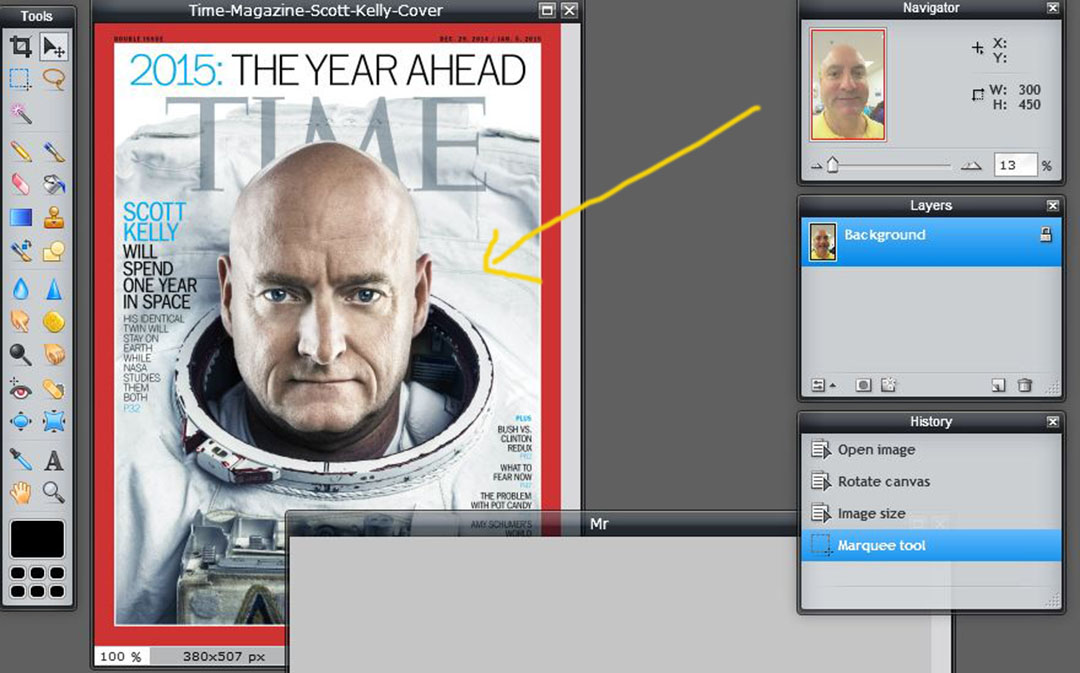
The local connection and space angle  makes it a fascinating topic that will stay relevant until this time next year. The teacher in question is very supportive of this.


This week too, the 6th graders continue to work on their covers. For more details, and to track their progress, check in here…

TruthorPhotoshop