Thinking digital in unusual spaces

This video by Microsoft has not been watched a lot, but it sure demonstrates what kind of digital world we might be getting close to. The neat part is, it’s not just all digital, but a transition from analog experiences to interactive ones.

Watch the part around 4.09 minutes, when the man opens up the newspaper. How different is it from your experience today?

Not that you can scroll through a column, or click on a news item in the newsprint. But think about it: ten years ago, we never thought we would be able to read a newspaper on a phone, did we?

Or use a ‘tablet’  styled laptop in this way. Or take a picture of  an icon or bar code and have it link us to content. Which is what Quick Response Codes allow. (See my twinterview on this for more details.)

The critics of this tend to question how useful a hand-held device will be, when ubiquitous computing will make common objects interactive. “Why would the whole world revolve around a single technology (touch screens)?” asks one person commenting on the Microsoft video. Google probably has answered that, now, with its Android. Watch how its navigation application works.

Can Google juice contaminate bottled water?

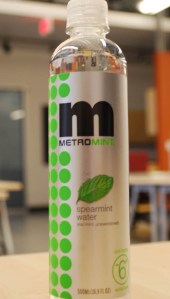
Metro_water_hpEver since I read an article about branding sand — I think it was this one– I have been fascinated with what differentiates a commodity from a brand.

Sand or silica is such an abundant mineral  that it’s amazing how much value it holds. Other commodities such as coffee or wheat seem to pale in comparison with what we do with silica.

But the water business comes close. Branding H20 seems commonplace today, but it is a highly competitive business.

Which is why I found this package for Metromint –a cross between a bottle of shampoo and an energy drink– irresistible when I was in the grocery store the other day.

The company has an interesting tone of voice. It is part of the Soma company, that calls itself  ‘an innovative group of beveragistas.’

The Metromint blog is full of consumer-driven stories, contributed by folks like Chocolate Snob and The Karin.

The packaging is simple on its front end (busy at the back) with something called the Chill Factor. There’s a number for every variant. The bottle I picked up, Spearmint, had a factor or -6. On a day like today that’s inching up to 104 degrees, I long to try it.

But…

Just as I was about to chill and try it out, I stumbled on a piece of news. Damn Google! This particular variant had been subject of a health alert and was recalled late last year. Bummer!

Suddenly all the packaging, online presence, promos and social media-enhanced branding didn’t matter. Here was the prospect of ingesting bacillus cereus staring in my face. It’s one of those food-borne bacteria that probably won’t kill me, but it contradicts everything about bottled water — being safer than the stuff off the tap.

I don’t bring this up to denigrate the Soma brand. It is probably as susceptible as any restaurant or packaged food. But it highlights how branding in today’s world is a completely different task than what it was less than a decade ago. The mere presence of negative ‘Google juice’ –the ability for any and every mention of a brand to be preserved for eternity– is something every brand custodian has to keep in mind.

Outside of bottled water, any service (any ‘branded’ business for that matter) is vulnerable. That’s the reality that I have to face up to as well in my job, using a slew of communication tools to get people to interact with the Decision Theater. I am sure you do too, whether you are nurturing your personal brand or one of your clients.

And it’s not just Google’s memory we have to think about.

Google’s SearchWiki shows where we are headed

If you’ve not heard of SearchWiki, prepare to be amazed. It’s going to change the way you think of Google. Tired of getting some really irrelevant results? Delete the ones you don’t like, add new URLs and markup the ones that you want to come back to later.

Actually it does more than even social bookmarking –a customized Delicious account, for instance — but considering how where Google is going with its new browser (Chrome),  and wiki (Knol), this wikified browser experience could be the way Google learns more about users’ needs.

I can see where this might be going. A search engine meets wiki meets social bookmarking would infect us with the collaboration virus surging through our veins. Soon, we may be able to share our customized search results with a group (a Facebook widget might make sense too) we are collaborating with.

Take a test drive my HoiPolloi Google Search Page at this customized site.

You could switch between HoiPolloiSearch and regular Google search. Even the paid search results change when you toggle between both. The pages could be free of ads for non-profits, government or educationional organizations!

Quotes form the week ending 27 September, 2008

“Putin rears his head and comes into the air space of the United States of America, where – where do they go? It’s Alaska. It’s just right over the border…”

Governor Sarah Palin, in response to a question by Katie Couric of CBS about her experience in international relations.

“When the stock market crashed, Franklin D. Roosevelt got on the television and didn’t just talk about the, you know, the princes of greed. He said, ‘Look, here’s what happened.”

Barack Obama’s running mate, Joe Biden, displaying a poor sense of history, on the Today Show. Roosevelt was not in office at that time, and, radio, not television, was the medium used.

“In what respect, Charlie?”

Sarah Palin, in her first media interview given to ABC News. Charles Gibson asked her about her stance on the Bush Doctrine, about which she didn’t seem to have a clue.

“Turn off the rumor mills, pull down the mocked-up artwork, and say goodbye to the blogger speculation.”

Announcement of Google’s Gphone, launched in collaboration with TMobile. It is the first mobile device built around a Android, Google’s Linux application.

“He wants to socialize Wall Street and privatize Social Security. Talk about upside down.”

Reader or The Arizona Republic, Roy Otterbein or Phoenix, commenting on Bush’s approach to the financial crisis.

“Our 94-year history of leadership in the financial industry has been a source of confidence…”

Copy from a Merill Lynch full page ad, appearing in the September 20th issue of The Economist, whose cover featured a cyclone sucking up brand names Fannie Mae, AIG, Morgan Stanley, Washington Mutual, Freddie Mac, Bear Stearns and Lehman Brothers.

“Talks are breaking down, I think McCain’s move just proved how important it was to be in DC.”

Tweet by one James Eiden about legislators and the White House hustling over the $7 billion bail out.

“McCain’s bluff called! Un-suspends campaign and attending 1st debate, even though $700B agreement not reached yet”

Another tweet by one Presceile, revealing how the pendulum swung.

“The US President has been wrong about so much during his eight years in office that it is tempting to dismiss his warnings of the impending financial apocalypse as yet more hyperbole – the boy crying wolf.”

Economics editor Edmund Conway or The Telegraph, on the need for the British to act fast too, and stop trying to give paracetamol to someone with a heart attack.

Quotes for the week ending 13 Sept, 2008

“Google is the oxygen in this ecosystem”

John Battelle, journalist and author, commenting on the company called Google that started out in this garage on 7 September, 2008.

“I had thought 51 years of rough-and-tumble journalism in Washington made me more enemies than friends, but my recent experience suggests the opposite may be the case.”

Robert Novak, longtime journalist, columnist for the Chicago Sun-Times who was disgnosed with brain cancer.

“In an age when politics is choreographed, voters watch out for the moments when the public-relations facade breaks down and venom pours through the cracks.”

Nick Cohen, The observer, UK

“Colgate University Has an Official Twitterer. World Yawns.”

Headline for article in the Chronicle of Higher Education, about how the university is using micro-blogging.

“The reports of my death are greatly exaggerated.”

Steve Jobs, using the Mark Twain line to open his address at a Mac event.

“It works like predictive texting. You start to type in a word…it suggests what you might mean to say. Like….you start to type in “stre”, and it might suggest “street view” or “utter lack of privacy” or “you only need to sign off 3,793 papers to get your face off our program”

Jodie Andrefsky, with a cynical take on Google’s claim to ‘anonymize’ people’s searches on the new web browser, Chrome.

“Houston, we have a PR problem! I’d offer the McCain campaign some PR advice, but I can’t seem to stop laughing…”

Len Gutman, at ValleyPRBlog, a on Saragh Palin’s PR nightmares.

“Good journalism is essential to democracy. With good journalism, you have good government.”

Calvin Trillin, hournalist, poet and author (A Heckuva Job: More of the Bush Administration in Rhyme), who will speak at ASU on 30 September, 2008

“We become the proverbial, ‘just stopping in for a cup of coffee don’t have time to chat social network user’.”

Mark Meyer, Director of e-commerce and interactive marketing for Emerson Direct, a fellow blogger at SocialMediaToday.com

Quotes of the week ending 8 March, 2008

“Obamicans.” “McCainicrats”

Former White House chief of staff Karl Rove in the Wall Street Journal, about needeing to watch Republicans who back Barack Obama and Democrats who like John McCain, respectively.

“So, I think they have to spin this as best they can, but the reality is still the reality.”

David Axelrod, chief strategist for the Obama campaign, on Clinton’s win in Ohio and Texas this Tuesday.

“We are all living in the middle of a paradigm shift.”

Andrew Leckey, Director of the National Center for Business Journalism, on the role of journalists, at a workshop in Phoenix, Arizona.

“it’s no doubt true that many PR & advertising agencies don’t, in fact, ‘get it’ yet … But it is also true that many clients don’t get it yet, either.

Todd Defren, PR Squared, commenting on the fact that marketers want to put social media into the bucket of metrics and campaigns.

“We can also look forward to flexible screens, holographic projection and LED wallpaper that allows any flat surface to function as a display.”

Bill Thompson, on the technology of teaching.

“In the end advertising isn’t about the click.”

Mike Leo, CEO of Operative, in Businessweek, on the slowdown in Google’s advertising’s pay-per-performance model.

“Haven’t you people learned the art of pretending that you know what you’re doing?”

Cathy Taylor, on why ad agencies (some of whom occasionally blog) are not walking the talk about social media.

“A message is one-way communication and a conversation is not. Rather, a conversation is like verbal tennis where words and ideas bounce back and forth between both parties.”

Andrea Goulet, commenting on the book Now is gone.

Wikipedia better watch its back

No matter what you say about Wikipedia in terms of the accuracy of information or the rules of editing, it created a great appetite and destination for knowledge sharing. But it did not have much of competition. Until now.

knol.jpgGoogle is after its lunch. “Our goal is to encourage people who know a particular subject to write an authoritative article about it,” says the new invitation-only wiki project called “knol.”

But it doesn’t appear to be after the exact model of Wikipedia. The key differences being:

1. Authorship over anonymity: Knol will give prominence to authors -as opposed to the anonymity of Wikipedia authors who only recently could be tracked down by their IP addresses.

2. Censorship: It won’t be in the business of attempting to “bless any content.”

3. Financial incentive: Authors could make money if they choose to allow ads alongside content.

I see the first two options as definite Wikipedia killers, apart from the others that Steve Rubel outlines. The third is troubling, because this would invite all types of content creators who won’t have a problem identifying themselves, but could provide infomercial-quality content, and get paid to do it. Tech Crunch‘s Duncan Riley notes this also means a shift from indexing content to becoming the content provider.