Let George Orwell fire up your characters, inspire your scenes, create conflict.

Image by Gordon Johnson from Pixabay

I was looking for inspiration as to how to get my students to plunge a reader into a story through a character, and I remembered Winston Smith. Perhaps he’s not as famous as, say, Peter Parker. But he’s embroiled in quite a web, don’t you agree?

It’s been years since I’ve read (and reread) Nineteen Eighty Four, but there’s an impression of Winston I still remember. He’s shifty and nervous, has a slight limp, and even his eyes and skin are described by Orwell to set his main character in a bleak environment that becomes worse as dystopias go. His skin, I remember, is course. I went back to the book and found how Orwell describes it as being the result of rough soap and blunt razor blades. Just that tiny detail of ablutions helps define what he has been through.

What a way to build character!

Short story writing is particularly challenging. The sequence of events must begin quickly and end at some point soon, within about two thousand words.

So why am I using a novel to inspire short stories? Orwell’s novel is choc-a-bloc with vignettes that make a story more than a series of events. I’ll stay with just three.

Flashbacks. They include flashback sequences that reveal insight into (a) how a character got to be this way or in this predicament (b) What was it like in the past that is so different from the present. Take, for instance, the detail in the first chapter when he pulls a notebook, an pen and a bottle of ink out of a drawer. It transports him — and the reader — into another scene.

It was a peculiarly beautiful book. Its smooth creamy paper, a little yellowed by age, was of a kind that had not been manufactured for at least forty years past. He could guess, however, that the book was much older than that. He had seen it lying in the window of a frowsy little junk-shop in a slummy quarter of the town (just what quarter he did not now remember) and had been stricken immediately by an overwhelming desire to possess it. Party members were supposed not to go into ordinary shops (’dealing on the free market’, it was called), but the rule was not strictly kept, because there were various things, such as shoelaces and razor blades, which it was impossible to get hold of in any other way.

It’s this scene within a scene effect (something movies do well) that saturates us with information about the character, and the coercive environment. It sets us up for how Winston will long for a different social and political milieu, and rebel against the present one, to his peril.

2. Sound Effects. On a page, words can only do so much. But the right combination brings a page to life with audio. Take this scene when Winston is in a room witnessing the compulsory ‘two minutes of hate.’

“The next moment a hideous, grinding speech, as of some monstrous machine running without oil, burst from the big telescreen at the end of the room. It was a noise that set one’s teeth on edge and bristled the hair at the back of one’s neck. The Hate had started.”

3. Conflict. That famous rats scene lets Orwell paint a picture of O’Brien as a macabre, sadist. The metal cage attached to Winston’s face is not as terrifying as the words they come out of his mouth. The cage is a device to heighten the conflict.

“When I press this other lever, the door of the cage will slide up. These starving brutes will shoot out of it like bullets. Have you ever seen a rat leap through the air? They will leap on to your face and…”

Conflict could be both internal and external says Wendy Kram, in Writer’s Digest. She cites Silence of the Lambs, in which Clarice must face her own childhood trauma, while dealing with the challenge of catching a serial killer.

There’s no shortage of conflict in this book I’m just reading — “The Seven Moons of Maali Almeida” (which won last year’s Booker prize). It’s got one of these three elements on every other page. Just as in Nineteen Eighty-four, a dystopian gloom hangs over its central character, Maali. But unlike Winston, this guy is dead, funny, and is still floating around with a broken camera. The ghost story become a political thriller through flashbacks. There’s an uncanny connection: Winston and Maali are record keepers, documenting history in two different ways. The government is out to get them and vice versa. Both become psychological explorations of these political systems they have been plunged into. Bucketloads of conflict, with some wicked insights into life in Sri Lanka.

At least, Bard is honest about it’s inadequacies.

So I just began testing Bard today. Before I dipped my toes into it, Google hit me with a series of cautionary notes, to set my expectations low. Here’s the first:

“I’m Bard, your creative and helpful collaborator. I have limitations and won’t always get it right, but your feedback will help me improve.”

Followed by this pop-up about expecting the ‘inaccurate’ and ‘inappropriate.’

So here’s what I set out to test. I didn’t want to ask the AI app to write an essay or comment on a popular topic. I wanted to see if Bard could come up with content that could be useful in a presentation.

I threw at Bard went like this:

“Create five slides for a presentation titled, The Future is Now.” ( I recently had my students in 7th grade work on a similar presentation. Could Bard match their work?)

Here’s what Bard came up with

Slide 1: Title slide

The Future is Now

Slide 2: Introduction

The future is coming at us faster than ever before. New technologies are emerging all the time, and they are changing the way we live, work, and interact with the world around us. It can be hard to keep up with all the changes, but it is important to stay informed and to be prepared for the future.

In this presentation, we will explore some of the key trends that are shaping the future. We will look at how artificial intelligence, robotics, and other technologies are changing the world around us. We will also discuss the challenges and opportunities that these changes present.

Slide 3: Key trends

  • Artificial intelligence (AI) is becoming increasingly powerful and sophisticated. AI is already being used in a variety of applications, from self-driving cars to facial recognition software. As AI continues to develop, it is likely to have an even greater impact on our lives.
  • Robotics is another rapidly developing field. Robots are being used in a growing number of industries, from manufacturing to healthcare. Robots are becoming more and more capable, and they are likely to play an even greater role in our lives in the future.
  • Virtual reality (VR) and augmented reality (AR) are two other technologies that are changing the way we interact with the world around us. VR allows users to experience a completely simulated environment, while AR overlays digital content onto the real world. These technologies are still in their early stages, but they have the potential to revolutionize many industries.
  • 3D printing is another technology that is changing the way we manufacture goods. 3D printers can create objects from a variety of materials, including plastic, metal, and even food. This technology is becoming increasingly affordable and accessible, and it is likely to have a major impact on the way we produce goods in the future.

Slide 4: Challenges and opportunities

The changes that are taking place in the world are both challenging and exciting. On the one hand, they present us with new opportunities to improve our lives and to create a better future. On the other hand, they also pose new challenges that we will need to address.

Some of the challenges that we face include:

  • The potential for job displacement as automation takes over some tasks that are currently done by humans.
  • The need to ensure that new technologies are used in a way that benefits all of society, and not just a select few.
  • The need to address the ethical implications of new technologies, such as AI and robotics.

Despite the challenges, the future also holds great opportunities. We have the chance to create a more prosperous, equitable, and sustainable world. To do this, we need to be prepared for the changes that are coming and to work together to shape the future that we want.

Slide 5: Conclusion

The future is coming, and it is up to us to shape it. We need to be prepared for the changes that are coming and to work together to create a better future for all.

MY TAKE:

Bard made some good points, especially since it touched on robotics and 3D printing, and the expected reference to itself, AI.

What I liked: 

(a) It was free of tech jargon. (b) The sections on ‘Trends’ and ‘Challenges.’ (c) The organization and flow of the topics.

I wasn’t ready to let it go. I asked it next to “Turn this into a 5 minute podcast script, with a host named Equinox Chatterbard, and a guest named Radium Kurzwild. Also suggest a music track.” 

I waited with baited breath. Here’s what it came back with in under a minute.

Title: The Future is Now

Host: Equinox Chatterbard

Guest: Radium Kurzwild

Music: “The Future” by Daft Punk

Equinox Chatterbard: Welcome to The Future is Now, a podcast about the future of technology and society. I’m your host, Equinox Chatterbard. And today, I’m joined by Radium Kurzwild, a futurist and author of the book “The Future is Now: A Guide to the Technologies That Will Shape Our World.” Radium, thanks for joining me today.

Radium Kurzwild: It’s my pleasure.

Equinox Chatterbard: So, let’s get started. What do you think is the biggest trend that’s shaping the future?

Radium Kurzwild: That’s a great question. I think one of the biggest trends that’s shaping the future is the rise of artificial intelligence. AI is already having a major impact on our lives, and it’s only going to become more powerful and sophisticated in the years to come. AI has the potential to revolutionize many industries, from healthcare to transportation. It also has the potential to create new jobs and opportunities.

Equinox Chatterbard: What are some of the potential benefits of AI?

Radium Kurzwild: AI has the potential to improve our lives in many ways. For example, AI can be used to diagnose diseases, develop new drugs, and create personalized learning experiences. AI can also be used to automate tasks, which could free up our time to do other things.

Equinox Chatterbard: What are some of the potential risks of AI?

Radium Kurzwild: AI also poses some risks. For example, AI could be used to create autonomous weapons that could kill without human intervention. AI could also be used to create surveillance systems that could track our every move. It’s important to be aware of these risks and to take steps to mitigate them.

Equinox Chatterbard: What do you think the future of AI looks like?

Radium Kurzwild: I think the future of AI is very bright. AI is going to continue to develop and become more powerful. It’s going to have a major impact on our lives, both positive and negative. It’s important to be aware of these changes and to prepare for them.

Equinox Chatterbard: Thanks for your insights, Radium. That’s all the time we have for today. But be sure to tune in next time for more on the future of technology and society.

Music: “The Future” by Daft Punk

____________________________________________

So what do I think?

Bard turned my two fictitious characters, Radium Kurzwild, and Equinox Chatterbard into cardboard cutouts. (Maybe I’m biased — having a podcast.) I was not surprised. AI, being ‘raised’ on content and databases rather than idiosyncrasies, and unpredictable bursts of imagination of us humans, doesn’t know this — yet.

>>Radium sounded like a PR mouthpieces who steered away from making personalized (even controversial) observations. That’s what you would have expected of a guest in a podcast, right?

>>Equinox rephrased the ‘on the one hand… on the other hand” point from slide #4 above, making it safe response. (What’s referred to as ‘both-sidesism.’) His response when asked what the future may turn out to be was pretty lame: “I think the future of AI is very bright.”

>> Music: Not a bad choice. Daft Punk did have other tracks worth considering, such as ‘Human after all.” Perhaps Bard isn’t clued into these lyrics.

In case you’re interested, I did ask ChatGPT to write a song in the vein of Bob Dylan. It was a total bust. These modern day muses are still in their infancy.

For now, AI is more hype than substance.

There’s Human Intelligence, and Artificial kind. I wasn’t taken up by the recent bluster about AI which arrived in 2022 all dressed up, but wearing flipflops. Somehow there was a mismatch between its promise and what it delivers.

I did give it a try, however. Just like I once wandered into ‘Second Life’ slightly skeptical. Is this real, I wondered. Are we there yet?

1. AI ART – THE LOW-HANGING FRUIT WITH WEIRD, FUZZY SKIN

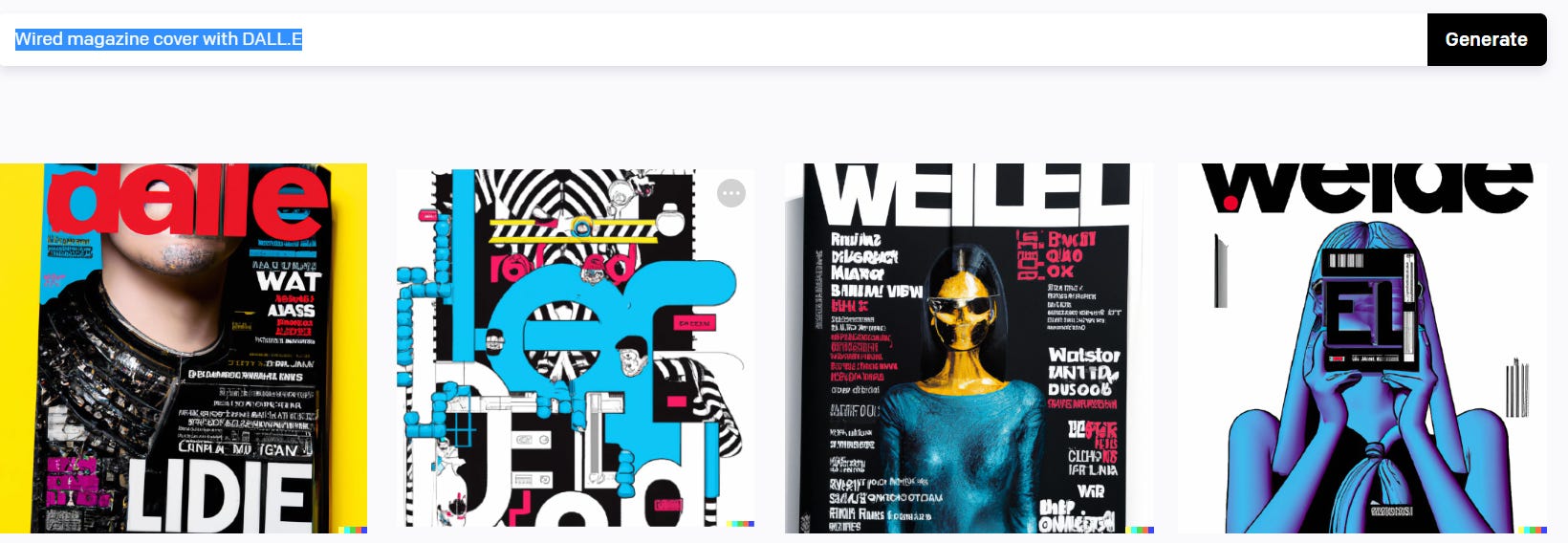
I had checked out the app called Starryai (which I wrote about in a Substack newsletter.) So, for my second attempt, I called up the algorithms on Dall.E to see if this fancy pants tool could design a magazine cover. Like WIRED.

The prompt that I typed, into Dall.E, was: “WIRED magazine cover with Dall.E.”

Could it ‘design’ a cover of tech magazine, using itself (Dall.E) in the title? Was it capable of reflecting on itself?

I was margially impressed. Marginally. In other words, not terribly. Sure, the graphics were overly arty as WIRED occasionally tries to be. Dall.E gets the look right, but the details are so bloody amateurish, even clumsy. It doesn’t seem to handle white space, or understand how to mimic a masthead. The fonts are a joke!

2. AI WRITING – NOTHING TO WRITE HOME ABOUT

I teach creative writing in all my classes. Naturally I’ve been intrigued, and even alarmed by how the talk about how AI could write like a human. Many people are hailing this as the death-knell for flesh-and-bone writers, journalists etc. Some tear their hair out about plagiarism in schools.

 The Nieman Lab is a bit more circumspect:

“While ChatGPT won’t win any journalism awards (at least for now), it can certainly automate much of the long tail of content on the internet.” — Nieman Lab, Predictions for Journalism in 2023

I checked out an application on the ChatGPT platform known as OpenAI that some people have told me can write fairly convincing content. I was suspicious. I had read a piece by a marketing writer, Mitch Joel about this. To check how smart this AI could be I typed in this snarky prompt: “Is Mitch Joel right about AI platforms.”

I wanted to see if this ghost in the machine was savvy enough to pick up his argument and reference it. As I guessed, it didn’t live up to my expectations. In fact, the software apologized for its inability to do more than explain what Mitch does for a living, and went on to explain how these are still early days! (Brownie points OpenAI for admitting you don’t know what you don’t know.) While it got the paragraphs and punctuation nicely. The second ‘graph was a doozy. Like a lazy copywriter churning out some garbage just to fill a layout to impress a client.

The website sets our expectations, in fact, saying things like, “ChatGPT sometimes writes plausible-sounding but incorrect or nonsensical answers.” Hmm!

Having said that, others are raving about AI content generators like Jasper. It’s supposed to be a boon for copywriters, social media posts and SEO content.

HERE’S MY TAKE ON AI. Content creators of the world —authors, journalists, copywriters, podcasters —shouldn’t feel threatened. For now. Good copywriters don’t sit at a desk stringing clichés to adjectives. They walk the factory floor, sit through plans board meetings, and argue with brand managers before the concept emerges. Translated: They produce content, rather than regurgitate it. Translated again: The fruits of AI are tempting but aren’t ready to pluck. Even for students. Low-hanging fruit – tempting but bland. Sometimes filled with bugs.

ChatGPT says it is addressing this. It’s like saying Samuel Bankman-Fried has declared he is making sure there aren’t any more crypto scams.

Are we concerned? As teachers, yes. Plagiarism is something no school takes lightly, if only because we want students to discover the value of originality, and creativity. It’s what will benefit them in any career. How about you?

When their ‘Privacy Policy’ sucks. What do you do?

Image, courtesy Michael Geiger on Unsplash

Let’s see what you make of this privacy statement. You’ve probably clicked on hundreds of similar ones and never cared to read them. Beware! Many companies count on you doing just that, so they pack all kinds of double-speak into it. You’re basically giving away the farm, and provide them with a legal defense to spy on you.

When you visit our websites, use our apps, read our emails or otherwise engage with us, we may automatically collect certain information about your device through a variety of technologies, including cookies, web beacons, log files, embedded scripts, location-identifying technologies, or other tracking/recording tools (collectively, “Tracking Technologies”), and we may combine this information with other personal information we collect about you.

Do most of us know – or care – about ‘web beacons’ or scripts? Here’s how Wikipedia authors define a web beacon:

“It is software used “to unobtrusively (usually invisibly) allow checking that a user has accessed some content.[1] Web beacons are typically used by third parties to monitor the activity of users at a website for the purpose of web analytics or page tagging.[2] They can also be used for email tracking.[3

Basically spyware we agree to have on our devices. Consider this statement: “With your permission, we may also access your photo or camera roll.” Wow! Those plots in espionage movies about someone remotely turning on a camera or accessing images from a phone’s camera folder isn’t the stuff of dystopian fiction, is it?

As always, it starts with an innocuous statement.

I was a bit shocked to see that the privacy policy in question went on to state that “We take your privacy as seriously as you do, and we are committed to protecting it.” In other words, they do want to secure our privacy; we have the right to opt-out of certain data being collected. But……If we object to any of the changes to the policy, we “must cease using our Products and/or Services, and may request us to erase your personal information.” Which is neither here nor there.

There’s only one cure for this invasion of privacy disease. Delete the app, for heaven’s sake. It’s not really free.

______________________________________________________

The above excerpt of a Privacy Policy is from a company whose app I used when my daughter began driving. It’s a terrible surveillance tool. The company will not be named but you probably know who it is.

The disinformation virus, here to stay.

I have to admit, I am a terrible skeptic when it comes to what people share on our networks.

I’m especially weary of what sails through WhatsApp. Are you? I belong to just four groups but I bet you subscribe to more. I often delete those memes and videos labeled ‘shared many times.’ Which means I have to either opt out of the network (and miss a grand aunt’s anniversary, and family pudding recipe) or put up with the drivel. One grins and bears it! But disinformation is much more than repetitive noise.

_____________________________________________

AS FOR MY GRUMPY SKEPTICISM, I put it down to my having once worked in marketing. Or being a secret fan of that 1974 book by Wilson Bryant Key, Subliminal Seduction. It accused advertisers of secretly painting seductive shapes into ice cubes. Conspiracy theory isn’t new! I scoffed, but it made me look deeper into the psychology of marketing and media.

_________________________________________

Sometimes I feel like a retired MI6 agent, looking for hidden meaning and toxic residue in everything we are served on our pixel platters. And I don’t just mean ice cubes. (Hey, just for larks, and speaking of things made of ice, did you know that the Baskin Robbins logo hides in plain sight the number 31 to represent its different flavors? OK, not sneaky, but interesting.)

And then there’s disinformation.

I bring up dis– and mis-information a lot in my classes. Is the headline clickbait? Or is it simply stating a fact? “Has the photograph on the cover of a book been doctored? For what reasons?”  

Reminding students to ‘trust but verify’ is a good practice for all teachers. But even more so these days, when young people are being strafed by much more nonsense than we were on any given day. Memes, for instance — with double toppings of satire and sarcasm — have become the conveyor belt of what passes for ‘news’ through TikTok. But they are also being exploited to transmit conspiracy theories, and racism, as this piece in The New York Times recently put it. 

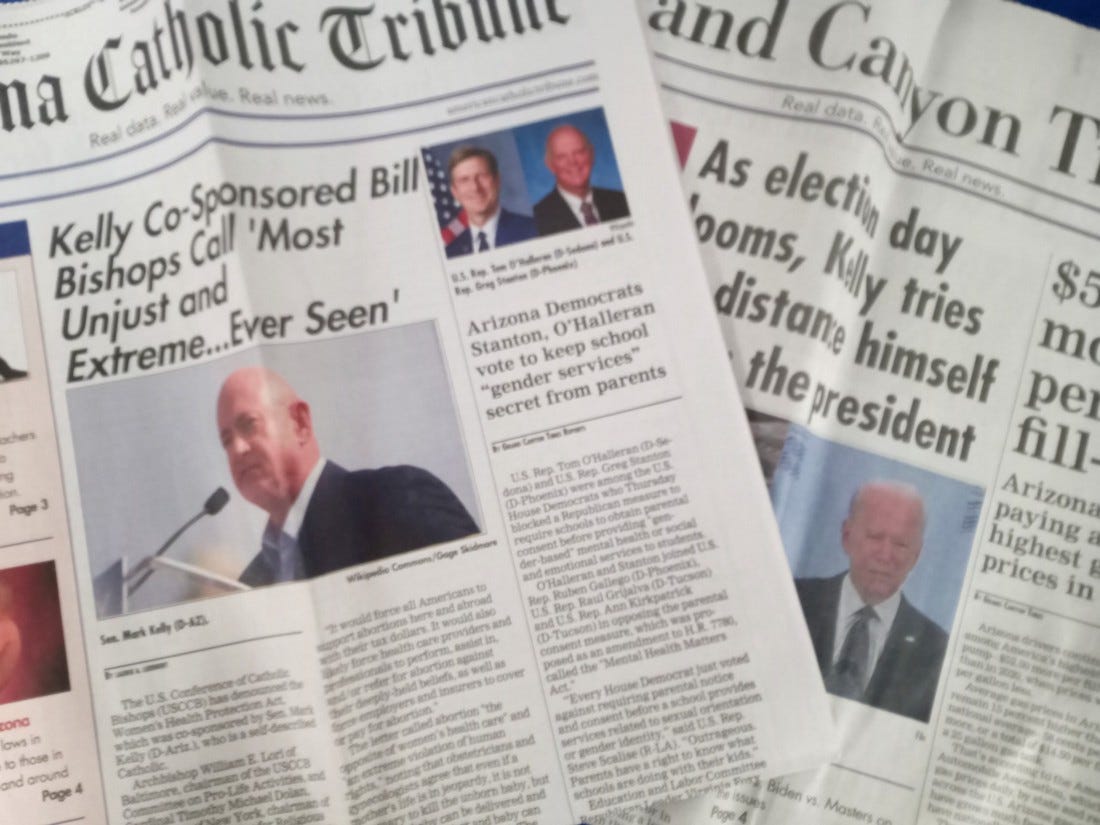
 In the US, we are in the midst of the cacophony aka midterm elections. If I stack the political pamphlets that arrive in my mailbox end to end, they could circle my property. Twice. A new variant of this virus is the fake newspaper. Take these two that arrived in my mailbox last week. It’s an insult to even call these newspapers. NPR calls them zombie newspapers. 

One of them could not even get the headline to not bleed off into the column divider. The quality of the photos (one even gave photo credit to Wikipedia!) looks as if they were printed on a dot-matrix printer someone had dug up in their attic. One pretended to be a Catholic newspaper, The Arizona Catholic Tribune; the other was called Grand Canyon Times. Both had the same subtitle under the masthead: Real Data. Real Value. Real News. What were they thinking? Couldn’t the ‘editors’ even properly disguise the fact that one was a clone of the other, with a different web address?

Speaking of which, the fake newspaper websites (ha!) were a dead giveaway. Using a simple Whois search I traced the latter to an organization called Epik Holdings that is listed under a Wikipedia entry as a registrar of websites operated by neo-Nazi and extremist groups. So much for the ‘media’ we have to deal with now. Makes me want to address disinformation right through the year!

What my students and I learned from a live podcast experiment.

To cut to the chase – I loved it!

Now for the rest of the story. Podcasting is nothing more than a person with a mic and a story well told. But, on a production level, it could get complicated when you add stuff like a ‘DAW’ or a digital audio workstation – a fancy term for a recording and editing software. Or multiple guests.

I love the spontaneity of podcasting, letting guests be themselves, warts and all. Yet I like to edit much; tighten things up, with intros, outros, multiple tracks for voices, and occasional sound effects etc. I use Hindenburg Pro for a bulk of the work, and Anchor.fm to upload the finished product to Apple Podcasts, Spotify and the likes.

The more ‘guests’ you have, the complexity ramps up. There’s overlapping audio when someone occasionally talks over another (a good thing?), bloopers that could be left in –and sometimes should – but at the expense of duration of the podcast. And sound levels to adjust, especially if you have a mic that allows for switching between cardioid (for voices directly in front), and omnidirectional. When I have forgotten to switch modes, the results have been…meh!

Some history here: There was a time, c. 2011, I when Derrick Mains and I hosted a radio show out of Phoenix we called Your3BL (listen here!) which stood for ‘Your Triple Bottom Line.’ It was out of KFNX studios hidden away in a nondescript strip mall. The man behind the glass did all the mixing and sound balancing, so it was pretty easy for us hosts. But Derrick and I liked to shake things up a bit now and then. Sometimes, we recorded the show elsewhere. Like one at Gangplank, a co-working space. There was a time I hosted it on a laptop in a classroom at Clark University in Boston with Derrick in Phoenix. We called in, through a dedicated phone line to the studio. That was one of the ‘live’ events that stretched my capabilities, but the recording taught me a lot about podcast production.

Recently I decided to interview two guests in school, and thought of upping the ante a bit. We recorded it in the gymnasium. That’s asking for trouble, if you know something about the cathedral-acoustics in a gym. Especially, when it’s the first time.

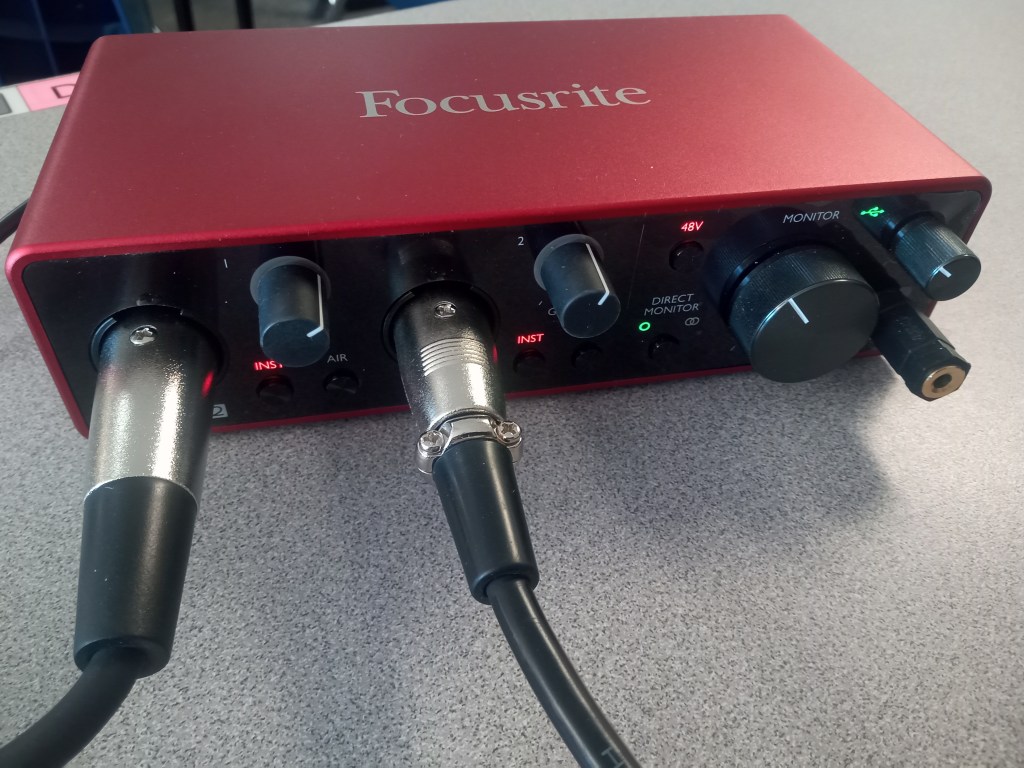
I wanted the acoustics to feel like it was a large space. Then there was the fact that we had two audiences: the ones in front of us, and the ones who would listen to the recording. The student audience in the bleachers came through loud and clear, cheering wildly when our two guests were introduced. But would the recording pick up the exuberance? To compensate, I had a back-up recorder on the desk, my trusty ZoomH4N Pro. I could grab that feed if I needed in editing. There was also a video camera at the back of the gym, hooked to a wireless lavalier mic which I placed next to our guests. This and the desk mic were plugged it in through the Scarlett Focusrite mixer. (That video mic feed came handy in editing, since one of our guests, an awesome pianist, played the theme from Pirates of the Caribbean which overpowered the desk mic. I was able to splice the better audio in later.)

You learn something! Like wishing I had two clip-on mics for the guests. I know, overkill! Or testing sound levels in the vast space before the real thing.

As for our guests, they were freshmen Reina Ley and Landon Madsen. A few weeks before, (Sept 2022), Reina had auditioned on NBC’s The Voice.  That same month, Landon, the pianist, had given a stunning performance at our talent show, Franklin’s Got Talent. The podcast were were recording, was a way to celebrate our student’s achievements, as we often do during morning assembly. Moments like this not only memorialize these particular achievements, they reveal something about all our students. The often unspoken talent hurrying through these hallways, toting trombones, football gear, trifolds, and other paraphernalia.

Here’s where the learning gets more interesting. This experiment in podcasting doubled up as an assignment for students in my class on Writing and Publishing in the Digital Age. I got them to help me set up the hardware in the gym. They were the ones manning the video camera, and doing the sound checks. Another was the photojournalist, with a regular camera. After fall break, these students will take this video feed and turn it into a news story, worthy of television. We have practiced with a green screen, so there will be an anchor, a reporter on the scene etc. Who knows where this will go! This, to me is what makes learning more hands-on, and lets them apply the theory of storytelling to real work they could publish (On Medium, the class website, and elsewhere) and see their output. Next month, they will be recording mock political debates in a history class, and produce a newspaper with many of these stories.

They, like me, love the challenge. After all, much of this (and the podcast) takes place in the Computer Lab. I remind my students, ad nauseam, it’s after all a ‘lab’ –where we are supposed to experiment!

Mansplaining spinfluencers I know diddly-squat about.

Image by Gerd Altmann from Pixabay

I may sound like a panjandrum (a word that rear-ended me the other day) because I’m not a huge fan of neologisms. Some of these recent words seem to be arriving by the truckload. It’s one thing to say ‘nonversation’ and ‘hangry’ — at least they mean what they sound like. But when did staycation and mansplaining become OK? Who comes up with this stuff? The Atlantic ran a piece that sheds some light on it.

There was a time when we had to explain (geeksplain?) what webinars, and dongles, and hashtags were. [Webinar, let’s face it, is a horrible word that should have been excommunicated with words like optics and more recent ones like spreadneck. Never heard of the latter? I’m glad.]

As for that Dongle? This was the name for that device you had to stick into your computer when you needed Internet access abroad. What an obtuse word! Hotspots probably severed our connections with the dongle world. We have other things we still plunge into our ports: thumb drives, also known as flash drive, USB drives, or stick drives.

Did you know that smellifungus is not what it sounds like? It would be perfect for describing the bacterial residue in your gym socks, but unfortunately it describes a person — a super-annoying whiner who bickers about inconsequential things. It’s female equivalent is someone social media labels a Karen.

Language, you see, is a collywobble, especially across the culturescape of english language speakers. We make things up — and repeat them — as we go. A breve, served at coffee shops in Tempe, Arizona could mean nothing to a tea drinker in Haputale, Sri Lanka which serves delicious kahata — a word that could flummox any tea drinker in Kensington palace, whether or not she uses the word flummox, which showed up in Tolkien.

Neologisms like kerplunk and digerati are all over the place. I recently heard that based is supposed to mean what teenagers in the Grease era considered cool. My daughter tells me that she abhors the term spinfluencers which is a subset of influencers, that wacky Insta label for people once known as ‘thought leaders.’) WIRED just ran a cover story on micro-influencers, and nano-influencers, so there may be a whole new species out there about whom I know diddly-squat.

By the way, panjandrum is one of those delightful made-up words from 1755 with a humorous origin. Webster’s best explains it here.

This story was also posted to Medium.com

Blurry borders and authors who cross the line.

Sometimes, it’s the border that crosses us.

Photo by Imre Tömösvári on Unsplash

Salman Rushdie knows a lot about borders. His books explore the concept of borders; he’s lived them. The recent knife attack on Rushdie in New York reminded us that — to paraphrase the author — we don’t cross borders; sometimes it’s the border that crosses us.

On a side note, I featured Rushdie’s other classic, Midnight’s Children, in a podcast about writing, if you’re interested. I met Rushdie at an event in California in 2004. He had just published a book, a collection of stories and essays, titled ‘Step across this line.

Borders are funny things. Just lines on the map, arbitrary, contestable, often inconvenient. Dotted lines that someone drew, and the rest of us are asked to observe. A canal here, a fence there, a dried up river bed, a train station. What happens to us when we step across one of these lines? First, nothing. Twenty feet this way, or that, nothing seems very different. Cactus spikes glowing in the strobe light on a truck. Barbed wire. Plastic bags billowing like ulcers on neglected shrubs. I’ve seen my share.

‎Listen to “Step Across This Border” On Apple Podcasts: podcasts.apple.com

I recall a border crossing on a train between Germany to Czechoslovakia as it was then called. Border guards in trench coats with heavy guns tapped on our compartment. Routine passport check. Very intimidating. Especially late at night when you didn’t know exactly where –meaning which side of the border — you were.

The reality is, once you cross, you are now in a different jurisdiction subject to new laws whether its speed limits or what you might have in your carry-on. People across the ‘line’ always seem to notice you are different. The way you hold up your head, your dress, your accent.

I’m not sure if this is your experience but scary border guards notwithstanding, there’s something else at work. People on the other side tend to be folks welcoming of strangers. Perhaps (a) they were once in your shoes, with no carry-on bag; (b) you are a curiosity that adds color — currency even — to their humdrum existence; (c) human beings are born to be social animals. Sure, I’m being optimistic. But at least it used to be that way.

It’s not just them. Something else happens to you. Inside. You feel the need to assimilate. To not suck up too much oxygen. To appreciate otherness. To not be the obnoxious tourist.

Any immigrant knows first hand. As a foreign student in London, my buddies were from Malta, Fiji, Seychelles, and Ethiopia. They had crossed many borders to get there. When we crossed into Northern Ireland, a region that was violently fighting the British at that time in the 1980s, there were a new set of borders to consider, even while we were technically in the same country. To say it was tense, even for our English chaperones is to put it mildly. Especially the part known as ‘Free Derry’ where fierce battles had once raged. (Remember that term ‘Bloody Sunday’?) But even in that porous border, we could walk through like locals because the locals seemed to want to have us there. At night, we could hear on radio that IRA bombs went off in the area where we were, a few blocks away.

I still think about borders, but now in a different light. Despite our accents, and varying skin colors, the borders we cross don’t have to get between us. For those of you too young to remember, Rushdie ruffled feathers. Apart from the geographical borders he crisscrossed, he crossed a line — someone’s line in the sand –when he published a book, Satanic Verses in 1998. The regime in Iran considered the book blasphemy and promptly issued a global death threat or ‘fatwa’ against him.

_________________________________________

So my question to you is, what borders, what lines might you have crossed in the past few months? At school in our daily morning assembly we call ‘Opening Ceremony’ our hosts often bring up topics like this. Inclusiveness. A tough value to put into practice. It’s such a cliche now to even say the world is more divided now. Especially when you consider that it’s some 50 years after the Internet sold us on the promise to unite us. There are new borders people draw around themselves. To paraphrase another Opening Ceremony host, instead of defining our borders, we could be creating and expanding ‘circles of influence.’

Why are vinyl albums so cool again?

Old tech fulfils three needs we are denied of in a digital world.

Photo by Erik Mclean on Unsplash

A few weeks back, I stopped by at a thrift store. An inexplicable gravitational force pulled towards the vinyl album section. Vinyl! The technology that was birthed soon after the invention of the light bulb. It’s fans seem to be on the rise. (I am fully aware that my vinyl album taste puts a date-stamp on my age: Engelbert Humperdinck for instance, and Olivia Newton John.)

This imperfect, scratchy sound of music has found its way back into our lives — like the Polaroid cameras. Or the music of Queen. When I was a teenager we sang along to the anthem-like lyrics of Bohemian Rhapsody. Today my 12- and 13- year old’s know every word of it. So my question is: why are old media formats so indestructible? Why, for example, hasn’t vinyl gone the way of, say, fax machines? Why do Taylor Swift and Billie Eilish release albums on records even while everything else is drawn to streaming platforms? I’m really, really perplexed about this.

I am looking for answers because in my writing and publishing class, a discussion of platforms and formats comes up a lot — something writers must keep their eye on because their audience preferences will always change, sometimes faster than they can keep up with. How might the content be consumed? Songwriters and poets, authors and podcasters, videographers, script writers, and web designers have to be one step ahead of the game. Remember how Prince wrestled with not just copyright, but distribution of his music?

My appetite for vinyl was whetted after I picked up a old record player at Bookman’s. It’s one of those suitcase-type players with a built-in speaker that can fill a room quite well no matter how squirrelly the track is. The Humperdinck double album was a steal!

Humperdinck has an interesting backstory that I refer to in my podcast below, if you’re interested. (You can also listen to a few tracks from Grease and Queen!)

This pull toward older technologies is larger than the music industry. I wanted to dig a bit deeper into this so I asked some of my colleagues about the ‘ancient’ technologies they use in that classroom and elsewhere. Don Meyer, my colleague who teaches British lit, said that he recently found cassette tapes of Macbeth were indispensable. Cassettes, for goodness sakes! Mrs. Walters, reminded me of one of the technologies that will probably never become extinct: The textbook. Duh!

So, here are three reasons old tech doesn’t have an expiry date? It is reliable. It is often fixable. And it’s available despite it being relegated to the old school. To the last point, fortunately it’s possible to find almost anything out of circulation on eBay. Including typewriter ribbons, film rolls, and those cassette tapes of Macbeth, starring Sir Alec Guinness. But I’d first go to the thrift store, because you never know what might show up in the vinyl section.

Here’s a fun fact: I’ve got a Corona typewriter in my class — a computer lab with 39 PCs. You should see students line up to use it!

Big Brother Is… Teaching You?

Photo by Etienne Girardet on Unsplash

A week ago, I asked if I could be a fly on the wall of a ‘simulation’ in Totalitarianism. It was a different way of teaching a unit of history. I really didn’t know what to expect other than what some of my students had described. They seemed all fired up by the fact that it was a simulation, and others had a few choice things to say about totalitarianism.

The teacher, Mr. Greer, began the class by asking his ‘party’ members to report on the citizens, who sat in rows, in true Orwellian fashion. They comprised a Clothing Officer, Lunch Officer, Education Officer and Propaganda Officer. Some students had been recruited to play the roles of snitches and spies. The other hapless citizens lost points for smiling, or for not standing up when addressing him. They had to defend themselves about the food they had at lunch or the color of clothing they did not wear to conform to that day. On one occasion, when a student was accused of a ‘thought crime’ there’s an audible gasp in the room. Luckily I had taken my recorder.

In the podcast of this class, you’ll hear ‘Chairman Greer’ do what, well, totalitarian leaders do: behave erratically, and throw people off balance. The students, however, loved it! As one student pointed to me, “If you don’t experience it, you don’t really learn anything!” Yeah, right, my teacher mind went. I hate PowerPoints as much as the next fellow, and students have had enough of it. No wonder simulations are dope, to use their expression.

Indeed, inside this ‘simulation,’ it didn’t feel like a classroom at all. It felt like theater. Made me think: This is the kind of education you sell tickets to attend. If only we could implement that model more!

__________________________________________________________________________

A longer version of this article could be found at Medium.com