What should schools really teach?

With schools in session, tests and test preps take up a lot of time. From AP test registration, PSATs and benchmark testing. A necessary evil?

Peter DeWitt, a school principal who blogs about leadership issues, (in Education Week), talks about Social & Emotional learning that gets downplayed as a result. He believes that schools should not lose sight of what’s as critical as the ‘data’ they are after. “For too many years, the focus has been on standardized testing and international comparisons of student performance with little attention given to helping students deal with the trauma they experience,” he writes.

Others take a different approach – that education is not something you do from the neck up. In the trend to prime students for colleges and careers, schools are driven toward short term results. just to have a scorecard to brag about, after all. Social and emotional learning doesn’t have a rating scale.

My principal, Mark McAfee, puts it this way:

The richness of a classical education…does not show up on a standardized test or that which is impossible to test. Namely, and among other things, works of literature for the sake of their beauty and effect on the heart of students; rhetorical skills; the soul-shaping effect of the arts on our youth; the physical courage, teamwork, trust, and hard work learned by our athletes on the field of play; the teaching of virtues, a thorough understanding of the chronology of ideas and the history of Western Civilization and our country’s founding.

For this reason at Benjamin Franklin High School, we have a daily school assembly, an ‘Opening Ceremony,’ during which students hear about anyone from C.S. Lewis to Machiavelli. The study of leadership and character through great men and women, and things such as music, art, philosophy, dance, are (at the heart of) our school curriculum, and pays great dividends.
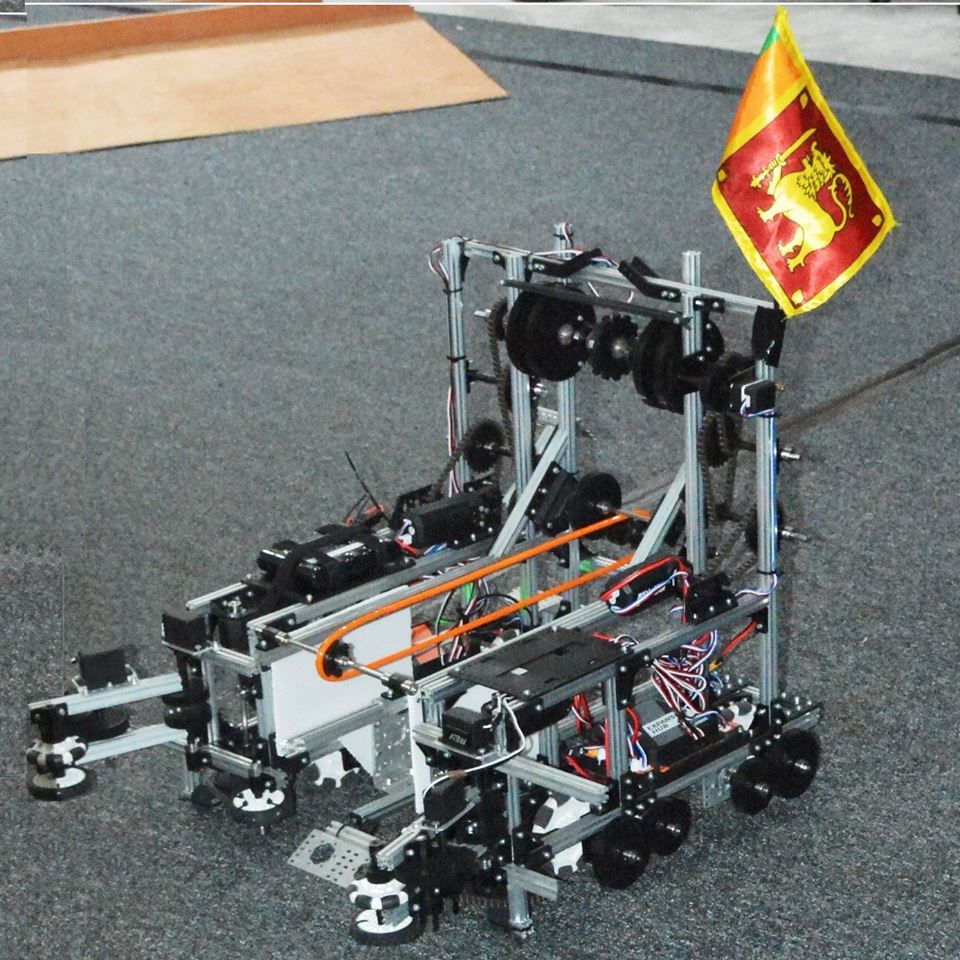
‘Energy Impact’ challenge at First Global Robotics

The biggest international robotics event starts this week in Mexico City, and will run from the 16th to the 18th August. Sri Lanka’s team was featured on the home page of First Global this week.

This year’s theme for 2018 is “Energy Impact. This means the robots must work in collaboration, working in three teams (three random nations are picked for each round) to create environmentally friendly solutions in the contest environment.

The larger purpose is to let students from countries with different world views, understand what it takes to work together as alliances.

When I spoke to the team a few days ago they seemed very confident of the maneuvers and demands for this year’s challenge, involving fuel cubes, power lines, solar arrays, and wind turbines. It’s been months or preparation, though each match is just two and a half minutes long!

Inside the Classical Education model. Latin, robotics, and…podcasting

In our middle-school years at St. Peter’s College, Latin was a subject. We didn’t know why we had to study a ‘dead language’ or how it fit alongside biology and geometry. But it later transpired when the seeds of a classical language began to sprout. Our love for theater (whether it was Oliver Twist, or Hamlet), our appetite for reading, debating, linguistics, and history could be traced back to learning what seemed like tedious (read: boring) declensions and the likes.

This school year I joined a classical High School, and now see the internal architecture of a classical education. The three-part structure of ‘grammar, rhetoric, and dialectics’ is just the start. Music and the fine arts, science and athletics are key elements. And of course technology.


A few months ago in teaching communication to my college level students, we looked at how rhetoric mattered; the underpinning of public speaking, ‘Ethos, Pathos, and Logos.’ So I was delighted to see how my High School’s monthly themes are structured on classical Roman virtues such as Gravitas, Humanitas, and Comitas.

You’re probably wondering what does this do for learning, and students’ character? I can only say this. After a month of teaching with this model in place (teaching computers and tech, mind you!), students come to class eager and prepped to learn; respectful, inquisitive, thoughtful.  This week, looking at inventors and inventions we did thought experiments (a.k.a. Bell work) on social norms and expectations when Thomas Edison messed around with filaments and early audio. Next week they will see parallels with someone like Douglas Engelbart, the prolific Edison-like chap who gave us the mouse, among other things. They were philosophers in their own time, who embodied, and fit, the classical model.

At the end of the week two students approached me to sponsor clubs. One was a Robotics club, and the other was for Podcasting. I had to catch my breath – podcasting! What would 12-year olds want to do with podcasts? It comes down to the classical model which feeds the need for young people to engage in much, much more than Fortnite, or memes. If we only let them.

Team Lanka at Robotics Olympics in Mexico this week

Last July, our team went to to the kickoff  Robotics tournament in DC.

This year, the team’s expanded to include students from other schools in the country.

  • Students: Cong, Daniel, Felix, Hamza, Lasith, Navod, Sachin, Sherwin, and Syanthan.
  • Coaches: Shankar, Jekhan, Dilum, and Srimali

This is one impressive gathering of 170 nations. It is hosted by the ‘FIRST’ organization, which is the umbrella organization that holds 5 other robotics tournaments around the country, such as FIRST Lego League Jr., FIRST Lego League, FIRST Tech Challenge, and FIRST Robotics for grades K-4, 4-8, 7 – 9, and 9-12 respectively.

I’ve worked with FIRST for the past 6 years, and met Dean Kamen, the founder, who’s one of the biggest STEM promoters I’ve ever known. He puts his money where his mouth is, a serial entrepreneur and educator who inspires youth across all ages. If you like to know how to get your school involved in robotics, or STEM, let me know.


How did the stylus, SHIFT key and floppy survive?

When teaching students keyboarding, or document creation I can’t help notice how much old tech is embedded in our fancy tech tools and applications.

Consider the stylus, which originated as a reed, to inscribe ‘information’ on tablets made of clay. History tells us that humans used tablets way back too! 

Then there’s the irreplaceable pencil, often the symbol that something could be edited (for instance in LinkedIn). Facebook uses the pencil icon to ‘make a post’, and for editing one’s profile.

Or consider the floppy disc -which none of my 7th grade students could identify. It lives on as an icon on the ribbon of Microsoft Word. Those who designer of the interface must have been hard pressed to find a replacement to the simple icon.

And isn’t it odd that we still use the 144-year-old QWERTY keyboard from the typewriter era? It apparently made its debut on July 1, 1874. Even the SHIFT key is a hold-over from that revolutionary device. It came into being with the Remington model of 1878. The first Remington sold for $125. I picked up a similar-looking typewriter for $50 recently. It sits next to a laptop, fighting for attention!

New tech can’t completely erase old tech. Nor do we seem to be able to replace one with the other, do we? Makes me wonder what else will survive, should touch pads, thumb drives, and the camera (how many use one today?) icon go away.

Screens or No screens? Battle lines are being drawn

Which side of the fence are you on when it comes to screens in the lives of your children?

We all have stories to tell. So as I regularly pose this question to my friends and colleagues I like to stay armed with evidence, and more importantly, other parents’ findings. You may want to read the story by Anya Kaemnetz on NPR this month. she quotes may different people. From a sleep researcher parent, to a pediatrician, to an obesity doctor.

  • The obesity doctor has this ‘rule’ in the home: The 5- 2- 1- 0 formula. It’s basically servings of fruits and vegetables a day. No more than hours of screens. 1 hour of physical activity, 0 sugary beverages.
  • The sleep researcher doesn’t allow screens to be used before bed time as t impacts sleep quality and of course sleep time.

Meanwhile the cell phone ban in schools has many advocates, including in France. Would it kill the Ed-Tech supporters? And the one-on-one movement?

What’s your take?

Robotics Team to represent Sri Lanka in Mexico

If you’ve been following my robotics coverage here, I am happy to report on this year’s Team Sri Lanka, who will represent the country at the second Robotics Olympics. The event will be in August, in Mexico City.

I met with the team coaches in Colombo in mid June to find out how they have been progressing. They have been building the robot from the kit they received from First Global, under guidance of a engineer and IT teacher, Shankar. His expertise is in CAD design and he seems excited –though unfazed! — about his students who must build a robust competition-worthy robot.

At the time of writing they are working on a lift mechanism –a so-called ‘cantilever lift’ mechanism — that will allow the bot to move objects to the area that earns them maximum points.

In case you’re wondering, here’s what last years Robotics Team looked like.