Screens or No screens? Battle lines are being drawn

Which side of the fence are you on when it comes to screens in the lives of your children?

We all have stories to tell. So as I regularly pose this question to my friends and colleagues I like to stay armed with evidence, and more importantly, other parents’ findings. You may want to read the story by Anya Kaemnetz on NPR this month. she quotes may different people. From a sleep researcher parent, to a pediatrician, to an obesity doctor.

  • The obesity doctor has this ‘rule’ in the home: The 5- 2- 1- 0 formula. It’s basically servings of fruits and vegetables a day. No more than hours of screens. 1 hour of physical activity, 0 sugary beverages.
  • The sleep researcher doesn’t allow screens to be used before bed time as t impacts sleep quality and of course sleep time.

Meanwhile the cell phone ban in schools has many advocates, including in France. Would it kill the Ed-Tech supporters? And the one-on-one movement?

What’s your take?

Could robots cross the line?

There are four ‘Laws of robotics’ that are seldom discussed whenever the topic comes up. There were written by the late sci-fi author, Isaac Asimov. More like guide rails, these are practical laws.

With the rapid rise in automation, AI, and robotics from battlefield robots (developed by South Korea, the US, and who knows who else) and surgical bots, these issues are worth discussing. Why leave the issues of automation and robotics to academic and/or politicians?

In this month’s column in LMD, I discuss the pros and cons of robotics. You can read it here.


The best tool for Storytelling or Digital Storytelling

The equivalent to the Google classroom is the Adobe classroom. Later this month, Adobe offers a class ‘called Explanimation.’ An awkward word coined to describe animation to explain, or tell a story.

Too often however, Storytelling is linked to software. From iMovie, to Glogster; from Visme and Animoto to Audacity among many others. Humans told stories around campfires before most technologies were invented. So tools like these should not become a crutch.

Storytelling –be it digital or analog– requires being able to describe something succinctly. Long before firing up the software the ‘story’ needs a structure and focus. There’s the tried and tested Beginning, Middle, and End. Or the Introduction, Conflict, and Denouement, if you will.

Students are natural born storytellers, but they often freeze up when it’s time to sketch things out. The best technology for this? Something invented in the same year that Shakespeare was born – the pencil!

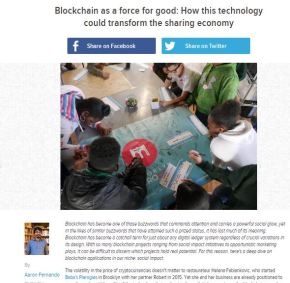
Blockchain fuels the sharing economy – Aaron’s article

For anyone considering dipping a toe into crypto-currency, there’s one person I’d like to point to – my son, Aaron. He’s worked with currency models from social currencies to crypto. The former is a way communities print and use their own money to sustain local industries. (One currency uses the line ‘In Farms We Trust’ as a way of thumbing its nose to the Federal alternative.)

His recent in Shareable, is titled “Blockchain as a force for good: How this technology could transform the sharing economy.” 

Blockchain is being adopted by restaurants, the energy sector, and the city of Austin, among others as he explains in the long piece. It’s definitely worth a read., even though I say so myself!

Thank you, Orbital!

Every time we have a STEM event, or SPACE Day, one group I always count on is Orbital ATK, a Chandler, Arizona-based company. Rockets and launches are in the news every month. Just this week, Orbital ATK launched the 139-foot rocket, Antares; the 200th mission to the International Space Station.

For STEM Night at Salt River Elementary, Orbital created an amazing demo using a ‘transformer rail gun‘ – basically accelerating magnets that transfer potential energy to kinetic energy. Plus canister ‘pop rockets’ that explained what Newton’s Third Law is all about. Thank you Javier Molina-Moughamian, Shannon Burke, Monique Dalton, Kelly Wallace, and Kimberly Barraza for being part of our team.

While some robots handle hernias, others could be invade countries. Are we crossing the line

I’m all for the use of surgical robots, or the emerging field of ‘drone journalism’ for data gathering, and even exoskeletons. But could others go too far?

Two types of robots worth considering this week:

Exhibit A: Robots in the battlefield. The Guardian reported that AI experts have called for a boycott of South Korea’s Advanced Institute of Science and Technology (KAIST). The arms race for autonomous robots as machines of war is real. The US Military with Lockheed Martin has been developing autonomous armored vehicles.

Exhibit B: Then there’s the more benign use of a robot –in a coffee shop! The Da Vinci surgical robot (which I have written about) was used in a ‘demo’ of sorts in Kullman, Alabama, to give people a chance to see its capability in a friendly setting. This robot typically handles gall bladder and hernia procedures. (No fear, it’s not an autonomous bot.) Nice touch, humanizing this strange-looking refrigerator-sized 4-arm robot.

The point being, teaching robotics ought to come with a layer of ethics. It’s not enough to be develop breakthrough robots just because we can. There is such a thing as the 4 Laws of Robotics, as written up by Science Fiction writer, Isaac Asimov. They are:

  1. A robot may not injure a human being or, through inaction, allow a human being to come to harm.
  2. A robot must obey the orders given to it by human beings, except where such orders would conflict with the First Law.
  3. A robot must protect its own existence as long as such protection does not conflict with the First or Second Law.
  4. A robot may not harm humanity, or, by inaction, allow humanity to come to harm.

The fourth law was added later by Asimov. We may have begun crossing the line, and ignoring it.

Interestingly, the UN this week has addressing the pace of robotics, through the Convention on Conventional Weapons (CCW) agreement, and the UN Institute for Disarmament Research. Lots of semantics in the debate, with regard to ‘autonomous’ and ‘automated’ and what constitutes ‘human control’ of these devices.

Egg-on-Facebook. Is this a confession or face-saving ploy?

Confession, or mea culpa?

Mark Zuckerberg’s published statement to Congress, tries to make it a bit of both. But that doesn’t easily get Facebook off the hook.

I find it incredulous that many of the data leaks (not hacks) were something Facebook ‘learned’ about from journalists at The Guardian, and Channel 4 etc. Or so Zuckerberg claims. How is it that a company that specializes in data harvesting and monitoring of millions of people and entities, didn’t have an algorithm or human sniffers to alert it to what was being done through its servers?

I find it odd that a company that was founded by a guy who literally ‘scraped’ data off Harvard’s computers (and thus stumbled on the business model) didn’t look out for the same thing happening to his domain.

Has Facebook ‘made things worse’ in Sri Lanka?

Singapore asked Facebook some tough questions. I hope Sri Lanka did.

On January 10th, Singapore’s ‘Select Committee on Deliberate Online Falsehoods’ took a deep look at how news spreads. It addressed such things as ‘digital manipulation’ and ‘hyper biased news’ in a well footnoted ‘green paper.’ Testifying at the hearing were the big 3, Facebook, Twitter and Google.

Facebook has been infected by social bots and seems to be unwilling or inept at fixing things, as we have seen in Sri Lanka’s case involving a complaint by lawyer, Jeevanee Kariyawasam. (Reported in the LA Times last week. The article quotes Sanjana Hattotuwa and Mario Gomez.)

Really worth a Read: Hate Speech on Facebok

(A report by the Center for Policy Alternatives, Sri Lanka)

It’s time to be proactive about social media platforms as they become de facto news feeds. Not by shutting down, but by timely, smart inverventions, as the CPA study recommends. The video below of Singapore’s stance, is worth watching!

Facebook, just like nicotine, has no good patch

About eight years ago, I would begin a workshop with an opening line that went something like this: Facebook is the greatest, most irresistible social network ever designed.by the CIA. Not factual, or course, but it got attendees to ponder how surveillance had become so easy, with no need for wiretaps, or laws such as FISA or ECPA.

Well, it’s now normal for journalists to talk of Facebook as being the great harvesting ground of big data organizations that use it to surveil and/or target users. That includes our friends and family in our networks. Social media addiction feeds the algorithm. Here’s what Mashable’s Damon Beres just wrote that it’s time to protect yourself -and your friends –from Facebook:

“The photos you post are interpreted by Facebook’s programs to automatically recognize your face; the interests you communicate via text are collated and cross-examined by algorithms to serve you advertising. Our virtual social connections enrich this marketing web and make advertisers more powerful. And many of us open the app to scroll without really knowing why. Facebook literally presents us with a “feed.” We are users the way drug addicts are users, and we’re used like a focus group is used to vet shades of red in a new can of Coca-Cola.”

He uses the analogy of the Marlboro Man, and the rugged cowboy appeal that continued to lure ‘users’ into a deadly nicotine habit, despite the truth which tobacco companies hid, and were reluctantly forced to admit.

So what to do? Some of my friends have quit Facebook. I haven’t yet. But I do recommend limiting data that algorithms could vacuum up: birthdays, business information, opinions related to our social causes, political rants and things we purchase online. No public displays of affection for family birthdays, anniversaries and such. (Birthday cards and letters were invented for this; despite claims to the contrary they haven’t gone out of style.) And Selfies! –unless you don’t mind feeding facial recognition algorithms now being used in many, many locations.

Deleting some of this now is a bit too late, but like the nicotine patch, it’s better than the alternatives. Unless your family and friends don’t mind the creepy second-hand smoke…

Banning hate speech in Sri Lanka poses social media conundrum

The apps stopped working in Sri lanka sometime on March 7th. The blanket decision to curb the hate speech that ensued after the clashes in Kandy was both a blessing and a curse. It’s not the best strategy, but it’s often the only one left when a government is caught unprepared.

Censorship – what else could we call it?- is a curse. “Social media is a noisy and contested space,” observed Nalaka Gunawardene. After all, “many have been using the platform to counter myths, misconceptions and prejudices.” Hate speech lives here alongside the more commendable forms of social interatcion. We have seen this movie before, though. Social media companies are often unable to, or incapable of filtering out the noise. Or the conspiracy theories, or the fake news. So pulling the plug is a hard choice. But it should go with long-term preventive measures that prevent offline hate speech. Which, as has been well documented, the government has not addressed for years. Again it’s worth quoting Nalaka who observes:

We did not reach this point overnight. For many years, ultranationalists have been poisoning the public mind with racial and religious hatred. Some local language newspapers – in both Sinhala and Tamil – regularly use racially-charged language and accommodate extremist viewpoints. Privately owned TV channels, engaged in a fierce competition for ratings, have also sometimes played with fires of communalism. 

His article, a long read, is titled “Smart phones and stupid governments.”

In 1983, the outbusts of hatred and bigotry travelled over long distances with no help from phones, let alone smart phones. There was no platform to block or blame. The culprit? Politicians! People at the top of the totem pole with no crisis plan, no leadership.