No, this is not about Facebook, and how we seemingly interact with text that sometimes seems like a bunch of posturing and talking at cross purposes!
This is about a performance I went to last Saturday at ASU, brought by the School of Arts, Media and Engineering.
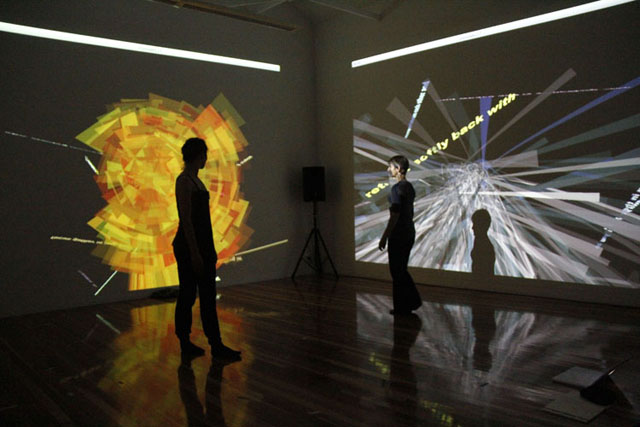 The key ‘performance — a semi-choreographed interaction of two women –was to demonstrate how conversations (and text) can ‘make’ people, and their reality. Meaning, how language doesn’t just represent us, but shapes who we are, even while we use it. Here’s how they describe it. The art form:
interrogates these questions (using) 3D infra-red motion tracking, voice acquisition, speech recognition, multi-screen video projection and multi-channel surround sound to create an immersive multimedia environment.
As the dancers move and speak, speech recognition software reveals sentences (and sentence fragments) on two screens at right angles to each other. Then these texts begin to intersect, and create some interesting visual ‘performances’ – dropping off, angling, growing, and interacting with the other person’s texts.
The event was the work of visual artist, Simon Biggs, and composer, Garth Paine, both of whom dabble in the algorithms that work behind the scenes.
Why I found this fascinating was that it is in an oblique way related to my work in Chat Republic, and how our conversations determine our realities. We are, whether we like it or not, immersed in a digital landscape, and what we say to each other lives in a textual sense out there.
One does not have to be steeped in social media to be part of this Web 2.0 world, where much of what we do is cross-referenced by algorithms –when we sign on to purchase something, do a Google search, or leave a comment –that build profiles of us, and builds identities of us.
Just check what Facebook appears to be doing, sneakily boosting your ‘Likes’ when you message someone.
 It’s not difficult to grasp what this is supposed to mean –after all the Internet as we know it is nothing more than a collection of billions of things such as servers, routers, ATMs, satellites, and devices that send and receive data.
 So this week, it was a chance to communicate with
 While many of you are staking bets on whether to back Germany or Portugal, I’ve been wrestling with another tough choice: Extend my content to other screens using Chromecast, or go with a media player such as Roku.
 Which made me long for something quicker and needs no workaround. Roku has raced ahead and given us about three choices, so this week it was one hearing on my bench: Roku original, Roku 1, or Roku 2.
  Back to AI. That famous ‘machine’ known as Watson, which beat humans in that game show Jeopardy, was able to search a massive databases and respond faster than Ken Jennings and Brad Rutter. But that was not all. It also outsmarted them in strategy – that is in picking the categories that would win bigger. It is eerie to watch those rounds and see how a computer sitting in between two humans looks like. (It sounds human too, as it calmly picks a category such as ‘chicks dig me’ to the nervous laughter of the live audience.)
 I was intrigued to read about how JWT, the agency that handled IBM and this show, was briefed on how to present Watson. At one time, the inventor behind it, specifically asked that Watson should not bear any resemblance to…HAL. If you know Stanley Kubrik’s and Arthur Clarke’s
 So on November 7,
  Because I teach a computer and technology class I see a large cross-section of tool literacy alongside media illiteracy. This is in no way meant to blame the digital natives as much as put the ball back into the court of educators. There are no Media classes in a typical elementary school because we always thought that Media was something people opted in to learn later.
 Hoipolloireport