Yes, you’re being tracked! Unless you change your phone’s default settings

Have you ever left a restaurant and received a message on your phone asking you to review the service? It’s very creepy. But it’s also what agree to when we use certain phone features or an app. (Sure, the app is ‘free’ but we pay for it by allowing some organization to grab our data, and /or track us.)
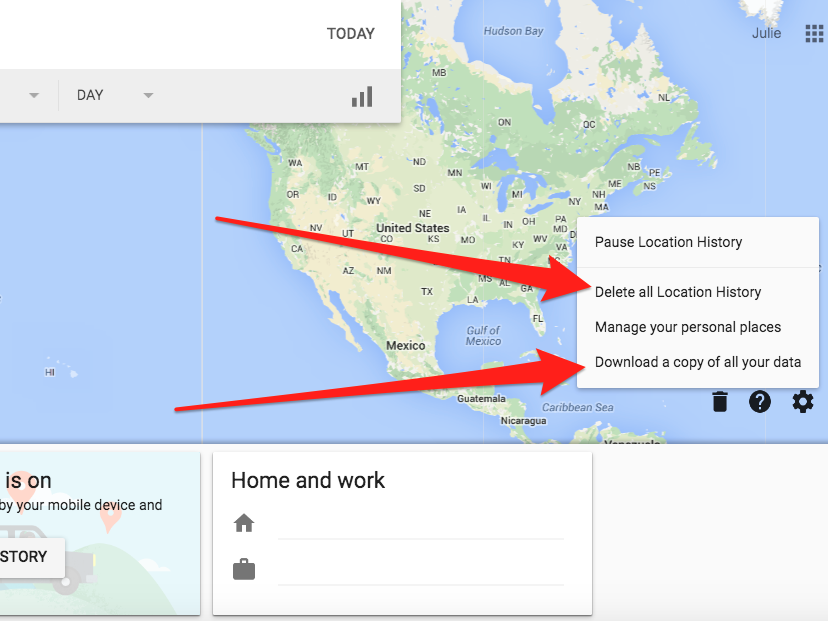
If you haven’t already done this, try Google Maps Timeline once you are logged in to Google. It pulls up a map of where you’ve been. It lets you click on each date in the past few weeks, and (if your location setting was on) you’ll see how Google has recorded exactly what time you stopped at any address, and left. So if you crossed a border, it will give you precise times when you passed through the border.

Of course this information is supposedly private. Or at least the Personal Identifiable Information (or PII) is. Of course you could –or rather should do these things:

  • Change your default settings on your phone.
  • Go into Google’s settings and delete your location history.
  • Avoid using clicking on the location icon if you could help it.

But we often forget. Or worse, think this information is harmless.

This is the kind of information that students ought to know. Not just to become paranoid about Google, but to become more aware of our data. Especially when it seems like logging into Instagram and Snapchat is a pre-teen default setting in itself.


The Real Moonshot – getting back to the Moon, soon!

While we have been obsessed with Mars, a big project has been underway to revisit the Moon. This little guy below, a Rover being tested by TeamIndus (India), is small compared to some of the Mars Rovers. It weighs just sixteen and a half pounds.

Google created an XPrize challenge, known as Lunar XPRIZE, with a $20 million prize for the team that could do three things:

  • Successfully land on the Moon,
  • Travel 500 meter
  • Transmit images back to Earth.

Five teams are in the running: Israel, US, Japan, India and International team.

Google is known for it’s ‘Moonshots’ –from balloons that could beam down the Internet to remote parts of the world, to autonomous cars, to cancer research. And of course robots.

And it’s being sponsored if you will, by Google.

Itchy fingers, clumsy tweets

Donald Trump’s (ab)use of his Twitter account will one day be looked at by historians in about the same way archeologists scrutinize cave paintings.

Back in April, when I was working on my June column for LMD, I had this sense that Trump’s clumsy (but some would say strategic) tweets would be worth focusing on.  Besides the political and international furor swiring about them, there are lessons in them tweets for anyone using social media.

And that was even before he bestowed upon us covfefe.


Robotics update: Team Sri Lanka’s progress

Back in March, I wrote a post here about a call to schools in Sri Lanka that might be interested in participating in the first ever Robotics Olympics.

The Team has been busy working on the challenge, which involves designing and programing a robot that could solve a water problem. They comprise: Ali Anver, Akash Gnanam, Amjad Hamz, Vinidu Jayasingh, Ishini Gammanpilla

The event: An international gathering of 160 countries, hosted by FIRST Global
The Goal:  To ignite a passion for Science, Technology, Engineering, and Mathematics (STEM) among the more than two billion youths across the world.
Dates: 14 – 18 July, 2017
The Challenge: The teams will work in ‘alliances’ as in the real world, using the robot to solve a global water crisis, specifically called ‘H2O Flow’. Which in and of itself is fascinating because unlike other tournaments, success is not based on individual skills alone. They must work as an international community. This is, after all, the Robotics Olympics!

Team Sri Lanka head to International Robotics event in DC

I like to break to the news about a story that has been in the works since April. Sri Lanka was invited to participate in the first ever International Robotics event, billed as the Olympics of Robotics. It is organized by First Global, an extension of FIRST Robotics, by Dean Kamen, a serial entrepreneur The event will be from July 16 to July 18th.

The team (4 students) received the robot kit from FIRST Global in April. Given the short time frame, they have been moving mountains to build, program and test the robot. I have been in touch with the coach and the school while they have been prepping for this. More details will follow.

Meanwhile, here’s a look at the team testing some of the working parts of the robot.

Nano bots – clever or creepy?

It’s not difficult to envision robots that might be among us. After all, some already do: drones and autonomous cars.

But take this to a nano scale, and it begins to sound creepy. For instance nano-bots have been envisioned to seek and destroy cancer cells in our bodies. (A nano meter is one billionths of a meter.)

On a slightly larger scale are robots that could look like insects or other critters, and work together as a swarm –a project that a friend at Arizona State University is currently working on. These bio-inspired robots could have many applications.

So the smaller they get, and the smarter they build them, we could expect to see them be among us. What this means for students is that there will be a huge demand for those who understand, investigate and have a mindset ready to work on these curious ‘machines.’

Science and STEM teachers often bring up robotics as a way to open up this topic to young students. Most of us use bots with wheels, arms and sensors. It’s time to think small!

If you like to read more on this, there’s a wonderful blog post on Invisible Machines here at Blog Science-Teaching.

Could they be social minus the media? Dire mental health finding

If you have teenagers, you know the dilemma. How do we get them to make connections without a device?

A subset of this includes:

  • How do we keep the phone away from the dinner table?
  • At what time should all devices be off in the home?
  • Is there a good reason to allow my daughter to use Snapchat? Or Instagram?*

As someone who once conducted workshops on how to adopt social media, I feel it is my responsibility to now warn young people about the unintended consequences of trying to be ‘social’ via a screen. We don’t need research to tell us that a generation could be experiencing serious issues very soon if we thrust smart phones into their hands, and hope for the best.

This research just in: Mental health and Instagram. 

Conducted by the Royal Society for Public Health in the UK, it has young people using words like ‘fake,’ ‘intimidating,’ and ‘superficial’ to describe platforms such as Instagram and Snapchat. The report explains how:

  • Young people say that 4 of the 5 social media channels make their feelings of anxiety worse!
  • A phenomenon called ‘Facebook Depression‘ which involves being ‘constantly contactable’ and having unrealistic expectations of reality. I had never heard of such a phenomenon, though suspected this existed.
  • FoMo (Fear of missing out) is also a thing, and is another cause of distress, something adults are just getting to know about.
  • There are indeed opportunities, despite the dire warning this report sends out.

Not many young people realize that Facebook owns Instagram and WhatsApp. 

Aaron’s take on “How to humanize digital marketplaces.”

As many of you know, my son, Aaron often writes on matters pertaining to markets, the economy, and alternative currencies.

I found this topic on ‘humanizing digital marketplaces‘ very relevant to lifestyles we now take for granted, ‘shopping’ for airfares, taxis, books, and even knowledge –all of it online. The article is at Medium.com. If you read it (it is a long read!) I’d be interested to know what you think. He will too.

How to Humanize Digital Marketplaces