Passport to ‘Digital Citizenship’ Webinars next week

Really happy to announce a series of Web conferences that I will be starting next week for the U.S Embassy in Colombo, Sri Lanka.

Webinar on social media - US Embassy, Colombo Sri LankaThis follows a digital video conference I conducted last year for the U.S.E, in association with the US State Department.

These six workshops –Webinars– are designed to be more interactive; the majority of participants will be at one location in Colombo. They were selected based on their application and response to a survey on the state of social media in Sri Lanka.

We are covering the usual suspects: Blogs, social networking, micro-blogging, video sharing and social search.  The attendees are from diverse backgrounds: advertising, corporate communications, government, web-based businesses, management, universities, media and non-profits.

Presenters: To make these sessions more focused and relevant I have brought on board some top practitioners to co-present with me. They are:

Dan Wool, a corporate communications and PR consultant for APS, a large electric utility in Arizona. Dan co-founded one of the world’s top blogs on public relations, marketing and social media.

Steve England, Chief Technology Office of MobileSoft, an advocate of on-demand digital printing who advises large tech companies and international advertising agencies on interactive marketing.

Gary Campbell, a communications manager at Arizona State University, a former print journalist turned digital, who has led numerous university training sessions in social media.

I will also bring in a few ‘surprise’ guests who will pop-in with some real-world examples of how they are using a particular strategy in their communication!

Quotes for the week ending 8th May, 2010

“In the Future, we’ll all have 15 minutes of privacy.”

Scott Monty, head of social media for Ford, on a post about Facebook’s latest move to connect to the rest of the web

“No one is laughing in Arizona. Do your job and secure the border.”

Governor Jan Brewer, in a YouTube video aimed at president Obama, who made a joke about the immigration Bill that Brewer signed into law.

“A lot of great stories are hidden within the public”

Manesh Nesaratnam, Malaysian film director of a movie, Your Grandfather’s Road, which is being crowd-sourced.

“That QR code on the left will even take your smartphone to my Twitter feed. And if you really liked this story, you can re-Tweet too.”

Kit Keaton, whose column in Fast Company, features this Quick Response code.

“A nastygram.”

Shel Holtz, referring to the letter Apple, which sent a nine-year-old girl a cease-and-desist letter after she suggested enhancements to the iPod.

“You gotta give him credit for his media manipulation skills.”

Pat Elliot, commenting on a post I wrote for ValleyPRBlog, about the value Sheriff Joe Arpaio holding a press conference to announce he is NOT running for governor.

We are heartened by news reports that J.S.Tissainayagam appears to have been pardoned…”

CPJ (Committee to Protect Journalists) in a statement on the presidential pardon for journalist J. S. Tissanayagam in Sri Lanka

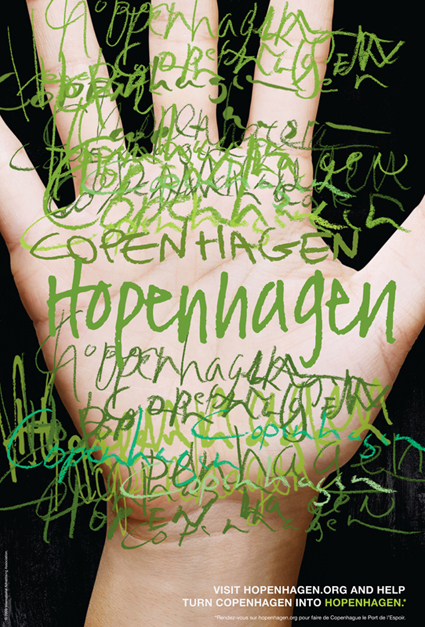
Hopenhagen: inspiring creative, but no offline visibility?

I’ve seen a lot cause marketing campaigns, so perhaps my expectations are high for this one, particularly.

The presentation by Ogilvy Earth (yes they did set up a group with this name for sustainability-related clients) is eye opening,.

It hinges on the word ‘Hopenhagen‘ which initially struck me as yet another clever pun. But it’s been well thought out, to focus on this city less as a destination for activists and tree huggers, and more as a symbol, a buzz word, a starting point for conversations, individual and collective actions…

Two things going for it:

  • An impressive media-backing. Speaking of media, those donating TV, print, radio, online and ‘out-of-home’ media include The Economist, EuroNews, The Financial Times, GOOD Magazine, Google, Harvard Business Review, International Herald Tribune, Reader’s Digest, National Geographic, Newsweek, Scientific American, Business India, Time Warner Cable, and a host of others. JFK and Los Angeles International airports, the Thomson Reuters building in Times Square, and even The Wall Street Journal, typically not supportive of such global warming attention, is also in this group.
  • The campaign is bristling with social media elements –with the usual suspects – Twitter, Facebook, a YouTube channel. There’s an interesting ‘passport’ to be obtained. I like how someone has setup a simple way to use the campaign as a Twitter background, at Twibbon.com.  The flash mob, that was also part of the campaign, and turned intio a video,  ‘sunbathing’ is very funny, though it’s not gone quite viral. Watch this:

But while all this is impressive and works well in the digital world, I was hoping to see more real world events, local visibility, community calls to action. Passports and online petitions can go so far.

The city of Copenhagen itself has adopted the campaign. Why stop with that?

  • Why shouldn’t citizens of other cities adopt the idea as well? Or claim ‘sister city’ status with Hopenhagen?
  • Where are the meet ups, the walks, the school programs, the spontaneous –copycat flash-mobs events, even– the engagement of utility companies, art venues, universities, churches and temples etc?

We get so focused on digital media, with its global reach, we often forget to communicate, through local channels, and our human networks. If people can change their Twitter background, they will be ready to change some aspects of their analog life as well, if only for a few weeks.

It’s not too late. If only Ogilvy Earth could get slightly more down to earth …

For attendees at social media conference y’day

Hyperlinks may seem insignificant, but they can be subversive, helpful and enlightening.

At last evening’s video conference I suggested that one way of improving our communication is to embrace this ‘link economy.’ And since social media is the connective tissue, it keeps this economy humming.

It involves some loss of control, which makes it unsettling to some, but it also opens up plenty of new opportunities. I see these as falling into four groups:

  1. Collaboration  – It’s almost impossible to use social media with a control-freak, silo mentality
  2. Crowd Sourcing – We soon learn that ‘they are smarter than I’
  3. Content Curation – While everyone is creating, some of us better start curating
  4. Community Building – Social networks are nothing but communities.

Social Media lets us:

  • Conduct due diligence faster, deeper
  • Look at trends, by mapping out events as they break –swine flu, forest fires, crime rates
  • Bypass bottlenecks — from network outages, censorship, slow feedback
  • Tap into the ‘wisdom’ of the crowds –citizen journalism

Two great Citizen Journalism sites:

One other interesting way to enlarge a story I omited to mention: The Lede from The New York Times. By the way, it happens to be a blog!

On the topic of Citizen Journalism and Civic Journalism:

The purpose of civic journalism is “not to inform the public, but to form the public.”

– Charlotte Grimm, Scripps Howard Foundation

Pay attention to these:

  • Wolfram Alpha –a search engine that will knock your socks off!
  • TwtPoll –If you use Twitter, and want to check the pulse of your followers, try this!
  • TweetDeck – aA desk-top application that will help you manage multiple Twitter accounts
  • iPadio – a simple way to podcast from your iPhone
  • Flickr – much more than a way to share pictures with your inlaws!
  • BlogTalkRadio.com – a simple way to create a podcast using a phone!

Finally:

  • Forget scoops, and consider ‘swoops’
  • Less Content Creation and more Content Curation

Is content still king? Or is there a new crown prince?

This morning I am participating in a web video conference for the US embassy in Sri Lanka on how to think about social media.

My working title for this is ”Think Outside the Blog,’ considering how blogs have become the center of gravity for so much of what we do –what we produce, consume, how we distribute, connect, and participate in the so-called link economy.

I therefore will be digging deeper, and framing it around Cocktail Conversations –how web 2.0 (which has infected our listening and speech faculties) lets us communicate in a very crowded room.

Why is the room crowded? First because everyone is gate crashing the party! It ‘s not just crowded, but noisy because everyone –and not just PR people, journalists and marketers– has a voice. Unfortunately everyone has arrived at the party with a megaphone, rather than an antenna. As such in social media (as in social life!) the best communicators are the best listeners.

But I will also be broaching the topic of whether content is still king. I hear this all the time, at new media hangouts, writing seminars etc. I don’t dispute that cointent is VERY important (the alternative is fluff) but we don’t give enough respect to context. It’s way too easy to come up with, and deliver content. Context takes more work.

Another way to think about this topic is to think about who really has a voice today? In the market economy, those who had the money to run ads and PR campaigns controlled the conversation. In the link economy there are new contenders to the throne.

“Mainstream no more” is tough pill to swallow

As we come to the end of May, two things with huge implications have shown themselves.

THE FIRST was the Wall Street Journal’s faux pas, trying to force a set of rules on their journalists who’ve started adopting social media into their work flow. Just one of the rules, that ‘Business and pleasure should not be mixed on services like Twitter‘ sounds like it was written by someone who woke up yesterday. Or didn’t hear about the ‘95 Theses‘ published ten years ago. Not this one, but in this book!

THE SECOND was the launch of a company called Blink.lk. It’s a new media company in Sri Lanka, launched by a former journalist and longtime friend Tyron Devotta. (Full disclosure: I am partly involved in it, at least in sentiment.)

One of their first posts on the blog –that has fittingly preceded the main web site–was called “Mainstream No More.” It’s written by a staffer, a former reporter. She expresses the struggle this switch involves. Today, anyone in the storytelling business has to get under the hood of social media and see what makes it so compelling to the audience. Or as Jay Rosen aptly called them, “the people formerly known as the audience.”

My old hangout, American Center turns 60

Happy to learn, from the U.S. Embassy blog in Colombo, that the American Center is celebrating its 60th birthday.

In the eighties, the AC was a part of my growing up. I would ride my bike on Sunday afternoons and settle down in the Communications section of the library. This was where I would catch a week’s worth of pre-recorded ABC News with Peter Jennings. I am sure there are thousands of others to whom this was a portal into a variety of interests.

Happy Birthday, American Center! Read the American Center newsletter here.

So what would it have been like when the American Center opened in Colombo 60 years ago? 1949 was a curious year, with these landmark events:

Quotes for the week ending 2 May, 2009

“If you’re out in the middle of a field and someone sneezes, that’s one thing. If you’re in a closed aircraft or a closed container or closed car or closed classroom, it’s a different thing.”

U.S. Vice President, Joe Biden

“Biden takes train after warning family to beware of confined spaces…”

Headline in ChicagoTribune.com on White House damage control over Joe Biden’s statement.

“The swine influenza outbreak makes Twitter more useful and somewhat useless, at the same time.”

Wayne Kurtzman, Media Bullseye

“Apparently the rate of infection is not as widespread as we might have thought.”

José Ángel Córdova, Mexico’s health minister

“Yes. And NO NO NO. Recently we’ve all been guilty of cheap and dirty!”

Lilamani Dias, CEO of LOwe, Sri Lanka, asked whether advertising standards have inproved over the past five years, on the occasion of the annual creative awards, The Chillies

“Social colonization is when every web experience will be social.”

Jeremiah Owyang, on the news about Facebook opening its walled garden to third-party developers.

Bottom line, Carnival should have been ready sooner with a statement and made it easily accessible on its web site. Surely it has a crisis communications plan?

Len Gutman, Editor of ValleyPRBlog, on the the potential cancellation of a crusie to the Mexican Riviera