Personality Not Included” released today

Rohit Bhargava‘s book, “Personality not included,” a book on branding, is being released today on Amazon. I downloaded a copy of the introductory chapter, via a Facebook group I was invited to. The full title, which includes “Why Companies Lose Their Authenticity And How Great Brands Get it Back” explains what the curious title is trying to achieve. In a social media era, where he says “all forms are portable, personal, and filtered,” brand identities are susceptible to perception, as much as communication. A true personality becomes a brand’s secret weapon.

Having interviewed Rohit before, I know how passionate he is about digital marketing and branding. In keeping with the recipe of branding he advocates in the book, he’s letting his personality flow through. He is eschewing the “Bum rush the charts” approach to create a surge in sales and asking people -personalities–to be his advocates. He’s also posting on Twitter.

More un-meetings please!

There are conferences rooms, and there are six comfortable faux-leather lounge chairs in the coffee shop at Borders book store on Mill Avenue. We meet there often to plan projects, or just brainstorm on an upcoming event. Sometimes it’s a visitor, sometimes it’s with a media person. My two highly creative designers seem to thrive in un-meetings –the agenda or core idea staring at us on the back of a napkin.

If you’re in marketing, PR or strat planning, you know there is value in structured meetings and white boards, but too often the format substitutes for the outcome.

Un-meetings, on the other hand, are less intimidating. People check their ‘strategic’ meeting vocabulary at the door and yammer on like real people –like customers. Maybe it’s the coffee shop atmosphere that reminds us that we are customers first and worker-bees second. In coffee shops you hear words like “I swear I got goosebumps when I read that report.” In a conference room, with a supervisor staring down at you, that same thought would go like “I tend to agree on the substance of his argument…” or some nonsense like that.

So here are the five reasons why un-meetings in public places work:

  1. They permit attendees to let their personality, their biases and their passions show through
  2. They let people interact with each other in a non-threatening way
  3. They force people to think like customers –being surrounded by them
  4. They seldom run over the time limit –folks feel they have to get back to “work”
  5. No need for Outlook meeting requests

McCainSpace needs a redesign, rethink

John McCain’s blog roll doesn’t include a link to his daughter’s blog, McCainBlogette. Though it does have Conservative blogger Michele Malkin (HotAir) and LaShawn Barber. Oversight? I don’t think so.

Meghan McCain maintains her distance for a good reason — if you read her blog closely. She does write about her Mom, fund raisers, the White House etc but does her own thing. The McCAin site, however is a tightly managed brand. It features issues, insights, trove of a photography, multimedia, and a networking tool called McCainSpace.

I experimented with it, and was confirmed within a few hours. But it is not what I expected. Since it riffs on MySpace, it suggests a networking space not a fund-raising funnel. It urges you to “build your own network of grassroots activists, take action and have fun.” On the site I created, categories include Modify your goals and Review Your Donors. The only way to build an address book is name by name –no uploading a database.

Huh?

Call me naive, but networking and activism isn’t only about getting people to drop money into a fishbowl. “Taking action” and “having fun” won’t go anywhere fast if those on the network are called ‘donors.’ I think they launched McCainspace too fast. Perhaps they have some functionality in the works, but the clock is ticking.

Rapp Collins’ scrambled print ad drives web traffic

Rapp Collins epft tuvoojoh xpsl. That’s “does stunning work” in case you didn’t quite decipher that.

It ran a double spread ad with 53 names of ad people –scrambled. The only way to unscramble the names that turned out to be one Matt Jacobs, Nancy Vonk and Christian Barnett and others, was by looking at a web address at the bottom of the ad, and figuring out the letter substitution needed. The url itself was not the company address, but ‘greakfuckingplace.com’ which leads you to greatfnplace.com, which lets you type in a first name and last name to see a customized message.

Type a wrong name (you have to be pretty dumb to check if you’re not one of the 53 being poached) they allow you to contact them –basically apply for a job. But hey, this is Direct, so it’s no sin to ask directly, I suppose.

But in spite of the clever approach of going after creative officers and strat planners, and the trouble to encode their names, they do a poor job by making everyone of the 53 people being targeting see the same message –even traditional variable data printing does a better job of varying the fields and responses. But it does the job of driving traffic to the microsite, and maybe the main web site. Which justifies the expensive double spread in Advertising Age.

And speaking of Rapp Collins’ regular website it’s a tuvoojoh experience –unlike any other agency site I have seen.

Quotes for the week ending 22 March, 2008

“Arthur C. Clarke dies at 90.”

News that sci-fi writer and author of 2001: A Space Odyssey, promoter of the communications satellite, died in Colombo, Sri Lanka on Wednesday 19 March, 2008.

I’m as delighted as anyone that Starbucks joined in the “conversation” this week.”

Sarah Wurrey of Custom Scoop’s online magazine Media Bullseye.


“One of the unintended consequences of my dad becoming the presumptive Republican nominee is the increased level of public scrutiny on him and our family.”

Meghan McCain, daughter of John McCain, who blogs at McCainBlogette.com

“Barack Obama is three things you want in a brand … New, different, and attractive.”

Keith Reinhard, chairman emeritus of DDB Worldwide in a Fast Company article on “The Brand called Obama.”

“Financial woes overshadow all other concerns for journalists.”

Headline of a report by Pew Internet, on the positive response many journalists give new media.

“PR stunts can definitely be a great way to make a splash and get some attention — but you’ve really got to know where to draw the line.”

Len Gutman, at ValleyPRBlog, commenting on giant fetuses displayed by ASU students supporting right to life.

“The Internet feels like Dubai.”

Steve Rubel, on why the future of the web is web services not web sites –a combination of big ambitious projects and small initiatives.

Remembering Arthur C. Clarke

We sort of took him for granted in Sri Lanka, his adopted home. At the Otters sports club we frequented, Arthur Clarke was quite a household name.

In 2005, the business magazine (LMD) for which I wrote a technology column, asked me to cover Clarke. I would have liked to have conducted an interview via web cam, if not a Q&A online on a wiki, but the father of the communications satellite made it known that he was past doing interviews. I wrote it anyway, titling the article “From Sarongs to Satellites.

So this week, as the news broke that the sci-fi writer and keen observer of what could be possible had passed on, I wanted to look back and see how I had deciphered the man.

I loved his observation way back before CNN or mobile phones, that satellites would tilt the balance of cultural and political ideas. Anticipating the ‘world is flat theory’ theory by decades, long before networking became an aggressive pass time, Clarke foresaw a hyper-connected global family. He thought the Communications Satellite would be the enabler of what he termed “The United Nations of Earth.”

And the quote I loved most was this: “Swords into plowshares is an obsolete metaphor; we can now turn missiles into blackboards.”

My full article is here.

Pictures of how the other half lives

There are stories from China, Philippines, Nicaragua or Iraq that don’t get told enough through the press syndicates and major networks. Pictures of refugees, protests, local heroes, monks, farmers, and the “word on the street” captured through a lens.

To fill these needs are the unpaid stringers with cameras who share their world view, if we only care to look. Someday, a smart citizen journalism outfit will find a way to create an on-demand “newspaper” out of a mashup of Flickr, country blogs, and stories from the underground.

For now, just go to Flickr, and type in the country you wanna know more about, and I guarantee you’ll see and hear of things you never knew, or are right now taking place –captured by an amateur perhaps.

Since it is five years since the Iraq war began, newspapers have been trying to sum it up or explain it through op-ed pieces, in-depth reports and pictures. You may have forgotten or not seen this one. An image from Iraq taken by one Michael Yon. That’s Major Yon. On his blog, he tells the story of Major Mark Bieger who rushed to the side of a child soon after a car bomb exploded on their convoy that had attracted a crowd of children.
This is how the other half lives. We don’t get to hear about these narratives every day in a news cycle crowded out by the erratic behavior of Wall Street or the obsessive attention to scandals, the Clintons or some technology conference.

Journalists approve of social media

Journalists are not as fearful or pessimistic of the new media as some make it seem.  Pew Research study just out finds that journalists do approve of the changes taking place in their business model.

Considering the impact of the internet and social media on their business model, local and national journalists have given new media a vote of approval.

The study was done with 585 national and local reporters, producers and media executives.

Media blind eye to media attacks in Sri Lanka

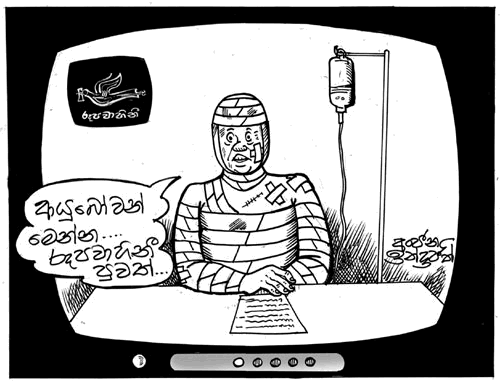
rupavahini.gifWith so much attention to China’s response to Tibetan protesters and the recent repression in Myanmar, there seems to be a blind spot when it comes to the media intimidation story in Sri Lanka. Five workers at the state television station, Rupavahini, have been attacked as the cartoon depicts.

It’s not funny. The methodical attacks follow a situation last December. Separately, journalists have being jailed without trial. Just a handful of organizations like the BBC and Reporters Without Borders are following the story. There are some indications that citizen journalists such as GroundViews will fill the void.