YouTube mashups as attack weapon

Johnson & Johnson learned the painful way how a social media could be used against you. See previous post and the YouTube video by angry Motrin mom.

This is not exactly a new approach. It was only last November that someone called out Unilever on it’s Axe positioning,  mashing up the brilliant Dove commercial about ‘real beauty’ and the same company’s sex-ridden ads for Axe —below.

These videos tell a different kind of story. The Motrin video is vary basic, the anti-Axe quite slick. Yet they achieve a few important things:

  • They assemble and summarize supporting evidence against the offending brand
  • They make the problem seem big enough to recruit new supporters of the cause
  • They provoke the marketer to react

To think, not too long ago, the only tool at one’s disposal when offended, was a letter to the editor of your local paper!

Motrin’s ad brouhaha: is social media nasty medicine?

Motrin’s baby-as-fashion accessory ad that created a lot of comment among moms in the blogosphere, also created a teaching moment about how social media can be used to monitor, respond and even prevent such a brouhaha.

Thousand of tweets, articles, and angry blog posts later, we need to step back and ask ourselves: how could a marketer learn form this.  AdAge has great analysis of this story with respect to the social media backlash.

First some background: About six months ago, Dunkin Donuts responded to a similar attack (by Michelle Malkin) about an ad that purportedly used a ‘terrorist’ icon, a kaffiyeh. The attack was without any substance, by the marketer took the ad down, fearing the negative chatter in the blogosphere would damage its brand.

Motrin’s parent company, Johnson & Johnson, no stranger to controversy, issued a statement apologizing missing the mark.  I don’t think it needed to have gone there, and could have done better damage control by engaging those they had offended. But hindsight is 20-20 in a crisis, and maybe they did not know how to engage the groups via social media.

Which brings us to pre-emptive public relations, and the ability to use new media to listen first. Without that, social media seems like a btter pill to swallow, because it all seems like a noisy echo-chamber waiting to take you out.


Digital books won’t make my bookshelf lighter

I have to be careful when saying that a digital product won’t undermine the analog experience. I hung on to my Canon Rebel 2000 for years until I realized the digital SLR was ‘not bad’ and in fact, good enough to make me switch. No need to belabor the vinyl music meets MP3 story.

So the news that Random House plans to digitize thousands of books to serve the nascent eBook demand, has me with mixed thoughts. On the one hand, I couldn’t see myself take a Kindle to bed, though I wouldn’t mind owning one. I can’t imagine how the book experience –that’s far beyond the reading experience–will ever be replicated or made obsolete by the tools we love in other platforms: scrolling, annotating, searching, linking etc.
In the end, the best way to think of the analog and digital bookshelf is not through the either/or lens. I may have a highly productive experience with a digi-book on a long plane flight, especially if it helps me load up the reader with other material and lighten my load. But I will always want that dead-tree experience for other times, even for that age old practice of standing in line for a book signing. Not that there won’t be a digital workaround for that soon!

Quotes for the week ending 22 Nov, 2008

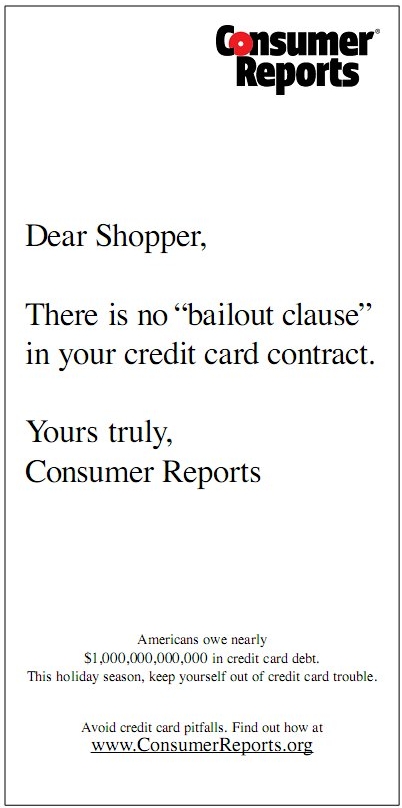
“There is no ‘bailout clause’ in your credit card contract. Yours truly, Consumer Reports.”

An ad appearing for Consumer Reports

“The greatest influencer is family and friends. The internet is second. Motor shows are third.”

Nigel Harris, the VP of Ford Motor Co. in China, on the automaker’s marketing strategy in the number 2 car market in the world.

“It’s almost like seeing the guy show up at the soup kitchen in a high hat and tuxedo.”

House Representative Gary Ackerman at the hearing of the House Financial Services Committee, commenting on the news that the Ford, Chrysler and GM top executives came to Washington in private jets, just to ask for a bailout.

“Lively no more.”

Message at virtual world site, Lively, (a Google attempt at Second Life) announcing that it was pulling the plug on the experiment.

“Have you ever wanted to mark up Google search results? … Starting today you can”

Google announcement of a more dynamic search application where users could customize and even delete the results to fit their needs.

“Frankly, Obama could appoint his dear mother-in-law as secretary of state, and if he let the world know she was his envoy, she would be more effective than any ex-ambassador who had no relationship with the president.”

Thomas Friedman on the ‘star quality’ appointment of Senator Hillary Clinton as Secretary of State.

“We are attempting a 180 degree shift in perspective: seeking an algorithm first, problems second. We are investigating core micro- and macro-circuits of the brain.”

Professor Dhamendra Mohda, a IBM scientist working on a $4.9 million grant from DARPA to replicate neural networks in computers that may be eventially applied to data analysis, decision making or even image recognition.

“Virgin launches Wi-Fi in the sky”

News that Virgin Atlantic will begin the first Wi-Fi service on ovember 24th called GoGo, with a live 30-minute inflight recording to YouTube by 30 Rock‘s Keith Powell.

“You can experience public diplomacy in real-time as Deputy Assistant Secretary of State for Public Diplomacy, Colleen Graffy, travels to Bucharest and twitters along the way.”

News at DipNote on another social media initiative adopted at the highest levels of public diplomacy in the US.

Google’s SearchWiki shows where we are headed

If you’ve not heard of SearchWiki, prepare to be amazed. It’s going to change the way you think of Google. Tired of getting some really irrelevant results? Delete the ones you don’t like, add new URLs and markup the ones that you want to come back to later.

Actually it does more than even social bookmarking –a customized Delicious account, for instance — but considering how where Google is going with its new browser (Chrome),  and wiki (Knol), this wikified browser experience could be the way Google learns more about users’ needs.

I can see where this might be going. A search engine meets wiki meets social bookmarking would infect us with the collaboration virus surging through our veins. Soon, we may be able to share our customized search results with a group (a Facebook widget might make sense too) we are collaborating with.

Take a test drive my HoiPolloi Google Search Page at this customized site.

You could switch between HoiPolloiSearch and regular Google search. Even the paid search results change when you toggle between both. The pages could be free of ads for non-profits, government or educationional organizations!

Visual browsing of World News

I have been looking into how a GUI ( geekspeak for ‘graphic user interface’) could enhance a message, and am considering doing some cool interactive, kiosk-type visualizations in our lobby at the Decision Theater. Interactive displays such as the Campus Metabolism project from the Global Institute of Sustainability is one way to do this. It’s a web-based but is much more interesting on a touch-screen in their lobby.

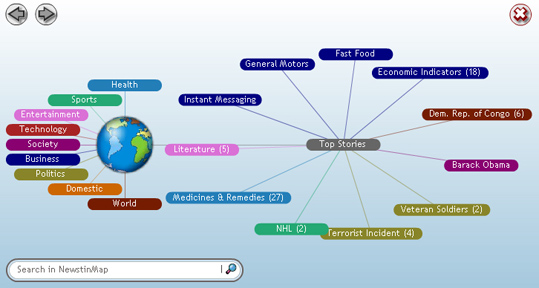
newstinBut apart from aggregating data, a GUI could simplify the user experience, for news, as this site called Newstin demonstrates.

Click on the Newstin map, and it basically organizes world news from 166,000 sources, organized into about 1 million topics. Mind you, Newstin was created before the iPhone, so it’s easy to see how a widget could transfer this kind of experience to a mobile device.

Bernie Goldbach’s vidcast experiments with new format

Bernie Goldbach may not be a household name, but for listeners of the podcast FIR (For Immediate Release) he’s the Irish correspondent who delivers an interesting perspective.

So I was really curious as to what got him started on a format like this, pointing a video camera at a newspaper, flipping the pages, and discussing stories. It reminded me of a radio segment on BBC radio (BBC World Service, if I am not mistaken) where the host/anchor gave listeners a summary of the news every day.

Some podcasts do this, but a video podcast has an additional benefit of pointing to the story itself, and being able to comment on parts of it.

Cronkite Week starts today!

The journalism school at Arizona State University celebrates 50 years this month.

A whole range of events, here. Topics cover Free Press in the Digital Age, A First Amendment Forum, TV Journalism, Business Journalism etc.

This month, the Cronkite school will also award Jim Lehrer and Robert MacNeil, the PBS news anchors, the prestigious 2008 Cronkite Award. Past winners have included Tom Brokaw, Hane Pauley and Helen Thomas

Powerful feedback loops, and why should you care

The challenge of facing the media cannot be solved by studying our talking points, and coming up with zingers. As the media morphs into a real-time machine with a Google-enhanced memory, there are forces to be aware of.

Dan Gillmor, who now heads the Knight Center for Digital Media Entrepreneurship at Arizona State University, recounts an incident that took place in 2002 that is even more relevant today. He was reporting in near real time via his blog about a panel discussion where then Qwest CEO Joe Naccio “whined” about the difficulty of raising capital.

The conference was in Arizona, but within minutes of his posting the story, someone in Florida emailed him a link to a story about Naccio cashing $200 in stock even as his company stock prices dropped. Gillmor posted that link in his next post, and almost instantly, the audience began to turn hostile against Naccio.

The feedback loop had unexpectedly given the audience –not the audience Gillmor thought he was writing for, but which happened to be sitting sight next to him– a new perspective. That audience-with-an-audience was also something the speaker never thought he would be facing.

Why should you care as a communicator or marketer?

  • The audience tends to be smarter than you think. Its demographics and psychographics can shift radically, even though no one may have left the room.
  • The back-channel is always at work. In grade school it was a piece of paper that was surreptitiously circulated among the class oblivious to the teacher. Today all it takes is a tweet, an IM, a text message…
  • Creating and encouraging feedback loops tip you off to something you may have never seen coming. People will come up with amazing ideas, if they are asked.
  • Your customers/audience could come to your rescue. Before his last podcast, Mitch Joel put out a tweet saying he had a bad cold and was ‘crowdsourcing’ his next show. The response was amazing! The audience practically ran the show.