Blogs allow CEOs permission to stop being ‘corporate’

There aren’t a lot of CEO’s who blog. Still. No one expects that of them. But there are many who -blog-like– speak their mind. So when people ask me for some examples, there are a few I usually refer to.

Kevin Roberts’ blogKR Connect, the blog of the the Australian CEO of Saatchi Worldwide.

Steve Jobs’ blog –actually this is not Steve. It’s the celebrated, outed ‘Fake Steve’ blog, but it’s worth reading…

Mark Cuban’s blog. Calling himself BlogMaverick, Mark has been setting the tone for CEO-speak for a long tome.

Jonathan Schwartz’s blog. I hold Jonathan’s Blog responsible for infecting CEO’s with the idea that it was time to bring social media in from the fringes into the mainstream communication

Schwartz, the former CEO of Sun Microsystems, was frequently called things like ‘blogger in chief‘ for good reason. His blog at Sun set the tone for everyone else blogging at Sun. He was not the kind of person who had one set of communication rules for the corporate office, and another set of rules for the rest.

I’ve interviewed many CEO’s and VPs for articles and podcasts, so know when someone is not comfortable presenting his/her human side just because there’s a microphone or camera in the room. Others don’t even have to switch into homo sapiens mode –they are exactly the same when facing external audiences as they are when communicating to internal groups.

How does your CEO, or client communicate? Are they instant ‘blog material?’ Do you sometimes wish you could capture the big guy’s thoughts in a podcast or blog, knowing that if you ask him to write it down or send it through his PR/legal funnel it would come out as something nonsensical?

I don’t recommend a blog for everyone, but I do know that its discipline and format has a way of giving a senior manager the permission to stop being all stuffed up and corporate, and to be more authentic.

Quotes for the week ending 8th May, 2010

“In the Future, we’ll all have 15 minutes of privacy.”

Scott Monty, head of social media for Ford, on a post about Facebook’s latest move to connect to the rest of the web

“No one is laughing in Arizona. Do your job and secure the border.”

Governor Jan Brewer, in a YouTube video aimed at president Obama, who made a joke about the immigration Bill that Brewer signed into law.

“A lot of great stories are hidden within the public”

Manesh Nesaratnam, Malaysian film director of a movie, Your Grandfather’s Road, which is being crowd-sourced.

“That QR code on the left will even take your smartphone to my Twitter feed. And if you really liked this story, you can re-Tweet too.”

Kit Keaton, whose column in Fast Company, features this Quick Response code.

“A nastygram.”

Shel Holtz, referring to the letter Apple, which sent a nine-year-old girl a cease-and-desist letter after she suggested enhancements to the iPod.

“You gotta give him credit for his media manipulation skills.”

Pat Elliot, commenting on a post I wrote for ValleyPRBlog, about the value Sheriff Joe Arpaio holding a press conference to announce he is NOT running for governor.

We are heartened by news reports that J.S.Tissainayagam appears to have been pardoned…”

CPJ (Committee to Protect Journalists) in a statement on the presidential pardon for journalist J. S. Tissanayagam in Sri Lanka

How to fly (through social media turbulence)

Airlines frequently fly into turbulence –not always the kind they are used to.  Just ask United. Better still, just ask Southwest Airlines. Over the years since they began embracing a slew of social media tools, Southwest has done a grand job of listening and responding. Sure, they’ve made their mistakes, fixed them fast, and moved on.

There may be a huge difference between an airline and an airplane, but I thought of juxtaposing them because of some common lessons they have for all of us –not just people who communicate about objects with wings.

If you missed this case involving Boeing, it’s worth a second look. The setup:

  • Child draws lots of pictures of airplanes.
  • Child sends one drawing to Boeing.
  • Corporate office sends him a standard letter saying it does not accept unsolicited designs, and has destroyed the letter.

Sad? Legal? Damaging to brand? All of the above?

The boys father was crushed/confused. He writes a blog so he asked his readers what to do.  Word got out. People came up with creative answers (including one that suggested writing the letter Boeing should have sent his son!) Boeing was forced to join the conversation at the late stage, and respond.

There are many lessons here. The first is about a canned response and a genuine response. So easy to do the former. But it’s out-of-place in a world where we make a huge din about being better at communications, great at listening yada yada.

To cut to the chase, Boeing Corporate (which uses this Twitter account that’s different from the one that talks of its engineering stuff) responded with aplomb, and thanked everyone for ‘supporting’ Harry Windsor, the child artist/airplane designer. “Supporting Harry,” as you might suspect is code for Punishing Boeing. Loosening them up. Humanizing them…

But we all live and learn. Boeing is a great company. They may have never in their wildest dreams of crisis planning imagined an eight year old would teach them a rapid lesson in communications. Neither do many organizations. So here are my takeaways from these two examples:

  • Plan  for the unplanned: Social media adds a lot more turbulence, often the kind that cannot be anticipated by the most sophisticated ‘tracking’ tools on board.
  • Know your audience’s audience: No matter who your end-users or customers are, your audience –and your ‘followers’ are always larger than you thought.
  • Put humans in charge. A professional response is not as good as a human response. Many of us/you are trained in the former. Don’t check your humanity at the door when you walk into your office.

Social media is nothing special. It has no secret ingredient. It is nothing more than humanized communications, for a world that has done an awful job at it.

Quotes for the week ending 30 April, 2010

The press release is dead, whether or not it’s optimized for social media. When was the last time you sent a release to a reporter who then replied with enthusiasm about covering your story?

Len Gutman, at ValleyPRBlog

Maybe it’s the term press release that is antiquated. Perhaps it should be called a fact sheet or project overview.

Holly Harmon, a reader commenting on the above.

“We are Wall Street. It’s our job to make money. Whether it’s a commodity, stock, bond, or some hypothetical piece of fake paper, it doesn’t matter. We would trade baseball cards if it were profitable. I didn’t hear America complaining when the market was roaring to 14,000 and everyone’s 401k doubled every 3 years. Just like gambling, its not a problem until you lose. I’ve never heard of anyone going to Gamblers Anonymous because they won too much in Vegas.”

An email circulating this week, written by someone supposedly form Wall Street

“An enraging piece of utter nonsense”

Huffington Post, commenting on the “We aren’t dinosaurs” email above

‘Print Grows Trees’ debate opens a fresh debate

PrintGrowsTreesPrint has always been dinged hard by those promoting digital communications as the green alternative. And why not? We’ve seen excesses that are so revolting –boxes of glossy annual reports that have to be tossed, multiple-page bank statements etc.

The Print Council has been very sensitive to that in their PR, and has a talking points document called “The fine print” to rebut those arguments.

So this campaign is not surprising. Called Print Grows Trees, it attempts to communicate some aspects of the print industry and its relation to forests. Specifically “to show that print on paper actually helps to grow trees and keep our forests from being sold for development.”

Let’s face it: Many of us who have gone digital are big fans of print; it’s not a simple either/or choice. We buy newspapers and magazines, but avoid picking up brochures and flyers whenever we could download them and read them as a digital file. We encourage people to ‘think before you print’ but we do carry business cards (GreenNurture uses Quick Response tags on business cards to avoid brochures) using recycled paper, printed with vegetable inks.

Print on demand, and Personal URLs (‘those ‘PURLs’) are some of the solutions that almost every printer now offers. PODI, the Print On Demand Initiative, educates members and everyone else about print and social media, QR codes etc. So yes, the print industry has done some good things to erase the dead-tree stigma. This campaign though seems to push the envelope (bad choice of word?) a bit.

It definitely –deliberately–frames the debate as an economic problem-solution and not just an environmental one. Is it a dangerous myth, as Jay Purdue and others suggest, one that “has significant environmental and economic consequences” to say that print kills trees? If you haven’t run into the seemingly oxymoronic term ‘digital deforestation‘ be prepared to hear more about it in the next few months.

Or is Print Grows Trees a symptom of ‘tree guilt’ felt not just the print industry but by all of us when we forget to turn on the double-sided feature before hitting Control-P?

Quotes for the week ending 24 April, 2010

“But it’s when you become the punch line on The Colbert Report that you know you’ve made the big time.”

Bill Goodykoontz, columnist at the Arizona Republic, commenting on Stephen Colbert’s ripping of Arizona’s new immigration bill –that was signed by governor Jan Brewer into law on Friday.

“facebook seems to be down – mass suicides worldwide predicted – story at 11”

Tweet by mmelnick, (musician, vegetarian, animal lover, truth seeker) who also re-tweeted “Attention humans: Facebook isn’t “down”. It’s become self-aware & will soon launch nuclear weapons. I’m pressing the “Lik …”

“Trees are a renewable resource, and paper can be recycled, recovered and used to make paper again. … Make print a valuable part of your communications mix.”

The argument behind Print Grows Trees, a campaign by Print Graphics Association Mid Atlantic (PGAMA) a not-for-profit trade association

“…uncomfortably close to advocating sexting”

The creepy Kin video ad that Microsoft had to pull for obvious reasons

“I think smaller- and medium-sized agencies make the transition from traditional to social-enabled PR much easier than larger agencies.”

Jason Baer, in a Twintervirw with Bob Reed of PRSA, where he also talked about ‘the science and math of social media.’

Blocking and tackling social media distractions

I speak to plenty of young people to whom Facebook is like email –something they leave on and check every few minutes. But they are chatting on other channels as well. If you look carefully some folks even check their phones for incoming mail at …church.

So the question I get asked is, whether TMS (too much socialnetworking) is killing our attention. How do you read a 300-page book, how do you watch a 2-hour movie, or listen to a keynote speaker without instinctively reaching out to your laptop or phone to comment/share/snipe?

We adults have a similar problem –TMI (too much incoming). nearly every Blackberry user I speak to complains of being a few hundreds of emails behind. I knew someone who two years ago, would tune out a speaker at a small-group discussion(for 10 – 15 minutes) just to respond to his incoming mail. It was embarrassing to watch!

I’ve been running into many people calling time out, addressing TMS and TMI. Two names you may recognize.

Joel Spolsky, writer for Inc. Magazine. In his last column, he analyzes why Too Much Communication is killing us.

Now, we all know that communication is very important, and that many organizational problems are caused by a failure to communicate. Most people try to solve this problem by increasing the amount of communication: cc’ing everybody on an e-mail, having long meetings and inviting the whole staff, and asking for everyone’s two cents before implementing a decision.

And Seth Godin, railing against Incoming.

That email, Facebook and message queue is a lot longer than it used to be. For some people, it’s now a hundred or even a thousand distinct social electronic interactions a day. It’s as if a genie is whispering in your ear, “I have an envelope, and it might contain really good or really bad news. Want to open it?”

It’s time to stop letting the genie take over our lives. It’s time to put the brakes ion email; to stop taking notes, to pay attention to the speaker. It’s time to join the conversation happening in front of you first.

The other conversations (online) could wait a few minutes couldn’t it?

Quotes for the week ending 17 April, 2010

“I write essentially 7,000 words every week for the blog and for the paper and all that stuff.”

AdAge on the New York Times Reporter, writing fro DealBook, who resigned for ‘accidental plagiarism’

“If you get the chance, grab a video camera (or a smartphone) and head to your nearest Tea Party. Who knows, your footage could dispel some false accusations; citizen-journalists are turning in the most reliable kinds.”

Lachlan Markay,  of Dialog New Media, on the Tea Party infiltrators.

“To all the Twitter lovers out there: this is NOT the first sign of the apocalypse….People will not desert Twitter for this. It’s inevitable — technology services need revenue.”

Josh Bernoff, on Twitter’s business model that might involve advertising

“Her brand is Teflon, ubiquitous and so strong that a book like this is not even going to dent it….The media is not going to give this story a second life.”

Michael Kelley, in Advertising Age, on Kitty Kelly’s latest unauthorized biography on Oprah

“Wait, Who Says My Tweets Belong to Google or the Library of Congress?”

Slate’s Heidi Moore, on the news that Twitter content from as far back as 2006 is being archived in the Library of Congress

“Weave in your personality. Sure it’s business, but you don’t want to be a social media sleeping pill. Avoid dry and boring messages, posts and links.”

Susan Young, at Ragan.com on the ‘Seven Habits of Highly Successful Social Media Communicators’

Are we crashing the conversation using social media?

I have to say I felt a bit guilty, reading Patrick Keane’s article in Advertising Age.

His point: Many people are confusing social networking with social media.

But that’s not the part I was feeling guilty about. He then goes on to talk about how there’s a big difference between joining the conversation and crashing into it.
Are you? Am I?

In this space -my blog– I have every right/reason to start and extend a conversation, one that I began somewhere else. Perhaps a face-to-face one, or one on Twitter, or as a comment on someone’s article or video.

But sometimes we use social media to dive in and out of conversations that amount to crashing the party. To use it as a megaphone in stealth mode. Two examples:

  • You may have come across this annoying practice of someone  dropping into a group just to seed an URL to a product or service.
  • Recently a member alerted our online group that a certain individual was up to no good. Basically posing as a member harvesting demographic information for some direct marketing scam.

So what’s the difference between that, and, say sending out a tweet with a shortened URL to one’s followers? I could come up with a reasonable defense of why this is, after all, targeted, not spammy. But the tool at our disposal has made it all too easy to go beyond what it was intended for.

It could end up being the biggest social media party-crashing tool, if we’re not careful.

UPDATED 03/15:

When posting a link, don’t lead people to a landing page for your book, webinar, e-zine or CD series. If you want to “hawk stuff,” go to your local flea market.

Podcasts and Slideshare – a cool way to distribute ideas

I’ve been dabbling with Slideshare and love how it lets you create and embed content.

So when my friends at GreenNurture began creating a series of presentations, we experimented with not just regular presos, but wondered what if we package a media kit as a SlideShare? What if we published a Press Release in this rich format? What if…..

We tried a few, and guess what? Our presentations were so popular that SlideShare contacted us to say that they were featuring GreenNurture on the home page.

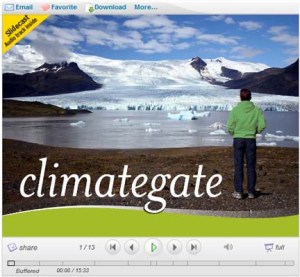
Today we have moved beyond that, and turned podcasts into a presentation. See below. I think it’s neat not because it pulls the format into a new skin, so to speak, but for anyone who does not want to download it to an MP3 player, but likes to listen to it on a computer, it adds a new experience. The forward buttons help you get back to a part of you missed.

And yes, there’s a word for this hybrid format –it’s called Slidecasting!

How Climate Gate is Leading Us to True Sustainability

View more presentations from GreenNurture.