When Robotics is more science than fiction

A few weeks back I took my Robotics team to see one of the coolest robots. It has ‘eyes’ and a brain, and it knows enough to get itself out of trouble, even when its handlers are not in the next room —let’s say 34 million miles away! This was the Mars Rover, at the  Mars Space Facility at Arizona State University.

The purpose of the visit was to get students to start thinking of technology as something much bigger than the gadgets they tend to get exposed to. To many 4th and 5th graders a computer is a box with a screen. A remote control is a piece of plastic with buttons.  And a robot tends to be thought of as an anthropomorphic device that takes orders.

Is our education system to blame?

Perhaps our society has to face up to the bigger challenges facing young people today. Challenges that may not be solved just because these kids become savvy using an iPhone app. Or being able to define the Pythogorean theorem.

Apart form a tour of the Rover, the students got to meet the NASA robotics team who demonstrated the simple-looking but complicated bots they are working on, using PVC pipes, , scrap metal, Styrofoam, and wire. Twenty years from now one of these could be making the big step to solve unsolvable water, energy or safety issues back here on earth. I think my students walked away from there realizing that robotics is more science than science fiction.

They took notes! They asked a lot of questions!

One of them, a budding designer, is making very complex sketches of his ideal robot.  Someday all children will…

I will leave that sentence unfinished –for now.

But as adults, there’s work to be done. Recently President Obama addressed students at the Carnegie Mellon’s National Robotics Engineering Center. He was imploring students to think like the future inventors and  entrepreneurs. This country is sorely lacking them.

“Now, imagine if America was first to develop and mass-produce a new treatment that kills cancer cells but leaves healthy ones untouched …or flexible display soldiers …or a car that drives itself. Imagine how many workers and businesses and consumers would prosper from those breakthroughs.”

Those things aren’t science fiction, he noted. It is the “kind of adventurous, pioneering spirit that we need right now.”

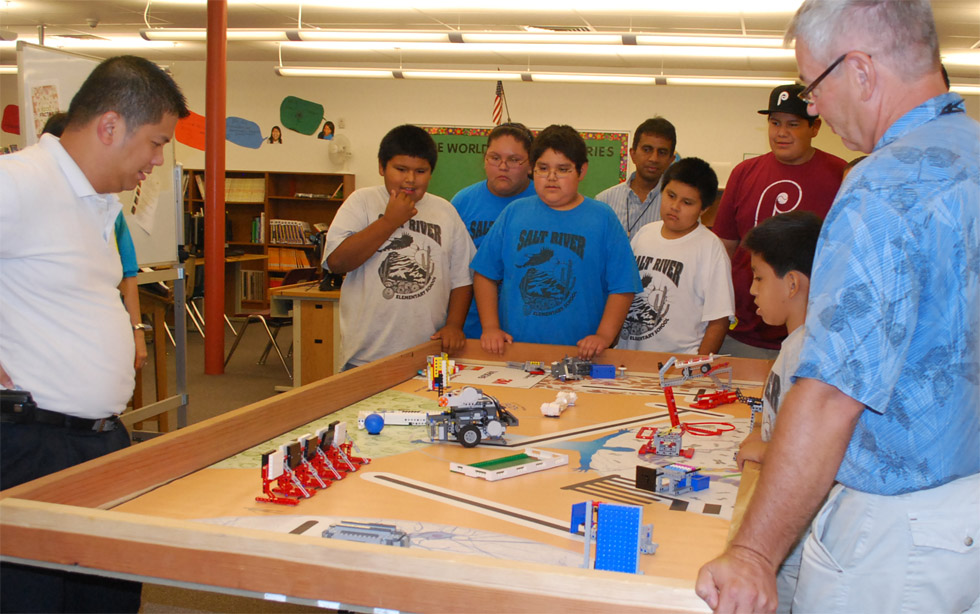
My class of 14 students is relatively small. We do not have the funds of a Carnegie Mellon. But we have big ideas. Wide-open eyes. Some of them are already programming the Lego NXT brick to perform some neat manoeuvres.

What does Big Brother looks like in a post-Jobs world?

Those in marketing have this quaint memory of Apple and its overthrow of those who enforce “information purification directives” in a stifling “garden of pure ideology” (the words spoken by the image of Big Brother on a giant screen).

If it was revolution, it was the triumph of the little guy over big intimidating folks such as IBM, not government.

But what does Big Brother look like today? What would George Orwell have railed about if he wrote about it now?

Few have heard about a program dubbed Einstein –essentially a government surveillance program. Details are understandably sketchy. It was set up for network security of government properties, but aslso to conduct surveillance, to look for the bad guys. Einstein came to be in 2009 as an early warning system, and was described this way:

Developed by the Department of Homeland Security (DHS), the Einstein software provides real-time monitoring and analysis of Internet traffic flowing in and out of federal agency networks. 

There is more here, and here. You would expect governments to get with the program and be vigilant on who’s accessing an intending to compromise their networks. I would be upset if they aren’t.

But then, with the ability to monitor social networking,  it gets more complicated. It is one close hop from monitoring who’s clicking on links and from where they are arriving on, say a Federal web site, to doing real-time surveillance of those people via their social networks. It’s also so easy to do. Easy to eavesdrop on a Skype call, or drop in on a Facebook user and check on the frequency of exchanges with a particular person, and do some data-mining based on that user’s friends, photos, interests…

Sounds like the cloak and dagger stuff in the movies? Think again. Two years ago, the Boston Globe reported on social media savvy undercover cops, and in another case, AT&T was sued for helping the government intercept phone calls. Today Facebook is being drawn into this debate about how much we should share, and what it “knows” about us, with one researcher alleging that it could track you even if you have logged out of Facebook.

Somehow I am not shocked, or worried about this. That’s the Faustian bargain we make when we use these services, many of which come at no cost to us. I’ve made the case before that the disease of over-sharing, and our need to communicate with our friends-of-friends-of-friends every moment and minutae of our lives invites this.

We could of course turn these off, or do something else: provide information that would confuse the heck out of anyone watching over our keystrokes. There’s a line in the 1984 commercial that shows us how, and how we could talk them “bury them with their own confusion.”

Go ahead, poke Big Brother in his eye!

iPad or eReader? If you had to pick one, which would it be?

I am getting perilously close to getting a tablet, but having held out for long enough, the choice just got easier.

I was never convinced about the early tablets for the simple reason that they just did not handle enough on the production side of things I would want one to do. I have talked to many about the fact that these were initially conceived as ‘consumption devices’ and every person I spoke to would add the “yes but…” factor. Meaning they put up with what an iPad lacked and found comfort in what it enabled.

But Amazon showed off the latest Kindle Fire last week, and it seems as if the debate gets  more complicated.

So now, instead of getting a tablet that also behaves like an eReader, I could get an eReader that works like a tablet.

The reviews give me plenty of backup for my bias, especially the fact that you get the Android operating system, and I could potentially get more out of the Amazon eco-system than Apple’s.

The only thing that concerns me is how Jeff Bezos positions the Kindle Fire. “We don’t think of the Kindle Fire as a tablet …We think of it as a service.” I can see why he said that, for market share purposes. It is better to create your own category than fight for space in a crowded one. But if it also meant that these devices were mainly on-ramps to the online store, then it makes it nothing more than a shopping cart camouflaged to look like a thin sheet of glass.

I could see where schools could find Kindles more attractive than iPads, if only because they have the promote reading first, after which follows sharing, research, note-taking, and content creation for collaborative purposes.

If you’re an educator, I’d like to find out on which side of the fence you are. Just recently, Teach for America (TFA)  members started experimenting with iPads.  I recently wrote about it, especially the emergence of an always-on classroom –first in universities, and every now and then, in high schools.

Send me your recommendations, your concerns, and your predictions!

Hippies or hipsters protesting? Is it the seventies all over again?

‘Peace through protest’ may sound the flavor of the month, or at least the theme of 2011, considering that peaceful uprisings overturned dictators during the so-called Arab Sprint.

But it reality, this is just the old recipe, delivered to our table on new tableware.

I watched a History Channel documentary on Nixon last night, and just seeing the short powerful segments when they cut away to the anti-Vietnam movement across the country made me realize this. You could cut-and-paste the present protest on Wall Street. Except for the bandanas and peace tattoos of the seventies, the similarities are striking.

People are fed up with their politicians (81 percent of Americans are dissatisfied with the way the country is being governed; confidence in Congress has dropped). They believe that the best way to send them a message is to show up on the street with hand-painted signs and chants.

OK, so we do have web sites, Twitter hash tags (#occupywallstreet) and Facebook, but it is easy to give too much credit to the mechanical tools of movements.

  • It does help when Salman Rusdie helps out with a tweet.
  • It does help when there is speculation that the Nobel peace prize this year may recognize Arab activists.
The revolution will not be televised.   But just watching the images, and the live stream makes you wonder if the hipsters have taken notes from their predecessors.
But what does this kind of speech, and technique forebode? Watch!

Messing around in class

Where is the classroom headed?

Having spent the past 20 some years around practitioners of the Montessori method (my wife runs a school) it has been interesting to observe how the ‘revolutionary’ advances in education today borrow heavily from the principles established by Maria Montessori.

So when I approached the topic for a long feature on how progressive educational institutions are planning to better engage students, I had this at the back of my mind. Moves to increase student engagement, and attempts to nudge the ‘sage off the stage,’ and student directed teaching appear to fit well with how Maria Montessori envisioned education. It’s also why some colleges and schools are quietly incorporating social media.

According to a 2010 survey from the Educause Center for Applied Research, 40 percent of undergraduates report updating wikis, and 25 percent use social bookmarking.

The article, titled “Messing around in class”  was published in Communication World magazine. I am truly grateful to three people I interviewed.

You can find a PDF of the article here. http://bit.ly/AFedu1

Marketing through Robotics and Facebook

This caught my eye this week. A smart move by the promoters behind Ariel, who found a way to get people to play a game of shooting stains (jam, ketchup, chocolate) at items of clothing. The trick was to use Facebook as the interface, and an industrial robot to do the dirty deed.

The other smart move was using a public space such as a train station (Stockholm Central Station) to carry out this live ‘experiment.’

Tablets, digital media coming to a school near you

I have been covering the intersection of technology and education recently, and have interviewed some amazing people at the forefront of the changing classroom.

One of them was Hans Aagard, senior technologist at Purdue University, Indiana. I was intrigued by that university’s approach –plunging in with a social networking application called Hot Seat. It is being used not just on campus, but in the classroom, while the lecture is in progress.

But yes, we are running into mixed signals.

  • While some teachers get their students to create content for topics that have been poorly covered or badly written in Wikipedia, many schools ban on students using Wikipedia.
  • A 2010 survey found that 62.7 percent of US undergraduates surveyed say they owned an Internet-capable handheld device, but many universities have signs posted outside lecture halls about turning off cell phones and electronic devices.
  • Faculty worry that too many screens in class could be distracting to the student and to others, while some high schools have made tablets and laptops integral to the learning experience.

More on this soon. My article was just published in a Sept-Oct issue of Communication World magazine.

So it was a pleasant surprise to see the subject “What Will School Look Like in 10 Years?” taken up in the New York Times  last week. I was particularly interested in the comment by David Silvernail, dir. at the Center for Education Policy, Applied Research and Education. He would rather schools invest in small amounts of technology …to teach students process skills, not just plunking shiny objects in their backpack and expecting them to automatically become smarter. Is he swimming upstream?

I have to admit I have mixed feelings on this.

I teach a robotics class in elementary school. For the past few classes I have been driving  home the importance of research. Finding solutions to problems they never knew existed.  I send them off to encyclopedias, dictionaries and other print material -on purpose. I could easily get them to log on to computers and search –there are more than 20 PCs in the room! But that would be too easy. I don’t want to hold up a think-outside-the-box mantra for problem solving and stick them in front of a… box!

Time to teach ‘media literacy’ to kids

I have two rules in the about TV for my daughter. (1) No watching TV from Monday through Thursday. (2) No turning to watch commercials when someone else is watching a program.

I’ve imposed rule #2 in spite of –perhaps because of– the fact that I once worked in advertising. I appreciate the fact that it is the commercial material that pays for the content in the media. But since Media Buying and its cousin Media Planning  is quite a science, with a wicked –often desperate — streak parents need to be vigilant. It is not accidental that advertisers deliberately place family unfriendly message in family programs. Few know that such a thing as product placement (and such things as ‘adver-games‘) exist to “regain the attention of consumers who can avoid advertising (by) using digital video recorders” etc.

I cannot begin to count how many parents have told me how they have had to do something about preventing their pre-teen son or daughter seeing trailers of movies that have a rating of PG-17 or higher. Because my wife and I are in education, we are constantly asked about how to deal with the problem. But while we rail against TV, let’s not forget the Internet could also be an equally bad influence when children use it unsupervised.

My first response is usually a question: “Do you have a TV in the bedroom?” If the answer is yes, then there is no rule on earth (no filter good enough) that could reduce the impact of the problem. A recent study in Britain found that nearly 8 out of 10 children watch TV by themselves for two hours a day.

My second question is related to  how many hours of TV or internet. The typical answer is “Oh, about 2 hours a day…” Two hours of passive entertainment may seem benign, but it is really two hours of training a young brain to accept information with no critical perspective, no time to reflect on what is presented. Worse, it trains young children to not use alternative sources of information, entertainment, relaxation.(Libraries, trees, sleep!).

But in the end, rules and timers will not be enough. What we need to do is teach our children some basic Media Literacy. Not in some academic way about theories of Marshall McLuhan or Neil Postman (Amusing ourselves to death). What’s needed is a way for parents to be able to tell their children that much of what they see and hear on television was designed to not make them think; that game shows and reality shows are far removed from reality –life simulated on studio sets. And that the emotions displayed in very realistic programs are planned, edited, and the people have been screened and coached.

Sadly, in the British study cited above, 66% of parents didn’t even know the characters or story lines of the shows their kids are watching. Experts who say TV for kids is not so bad recommend ‘co-viewing,’ but in that study 20 percent of parents who co-view approximately “sit in silence with their children.” Other studies have linked television watching to behavioral health problems.

Indeed Media Literacy  is hard, especially when it is easy to turn on the videos in the back seat of the SUV and keep the kids quiet and have an undisturbed chat on your bluetooth. 

Take a cue from the American Academy of Pediatrics which says media education for children could counter the negative effectsof watching violent TV.  Pediatricians have linked food marketing and obesity –an increase of 12 percent with one hour, increasing by 4 to 5 percent for each additional hour.  (May 2011 report).

A rudimentary lesson on media literacy would be a good start for children 4 and up. But it needs to be updated every six months. Later on, when the children grown up and you are fighting the deeper problems of over-sharing on social media, and sexting, you will be thankful you did!

Robotics Club kicks off at Salt River Elementary

A few months ago I never thought I’d be taking on the mantle of coach of a Robotics club.

Well, that day has come!

Today, we kicked off the first meeting of the Robotics Club at Salt River Elementary School. I’m honored to be working with Dr. Bill Johnson, who could probably build one of these amazing bots (to call it a toy is an insult!) in the dark, with one arm tied behind his back.

For all those who despair about kids today being more taken up by computer games than reading and writing, I have news for you.

Salt River Elementary School, Team TitansLast year’s school team, ‘The Titans,’ (students between the ages of 9 and 11) researched the basic conditions and consequence of diabetes, then proceeded to build a robot using mathematical calculations to send it off on a ‘mission’ to solve the problem. They were so good at it and their mission was so well thought out, that they went on to represent the school at the world championships in St. Louis, Missouri.

Care to know more about this? Check out this story.  ASU also featured it here.

Today, we showed parents what humans could do to robots. I talked of the several robots we have taken for granted. Yes, you may have heard of HAL and Roomba.

But not many people have heard of Jason (doing oceanographic studies) DaVinci (performing robotic heart surgery, left), Predator (the drone, of course), Hobo (the fearless robots that disarms explosives),  Dante II (the 990 pound, eight-legged robot built to monitor volcanoes), Kurt (the sewer inspector in Germany).

But more importantly than what humans do to robots is what robots do to humans -the interdisciplinary field of robotics helps us step outside our boundaries, and rethink what seemed impossible.

Here’s one of the smart robots that Dr. Johnson has created. It responds to sound and touch. But, as he notes, that’s only scratching the surface of what these kids are capable of doing.


Dear Eric Schmidt: If I may be so impolite, our track record isn’t great, either.

Interesting to see the debate ensure, now that Google has stepped into the debate on falling education standards.

Google chairman, Eric Schmidt lectured the Brits saying “If I may be so impolite, your track record isn’t great,” noting that education in Britain was holding back the country’s chances of success in the digital media economy. His abrasive comments were made at the Edinburgh International Television Festival:

“The UK is home of so many media-related inventions. You invented photography. You invented TV. You invented computers in both concept and practice… Yet today, none of the world’s leading exponents in these fields are from the UK.”

Ouch!

But here’s the problem, Mr. Schmidt. While it might be shocking to not teach CS to students at a young age, isn’t it terribly frightening that we’re not doing enough to teach/inspire students how to read? This includes how to spend more time in a library and not in front of screens, how to look deeper and wider about a subject on ‘platforms ‘ that don’t have hyperlinks and cool info-graphics. The problem is not in the UK, but in the US!

This may sound odd coming from me, because I do promote digital literacy, integration social media into knowledge sharing etc. But I work with kids, too. I can see where we are headed. Down the cliff! I have heard people brag about how their Johnny is sooo good at computer games, and loves Angry Birds, but these same parents don’t even own a library card in the home.

It is not just low-income children who can’t/don’t read. After investing some $6 billion in such ambitions programs in the US, the nation that is producing tablets and eReaders, and the coolest reading apps, has essentially flatlined in reading scores.

Time to lecture to the home team, don’t you think, Mr. Schmidt?