Instagram Vs Pinterest explained

Still trying to find the difference between Foursquare, Instagram and Pinterest?

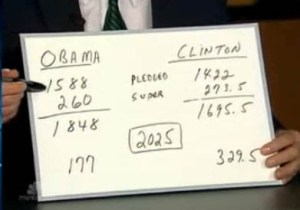
Social media sounds more complicated than it is. I like it when someone demystifies it. I like it better when someone uses a ‘dumb screen’ instead of gratuitously holding up some tablet (as do too many TV news reporters today, notice?) to make a point. Thanks to Douglas Ray for this.

This might help!

Speaking of white boards, this feels like an homage to the late Tim Russert (of NBC’s Meet the Press) who was a master of the white board when trying to simplify an idea in  a story.

I sometimes wonder if Tim would have ever clutched at an iPad to make his point as he did here, during the last election.

If you’re interested here’s the video of his explanation to Brian Williams.

Slow news costs lives! But does it always inform?

In 1815, more than 2000 people died at the Battle of New Orleans. Two weeks before. a peace treaty had been signed between Great Britain and the United States at the Treaty of Ghent.

But information had not still reached the US –it took two weeks for the news of the treaty to travel from Belgium.

But there’s an interesting counter to why slow news could be good news.  Some trends are not understood by the hourly trickle of news updates, as Alan Durning writes. He cites big issues such as pollution and urban sprawl as examples where slow news provides deeper knowledge of underlying issues. He uses a great quote from Ben Hecht to define this:

“Trying to determine what is going on in the world by reading newspapers is like trying to tell the time by watching the second-hand of a clock.”

Learning through customization and personalization

Would you be ok to have your child interviewed to be admitted to Kindergarten?

I know  of parents who have prepped their children for that face-to-face admission evaluation process widely used today by Charter schools. Hard to argue with this if we really want a revolution in education.

So, what if students are required to qualify to be admitted to school? Many schools resort to a lottery system, since there are a few hundred openings but a few thousand applications! But in addition to this, there’s the student interview. It’s a bit like applying for a job. One Pennsylvania charter school, Tacony Academy, has this requirement:

“each student must complete an Independent Research Presentation and present the results to a panel of teachers and administrators.

 The Independent Research Presentation should be science related and either follows Scientific Method, the Question-Answer model, or the Problem-Solution model.”

This kind of motivation tells a school how to better customize a program to the student.

Speaking of which, Ken Robinson makes a great observation as to why education should not be served like fast food.


Trust in media went up. Really?

If you’ve been following the Edelman Trust Barometer over the past few years, you’ve known that this the value of this ingredient has had impossible to predict. The 2012 Trust barometer did, however throw some surprises.

Government is the least trusted institution. What else is new?

Trust in the media actually rose in the past year! (That has to be impressive, considering that two years ago, a Pew Research study found it to be at an all time low, with Americans who were aghast with inaccurate and biased news.). Gains were in India, UK, the US and Italy. Which is counter intuitive, considering how the Murdock scandal tainted much of the British media last year. Not surprisingly, social media, recorded the biggest gains in media trust.

More details here from Edelman Insights

Will tablets and smart phones kill conversations?

A few weeks back, I passed a sad tableau of an Asian family: a dad and two sons waiting for Mum outside a Chinese grocery store. All three of them were silently thumbing away on their iPhones. In cars, in waiting rooms, the tablet and the smart phone has become the new baby sitter.

Over the past five years, having reported social media’s many benefits I often have to step back and wonder about what it means to be too much digital.

We have become so used to being ignored while having a conversation with someone with a Blackberry that we sometimes take it for granted.

It’s not just an etiquette problem as some have alerted us to in the past few years. It’s a social problem that will have deeper ramifications –too much ‘media’ perhaps – as we marvel at how connected we are.

It generates caricatures such as this and this.

  • Smart phones don’t automatically make us smarter. (Perfectly captured in that Geico commercial that poses that rhetorical question.)
  • Likewise one more screen in the home won’t make us better informed. While we do see attempts to engage students better using tablets, social media and other digital platforms, parents and educators need to add some caveats. Teaching children media literacy would be a start.

There is a connection between learning to have ‘conversations’ and learning how to learn by deconstructing information presented –a.k.a. discourse analysis. I am planning to connect my Robotics class with a class in Thailand, soon, and have given much thought to the balance of a traditional class with a digital experience where students will talk to each other with and without digital devices. More on this later.

I will leave you with two great pieces :

Enjoy! And do send me your thoughts, comments.

Online Privacy for the rest of us

If you didn’t see the blackout yesterday in protest of the Online Privacy Acts going through the House of Representatives and Senate (known by their acronyms SOPA and PIPA) it’s time to pay attention.

It won’t be trampling on the Wikipedias and the Facebooks of this world alone. Google, Reddit, and Craigslist, WordPress, Mozilla, and O’Reilly also protested the acts.

As Shel Holtz rightly noted in a great insightful piece, SOPA threatens much of the content residing on websites of organizations “as long as it resides on a .com, .org or .net domain. All it takes is for a user to upload a video, a photo or a presentation that violates someone’s copyright—even if it’s someone singing a cover of a song at a party—and under SOPA, Internet service providers could be ordered to block the domain name.”

Even those involved in advertising and SEO work.  Even Higher education! Syracuse University’s School of Information Studies, according the ReadWrite Web.

I just submitted an article for publication on infographics, so this one caught my eye. It summarizes the issue well. But…. does that mean this blog too could come under scrutiny by the SOPA police?

If you care about having your voice heard, you can sign the petition here.

Updated: The House of Representatives statement on the blackout, says that this was a Wikipedia ‘publicity stunt.’ In a press release (responding to the claim that some organizations had dropped their support of SOPA) it stated that ““Contrary to critics’ claims, SOPA does not censor the Internet.”

When PR gets muddied, the big mops come out

Let’s hope the PR industry cleans up its house 2012.

Two stories at the end of last year really hit home that it’s time to bring out the big mops to clean out the stables.

The British case of executives in a lobbying and PR firm, Bell Pottinger, bragging that they could influence politicians and ..Google search results through some ‘creative’ tactics. Hmmm! Here’s how The Independent newspaper in the UK reported on the sting operation:

“Reporters from the Bureau posed as agents for the government of Uzbekistan – a brutal dictatorship responsible for killings, human rights violations and child labour – and representatives of its cotton industry in a bid to discover what promises British lobbying and public relations firms were prepared to make when pitching to clients, what techniques they use, and how much of their work is open to public scrutiny.”*

The sting was conducted by the Bureau of Investigative Journalism.

The claim that it could do some ‘image laundering’, and what they called ‘dark arts’ struck me as nothing new. Bell Pottinger is in good (bad) company.

If you look closely at lobby firms, they seem to dabble in this pseudo science. Why? because dictators and bad governments are gullible enough to believe that their record could be scrubbed clean with a bit of good

The Livingston Group, which is a lobbying firm offering PR, proudly lists the foreign ministry of Libya as a client; other clients include universities corporations and other countries –such as the Republic of Azerbaijan and the Republic of Turkey. Here’s a short list:

  • Muammar Qadaffi had a PR agency back in 2008, called Brown Lloyd James. It specializes in Government Relations.
  • During the first Gulf war, the government of Kuwait was known to have used about 20 PR, law and lobby firms. One of them, with a strong reputation for Government Relations, was The Rendon Group. It practically stage-managed stories around the ‘liberation’ of the country.
  • China uses a PR agency for what it calls calls “external propaganda work and culture exchange.”
  • The Podesta Group was an influential lobby for Hosni Mubarak’s regime. It calls itself “a bipartisan government relations and public affairs firm with a reputation for employing creative strategies to achieve results.”

Fortunately, regarding the Bell Pottinger PR scandal, the most reputable organizations, including the CIPR (the UK PR bocy) and the PRSA (the US equivalent)  have come out and condemned this practice. They rightfully call their claims idiotic or unethical.

And the other story?

A minor skirmish, but it involved the world’s largest agency, Edelman. The agency parted ways with its client, Twitter after a few months. But the fall out was not so much about PR practice but how they handled the break-up. Edelman was in the news last year when it took on Rupert Murdock’s News Corp.

As for the PR industry, there is an interesting move worth following. The PRSA is in the process of updating the definition of PR. This was the definition, in place since 1982:

“Public relations helps an organization and its publics adapt mutually to each other.”

The new definitions, being voted on are here: worth reading, and watching out for!

Two interesting sidebars to the Bell Pottinger story, above:

* Bell Pottinger also mentions representing the government of Sri Lanka as one of its clients. The transcript speaks for itself.

* The chairman of Bell Pottinger, Lord Tim Bell, was the former media adviser to Margaret Thatcher, and chairman of Saatchi and Saatchi. As you know, the movie The Iron Lady is now showing.

2011 dominated by people rather than technology

It’s impossible to overstate how tumultuous a year 2011 has been.

Every year we seem to think that we have been shaken, twisted around, rudely awakened. Usually it’s about technology. But usually it’s about some life-changing technology, or a new ways of doing things. Refreshingly, this year there was a large human dimension to it, some of which I covered here on this blog.

It was as if we were looking through a camera and switching between two filters:  Pro-democracy and Anti-terrorism. But we also saw a share of media events, some even about the media!

  • The people’s revolutions in Tunisia, Morocco, Egypt, Russia, Libya…
  • In a surprising move, the US captured and killed of Osama Bin Laden — ten years after he declared war on the US.
  • Then there was Occupy Wall Street, a movement pooh-poohed by many but seemed to catch on, franchise-like, sprouting  arms, posters, and megaphones…
  • The shooting (and amazing recovery) of congresswoman Gabby Giffords dominated the early part of the year. At least here in Arizona.
  • The media scandal in the UK rocking Rupert Murdock’s empire.
  • The Kate and William extravaganza in the media -a.k.a. the royal wedding.
  • The earthquake, tsunami and nuclear disaster in Japan in April.
  • The passing away of Steve Jobs –perhaps slightly exaggerated as an ‘event’ (even on this blog!) But it made us consider how one man could have impacted so many.
  • Aung Su Kyi returned to the political arena, registering to run in upcoming elections

Human Microphones thwart heavy-handed bans

I’ve always been tempted to play with IABC‘s tagline, “Be Heard.” Do we business communicators really want to be the noise makers and talking heads? Or do we rather want to be the ‘inside voice’ of business strategy?

That’s why when I first began paying attention to the ‘Occupy” movement (OWS and its franchises  Occupy Oakland, Occupy Denver, Occupy Phoenix etc) I argued that we shouldn’t be too hasty to think of them as a fringe movement craving  just to be heard. Hard to pigeon hole, it was too easy to dismiss them because they didn’t fit the model of activist movements. I was reminded of  something innovators have reminded us from time to time. Disruptive ideas do not stem from existing templates. Marshall McLuhan put it well when he observed “I don’t know who discovered water, but it wasn’t a fish.”

Watching OWS evolve, it is interesting to see how they are inventing a  new template for being heard. Make that being taken seriously. They may be leaderless, but have found ways to have their own media team, financial system, and trademark bids. And I don’t mean media in the way we tend to think of it -the kind that come with a lens, a ‘like’ button, or segmented followers.

Much of the media we see being used in these movements are crude hand written signs.

When OWS group figured out that since electronic speakers and microphones are banned in public places (or require special permits) they created what’s known as the ‘Human Microphone’ –basically humans, en mass, repeating something a speaker says so that the sentences get carried across vast spaces of crowds. It sounds like a messy echo, but it is richer than the echo-chamber.

They have also begun another remarkable project in amplification: they are printing their own newspaper. Ok, that’s not new media. But it’s old media in a brand new way. (The fact that it is called, provocatively, the ‘Occupy Wall Street Journal’ may be a brilliant stroke of creativity.) But what really interests me is how they could do it with no real editorial hub, no newsroom, heck, no editor! (CORRECTION: See comment from Jen Sacks, below.)

There’s a livestream, of course, and someone who amounts to a news anchor.

How will this change media? Even if you’re not directly working in the media how this movement works with the groundswell will become one of the most lasting tutorials for anyone wanting to be heard.