Technology in schools. Love it or hate it?

IMG_0302

Touch screens and Robotics. My classroom this yea

In my upcoming July technology column I analyze the pros and the cons of Technology in Education. A few in my network have asked me about my thoughts on this ever-changing topic. (In Oct 2014 I did cover it – “Disrupting Education)

Here’s a summary of what’s to come. As you and I witness the discomforting transition from text books to tablets, from hand-outs to videos-as-homework, from sequential ‘lectures’ to disruptive (noisy) small group activity, it’s easy to fold our hands across our chests and fight it. But there are some compelling arguments on both sides. The Wall Street Journal, and the International Association of Technology in Education almost in the same week ran Pro and Con arguments about Ed-Tech. I get both sides! In my classes I argue against the inane use of social media for the sake of ‘publicity’, but I encourage thought use of digital media with real, and real-time audience participation.

‘Hall and Stevens’ Vs Khan Academy. In my younger days, I had to thumb through Hall and Stevens, the geometry ‘bible.’ Today’s kids are learning geometry from a guy called Salman Khan, founder the free online learning portal for mathematics and science. (Fun sidebar: ‘Hall and Stevens’ is available as an eBook; flip the pages as if it was a real book, here: https://archive.org/details/schoolgeometry00hall

Screen Time vs Think Time. I am a big proponent of virtual and augmented reality, especially if it could bring in ‘distant’ experiences (Civil War, 3D models of engineering, space science etc), but I also aggressively advocate limited screen time. Odd isn’t it? That’s the dilemma we educators and parents face. Augmented Reality
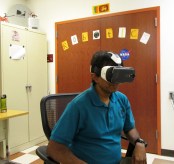
Your son or daughter probably goes to school with a device in her backpack with more processing power than the rocket that took men to the moon, and this child wants to be… an astronaut? You’ve forgotten how to log into your son’s school website to download his missed homework, but… he’s found a way to ‘jailbreak’ your cell phone? There are ‘teaching moments’ in all of these.

Sal Khan speaks of the “fundamentally dehumanizing experience” in education. And he was not talking about teenagers and even pre-teens staring at their phones and not talking to one another. A real, ‘digital citizenship’ crisis, right now! He was referring to children packed in a classroom! Hmm!

Love it or hate it, technology is gate crashing our class rooms, just like ball-point pens or calculators once did. Are you ready for it?

When science works, machines break, and coffee cups burn

In teaching technology we like to say that it’s OK mess up the first time. This is counter to how we like things to run smoothly – neat transitions, good closures etc. A formula, in other words. Even when doing a demo, you probably want your audience to see the end result.

earthquake-simulatorBut I’ve realized that in many lessons – life lessons, not class lessons– the worst thing you could do is to have something perform flawlessly.

Take this ‘Earthquake ‘simulator’ we built here. The plan was to simulate tectonic plate movement that brings down buildings. This was for our STEM Night, which happened on 21st April. A rickety contraption that would shake-rattle-and-roll using a power drill. We quickly ran into a few issues. The wheel you see here was cracking.With two hours to go to the ‘earthquake challenge’ we implemented Plan D – Duct tape. Which looked messy, but it worked. In a sense, I loved that uncertainty; an opportunity to tell students that this ‘problem-solving’ stuff we go on about, is real, even for us.

The next day, FOX 10 News showed up. More issues, with the weather guy and a camera pointing at our ‘machine’.

  • Problem #1: The drill that drove the wheel, had been taken home!
  • Problem #2: Reporter Cory McClousky wanted to repeat the ‘quake’ and of course, it failed. On camera. Nice!
  • Unrelated issue. Behind the earthquake simulator was the solar oven we used the previous day. I had left my coffee cup inside while we were waiting. A solar oven, in case you haven’t heard can reach up to 250 degrees in 30 minutes. So does the plastic cap, as you can see here, which warped out of shape.

You cannot plan these things. What looks bad, actually informs the story. McClusky’s parting line about the solar oven was: “We’re burning coffee cups in here…” Indeed. You can’t touch this.
STEM Night 2nd Red Camera (12) Solar baking After

FOX 10 News | fox10phoenix.com

 Cory Goes Back to School

What social media was like five years ago

I came across these pictures taken during a series of webinars on social media I conducted in late 2010, and it made me realize how far we have come. Or what we have left behind.

The series was called Passport to Digital Citizenship.

I have met some of these ‘students’ who have subsequently gone on to do amazing work in the digital space in Sri Lanka.

But now that I teach a different age and demographic of students, it is interesting to see how some major concerns of digital citizenship, have been over-ridden by new ones. Then there was no WhatsApp, and Instagram or Snapchat to think about. At that time, it was almost inconceivable that these new digital channels would practically revise the political spectrum in Sri Lanka – as Nalaka Gunewardene has well documented.

Webinar students - Passport to Digital Citizenship 2010


Thank you for the experience all of you who attended.

What are the most important tools you use in your work today? More importantly what are your biggest challenges?  Privacy? Information overload? Earning trust? PR?

Will you buy an Apple Watch to save time or eliminate ‘gaps’?

I’m not being a Luddite here when I say that the Apple Watch could be the killer app in social – as in being the thing that kills our ability to be social beings.

I’ve followed the developments of the smart watch for more than a year now, and have even talked to students and many others about it. I come at these ‘smart’ devices from this angle: Like all things in technology, whether or not we need the product of service, whether or not we approve of the trend, it’s important to stay tuned to what dimension is opens up. Technology seldom turns out to be what it started off as.

  • Facebook is less and less about making friends. It is now all about gathering and sharing data, and you are its accomplice.
  • Twitter did the classic pivot, from being a neat way to bypass the clunky Internet and stay in touch with a few, to turn into a one-to-many engine.
  • Quora (I’m not sure how many of you you still use it) began as a great community, but is also a search engine.
  • Instagram was once a terrific creative space until the selfie-obsessed discovered it

As for the Apple Watch, it opens up a new solution to the ‘stop staring at your phone’ problem. But just because it reduces the number of times someone will take a phone out of his/her pocket, it could start a whole new trend. Siri users, for instance will find it irresistible.

My comments to the story on TechCrunnch was that there’s a boon and a dark side. We hear that the best ideas are formed when we are offline.

To which I came this comment: “A big benefit of wearables is the sensors, don’t have to use it for notifications. Not that it will stop people engaging in info overload if it’s readily available.” The point is well taken, Michael Mahemoff. But I am glad you mentioned information overload.

Mind the ‘gaps’ – This is the perfect time to introduce Michael Powers (“Hamlet’s Blackberry“) who wrote extensively on this. He makes a great observation of “the gap” we need between utilitarian devices and the best uses we put them to. If you pile on screen experiences, says Powers, “there are no gaps in your connectedness (and) you never get to that place where the most valuable benefits are.”

I love the look and the convenience of a smart watch, but I don’t welcome it. I don’t think you need to be pro something and therefore against its disruptor.I adapted to an ebook reader, yet will always read and buy books made of atoms.

But just like Google Glass this is one wearable I will skip because if only because it eliminates the ‘gaps’ I am not willing to give up.

Take the poll, and let me know. Or leave a comment.

War of the Worlds, fought in Zeros and Ones

Cyber War is a hot topic once again. It has been covered by the BBC (“Silent War’), and even by TR (Russia Today) which cites Edward Snowden, and Defon. Also CNN, has covered it –scary CNN style!– about attacks on individuals via social media.

Last month, I was asked to cover this topic for an upcoming special feature in LMD Magazine. I found out some disturbing activities, and reality-checks that the public doesn’t seem concerned about. After all, we are busy worrying about how corporations’ databases are being attacked, and personal information stolen, because that’s what the popular news networks latch onto.

“But make no mistake: America is under attack by digital bombs,” noted Senator Michael McCaul last year when calling for cybersecurity legislation.

In his book “@War: The rise of the military-internet complex.” Shane Harris gives us one example of how governments fight a War of the Worlds scenario. The Chinese have been hacking sensitive US databases for some time, but in one such attack, the government initially withheld this information. Possibly so as not to tip-off the Chinese hackers, he says.

This was a de-facto military assault on a military target. And the target? The design plans for the F-35 Joint Strike Fighter jet in 2007, the so-called ‘fighter to end all fighters,’ that had a price tag of $400 million. It’s well reported today that more than 100 of the world’s militaries indulge in some sort of cyber war tactics. For more on this see Peter Singer’s excellent article in Popular Science.

For this article I interviewed Cornel Ruston, a Sri Lankan-born, California-based network security consultant, who talks about how why all organizations, not just government agencies need to protect their ‘crown jewels’.

The problem is, despite all the fancy communication technologies in our arsenal, we have become sluggish, in the way we communicate with all those who might help thwart cyber war-styled attacks. We tend to put more emphasis on the locks instead. But for every lock, there are a hundred lock-pickers.

If you like a sneak preview of the article, it will be released on Feb 26th.

Plans for more Collaboration at Digital Learning Day

In a time when pre-teens have Instagram accounts, and tablets readers have become the 4th screen (after TV, laptops, and smart phones), digital learning takes on new meaning.

For next month’s Digital learning Day, I plan to introduce students to some tools and processes that would prepare them for college and careers.

  • Webinars
  • Podcasts
  • Book Trailers
  • Wikis
  • Content Aggregation

Building on last year’s #DLDAY activities, adding more collaboration this year, means showing students the opportunities of collaborating with even those outside the walls of a school. I am thinking of technology experts, and students in another school –even in another country!

Yes, most schools have walled gardens, for good reason. Occasionally we pierce these walls, and #DLDay is that time of year when we could try out new things.

Suggestions are welcome!

Some useful background here:

Easy Content Curation Tools for Teachers

Content curation. It was a phrase slung around a lot about 5 years ago.

I wrote a lot about it then, in my IABC tech column etc. But today I have had to do some of this curation business when working on a lesson plan that has to be much more than links and words.

I began testing out a service called Lino (www.linoit.comto create a new ‘wall’ to support lessons in my class. It’s a bit like Padlet which I began testing last year.

The first test is to use it for a class on Book Trailers – a way to combine script writing, and microphone use with creating a promotional ‘trailer’ for a book. Also collecting facts, pictures, sounds, music tracks, video and slide decks in one convenient place. This is what one page looks like:

Lino_BookTrailer


Curation could become a lesson in itself, to help students understand how embed codes work, respecting copyright, crediting sources etc.

If you want to check them out try both.

BMW used “the Internet” to sneak in URL for Super Bowl ad

I was truly fascinated that a car company adopted a 21-year old news clip to promote its brand during the Super Bowl. This while other car companies did the same-old, same old car shots.

I am talking about the BMW I-3 commercial, featuring Katie Couric and Bryant Gumbel. This one:

Piecing together conversations from the behind-the-scenes interviews on the set, and looking at the two videos (the flash-back shot in the commercial, and the unedited video clip from 1994) it is interesting to see what clever editing was involved. Green-screens, and inserts.

Gumbel and Couric sound genuinely lame, as most of us were about this thing called the Internet in 2004. Unfortunately (or fortunately?) most of us don’t have archive footage of our conversations, when we first encountered the weird string of colon and slashes that were called ‘addresses.’

Around 2007, I recall a very prominent thought leader in marketing and communications similarly question the purpose of Twitter, and its @ sign, of course.

But back to the BMW ad, you may have noticed an email address info@amfeedback.com that slashed briefly on the cutaway shot, as if Gumbel is reading it. (They sliced in his voice to read the address, as if he did it in 1994. BUT, the actual address he read was violence@nbc.ge.com. (You could see the clip here.) Also quaintly, the ‘at sign’ in this clip is a circle around the a, not a continuous line connecting the a.

The neat trick is that the email address domain amfeedback.com is a promotional website for curious folk who thought they’d check it out – and I did, because I suspected the ad agency was not going to let that one pass.

Check it out for yourself! There’s probably a one-in-a-million chance of winning the car, but hey!

Podcasting is hot stuff. Again!

There seems to be a growth spurt for podcasting.

I love the fact that the audio format has been on the upswing, even despite the explosion of screen-based communication options. Depending on who you ask, they will tell you video didn’t assassinate the radio star for various reasons. Such as

  • Podcasts is immensely portable, and does is perfect for multi-tasking
  • Podcasts capture the ‘authentic’ voice of the person or the moment being represented – no fake ‘DJ voice’ required
  • Podcasts have in their DNA something akin to long-form journalism – deep dives into content, rather than skimming a topic

  • Podcasts lend themselves to drama, even while being authentic. The nearest thing to the documentary.

My recent favorites are Snap Judgement, Serial, Invisibilia (former radio Lab producers), and Star Talk.

Apart from the usual line up of This American Life, For Immediate Release, and EdReach, an education podcast for Ed-tech matters I now dabble in.


Interestingly this year will be six years since I first got into podcasting. And this year may be the year we begin podcasts at my school. More on this in a later post!

The body as a machine – works fine on Earth, but…

Since I write mostly about technology issues, I was struck by this description of how the body as a machine works.

The human body is a purpose-built machine, designed for the one-G environment of Earth. Take us into the zero-G of space or the 0.38 G of Mars and it all comes unsprung. Bones get brittle, eyeballs lose their shape, hearts beat less efficiently since they no longer have to pump against gravity, and balance goes awry.

Jeffrey Kluger, in TIME – story about Mark and Scott Kelley. The latter astronaut will spend one year on the International Space Station.

We take gravity so much for granted, don’t we?