Follow up to my post about NBC News visit to ASU a few weeks back.

Anne Thompson did interviews on student activism in sustainability, the urban heat island work, the School of Sustainability etc.
Follow up to my post about NBC News visit to ASU a few weeks back.

Anne Thompson did interviews on student activism in sustainability, the urban heat island work, the School of Sustainability etc.
Journalists are not as fearful or pessimistic of the new media as some make it seem. Pew Research study just out finds that journalists do approve of the changes taking place in their business model.
Considering the impact of the internet and social media on their business model, local and national journalists have given new media a vote of approval.
The study was done with 585 national and local reporters, producers and media executives.
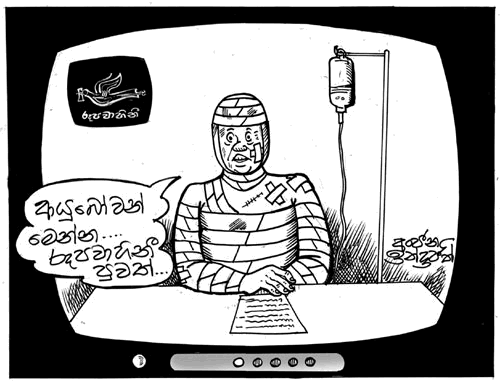
With so much attention to China’s response to Tibetan protesters and the recent repression in Myanmar, there seems to be a blind spot when it comes to the media intimidation story in Sri Lanka. Five workers at the state television station, Rupavahini, have been attacked as the cartoon depicts.
It’s not funny. The methodical attacks follow a situation last December. Separately, journalists have being jailed without trial. Just a handful of organizations like the BBC and Reporters Without Borders are following the story. There are some indications that citizen journalists such as GroundViews will fill the void.
“This is the wrong image, folks.”
“Each of Spitzer’s words was accompanied by a rush of camera clicks.”
“Airborne is basically an overpriced, run-of-the-mill vitamin pill that’s been cleverly, but deceptively, marketed.”
“The usual way for a newspaper writer to weasel out of such a request is to say that it is not a “local” issue.”
“Try doing what I do for a living … It’s not that easy.”
“I now see myself as The Curator of Conversations.”
Saturday’s unfortunate interview at the South By Southwest Interactive technology summit in Austin, Texas may go down as one of the most Twittered incidents. But it will also be remembered as one of the dumbest ways to interview a rock star CEO.
Sarah Lacy seems to have done her homework on the interviewee, Facebook CEO Mark Zuckerberg, but didn’t get a good reading of the audience. Going by several reports, she:
All this from someone who fully understands what the Web 2.0 is all about. (Her book on silicon Valley and the rise of Web 2.0 will be out shortly.)
Bruce Nussbaum of Businessweek summed up the incident well -pointing out to Lacy making the fatal error of “playing an old, traditional, mainstream journalist role” when talking to someone in an entirely new media space. Maybe this interview technique would have worked with a Steve Ballmer, but definitely not with Mr. Facebook.
To be fair, Lacy’s interview with Digg founders later on was totally different. But there was no audience to heckle her –she did the interview strolling along downtown Austin.
“Obamicans.” “McCainicrats”
“So, I think they have to spin this as best they can, but the reality is still the reality.”
“We are all living in the middle of a paradigm shift.”
“it’s no doubt true that many PR & advertising agencies don’t, in fact, ‘get it’ yet … But it is also true that many clients don’t get it yet, either.“
“We can also look forward to flexible screens, holographic projection and LED wallpaper that allows any flat surface to function as a display.”
“In the end advertising isn’t about the click.”
“Haven’t you people learned the art of pretending that you know what you’re doing?”
“A message is one-way communication and a conversation is not. Rather, a conversation is like verbal tennis where words and ideas bounce back and forth between both parties.”
Aren’t we all storytellers! Business communicators and PR people aren’t the only ones with stories to tell. At a weekly management meeting I often hear a response to a complicated question that goes: “Ok, so here’s the story…” Or take reports. The most interesting executive summaries I have read have a beginning-middle-end format, and one more element –the cliff-hanger to get you to read the rest of the 15-page document. (Conversely, the most boring ones have bullet points and stats. The do the job, but they don’t light a fire.)
And my point is? Yesterday I attended a workshop by the Donald W. Reynolds National Center for Business Journalism. It was on “High intensity business coverage” and dealt with the finer points of finding, crafting and publishing business stories. Terrific speakers, with amazing takeaways for writers, a very good cross section of attendees, including some the storytellers a.k.a. journalists I am familiar with from The Arizona Republic.
In one session, writing coach Dick Weiss talked about the ingredients of an A1 story: Action, narrative, dialog, passion, character, theme. But what stuck in my mind are two other elements he recommended –tension and quirkiness. Weiss has another nugget: “Start where the readers start” because it addresses their values, and the what’s-in-it-for-me question.
Storytelling isn’t a new skill. If you’re a parent you’re probably a master at it. Every night I need to invent a story for my daughter at bedtime and one day she gave me the ideal recipe: “Could you make it a little scary, but give it a happy ending?” From then on, storytelling has been a breeze. Sprinkle tension, bring about a resolution, fade to black… Since yesterday, I’m working on the quirkiness thing.
“This story seems to me not to pass the smell test. It makes the innuendo of impropriety, even corruption, without backing it up.”
“Fouad Mourtada, like thousands of people who create fake profiles of well-known personalities or celebrities on Facebook, has in no way acted in a willingness to cause nuisance to Your Highness.”
“Get out your palette. It’s time to do some 21st Century cave painting.”
“The views expressed on my blog, Deus Ex Malcontent, were mine and mine alone. I represented no one but myself, and I didn’t make a dime doing it.”
“It was an agonising decision for me.”
“The beauty of digital PR is that its “rules” have not been written yet. You can write them.”
“Congress is broken. Lawrence Lessig can debug it”
“It’s a handoff … They’re friends and allies. They share a view of politics and often riff off of each other.”
Judith Miller, the New York Times journalist who was jailed for refusing to divulge her sources, has an interesting take on the the new tourniquet being applied to the profession. Miller’s article about another contempt of court case, appeared today in The Wall Street Journal.
Coincidentally, the pressure is being applied elsewhere this week. Senator John McCain’s campaign is questioning the veracity of the story that appeared in the Times, about his alleged relationship with a lobbyist. The McCain “hit piece” as it is now being called, seems to have taken a turn; it is now a story about the New York Times itself. (The paper reported that more than 2000 comments had come in, critical of the article.) One McCain aide referred to the Times, which oddly endorsed McCain, as the “national inquirer,” suggesting that the much more had been expected in the post-Judith Miller world.
The Arizona Republic quotes an ASU professor, Michael Rubinoff, who thinks this might be more more than a “small radar bleep,” considering the momentum McCain has right now.
Interestingly, the editor of the Seattle Post-Intelligencer, James Mccumber wrote that he didn’t carry the McCain story in his paper because it was flawed, and was “pretty thin beer.”

“I frankly don’t care who just wrote what on someone else’s Wall or who just joined the Carbon Foot Print Group.”
“It’s 1980 in my office — I can’t get on the internet, but I hear it’s just great.”
“Sure, Wikipedia can and should be “used for research”, in the same way a classroom might use a cadaver for research. The class shouldn’t take the cadaver home to meet Mother, nor should it use the cadaver to co-sign for a loan.”
“A case study (is) really a story about a hero, a dragon and a damsel in distress. The dragon is the business problem-for example, a project badly behind schedule and over budget. Your company is the hero. The client is the damsel in distress.”
“As writers and directors, we have our nose in the tent for real for the first time.”
“Whatever one calls it, the Council/Bulldog project has a foul odor.”