A few months ago I never thought I’d be taking on the mantle of coach of a Robotics club.
Well, that day has come!
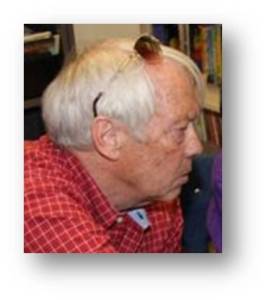
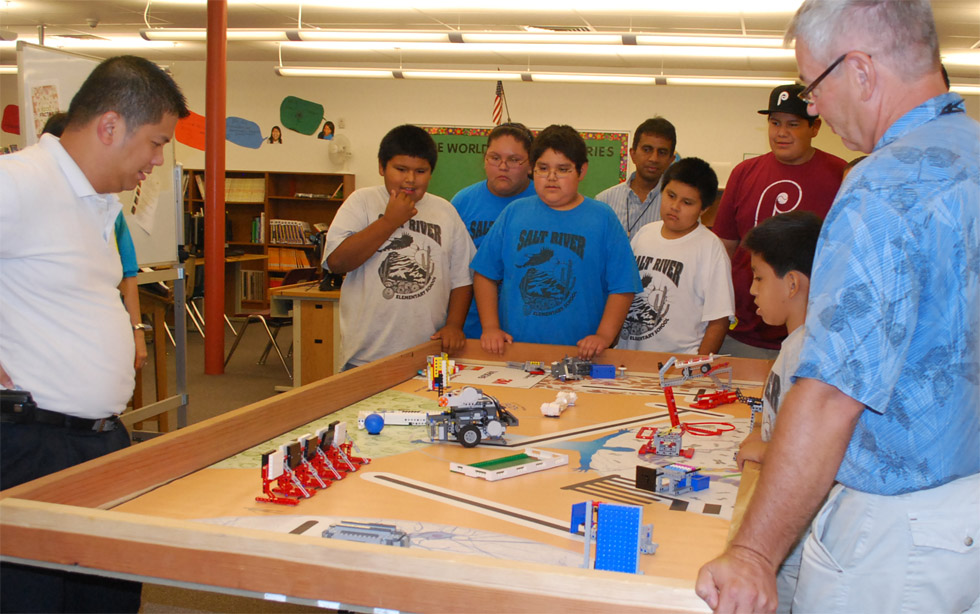
Today, we kicked off the first meeting of the Robotics Club at Salt River Elementary School. I’m honored to be working with Dr. Bill Johnson, who could probably build one of these amazing bots (to call it a toy is an insult!) in the dark, with one arm tied behind his back.
For all those who despair about kids today being more taken up by computer games than reading and writing, I have news for you.
 Last year’s school team, ‘The Titans,’ (students between the ages of 9 and 11) researched the basic conditions and consequence of diabetes, then proceeded to build a robot using mathematical calculations to send it off on a ‘mission’ to solve the problem. They were so good at it and their mission was so well thought out, that they went on to represent the school at the world championships in St. Louis, Missouri.
Care to know more about this? Check out this story. ASU also featured it here.
Today, we showed parents what humans could do to robots. I talked of the several robots we have taken for granted. Yes, you may have heard of HAL and Roomba.

But not many people have heard of Jason (doing oceanographic studies) DaVinci (performing robotic heart surgery, left), Predator (the drone, of course), Hobo (the fearless robots that disarms explosives), Dante II (the 990 pound, eight-legged robot built to monitor volcanoes), Kurt (the sewer inspector in Germany).
But more importantly than what humans do to robots is what robots do to humans -the interdisciplinary field of robotics helps us step outside our boundaries, and rethink what seemed impossible.
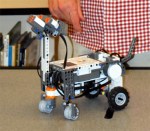 Here’s one of the smart robots that Dr. Johnson has created. It responds to sound and touch. But, as he notes, that’s only scratching the surface of what these kids are capable of doing.
 But yes, we are running into mixed signals.

 Hoipolloireport