When Robotics is more science than fiction

A few weeks back I took my Robotics team to see one of the coolest robots. It has ‘eyes’ and a brain, and it knows enough to get itself out of trouble, even when its handlers are not in the next room —let’s say 34 million miles away! This was the Mars Rover, at the  Mars Space Facility at Arizona State University.

The purpose of the visit was to get students to start thinking of technology as something much bigger than the gadgets they tend to get exposed to. To many 4th and 5th graders a computer is a box with a screen. A remote control is a piece of plastic with buttons.  And a robot tends to be thought of as an anthropomorphic device that takes orders.

Is our education system to blame?

Perhaps our society has to face up to the bigger challenges facing young people today. Challenges that may not be solved just because these kids become savvy using an iPhone app. Or being able to define the Pythogorean theorem.

Apart form a tour of the Rover, the students got to meet the NASA robotics team who demonstrated the simple-looking but complicated bots they are working on, using PVC pipes, , scrap metal, Styrofoam, and wire. Twenty years from now one of these could be making the big step to solve unsolvable water, energy or safety issues back here on earth. I think my students walked away from there realizing that robotics is more science than science fiction.

They took notes! They asked a lot of questions!

One of them, a budding designer, is making very complex sketches of his ideal robot.  Someday all children will…

I will leave that sentence unfinished –for now.

But as adults, there’s work to be done. Recently President Obama addressed students at the Carnegie Mellon’s National Robotics Engineering Center. He was imploring students to think like the future inventors and  entrepreneurs. This country is sorely lacking them.

“Now, imagine if America was first to develop and mass-produce a new treatment that kills cancer cells but leaves healthy ones untouched …or flexible display soldiers …or a car that drives itself. Imagine how many workers and businesses and consumers would prosper from those breakthroughs.”

Those things aren’t science fiction, he noted. It is the “kind of adventurous, pioneering spirit that we need right now.”

My class of 14 students is relatively small. We do not have the funds of a Carnegie Mellon. But we have big ideas. Wide-open eyes. Some of them are already programming the Lego NXT brick to perform some neat manoeuvres.

Stick them in front of the TV –if you hate them

Whenever I bring up this topic it turns unpopular, for obvious reasons.

It is unpopular to say this, not just as a communicator, but as a parent. Adults have gotten so used to using television as a baby sitter –and as a back seat pacifier in the SUV — that it offends them to hear the contra view. So here are two recent reports that makes you realize that there are better ways to engage our kids.

I had brought this topic up (“TV plus children equals brain damage“) in 2005 on this blog, and it still gets a lot of hits. Now I know why. It’s an evergreen topic, simply because there will always be dissenters who think a screen could do no harm.

There has to be a downside of where we are headed. Think about this one fact: The Kaiser Family report found that young people have increased the amount of time they spend consuming media by one hour and 17 minutes daily –up from 6:21 to 7:38.  That is almost the amount of time most adults spend at work each day! TIME magazine did a cover story on this in 2006. A lot has changed since then, obviously.

If you are too busy multitasking to read the report, here’s the podcast!

Messing around in class

Where is the classroom headed?

Having spent the past 20 some years around practitioners of the Montessori method (my wife runs a school) it has been interesting to observe how the ‘revolutionary’ advances in education today borrow heavily from the principles established by Maria Montessori.

So when I approached the topic for a long feature on how progressive educational institutions are planning to better engage students, I had this at the back of my mind. Moves to increase student engagement, and attempts to nudge the ‘sage off the stage,’ and student directed teaching appear to fit well with how Maria Montessori envisioned education. It’s also why some colleges and schools are quietly incorporating social media.

According to a 2010 survey from the Educause Center for Applied Research, 40 percent of undergraduates report updating wikis, and 25 percent use social bookmarking.

The article, titled “Messing around in class”  was published in Communication World magazine. I am truly grateful to three people I interviewed.

You can find a PDF of the article here. http://bit.ly/AFedu1

Marketing through Robotics and Facebook

This caught my eye this week. A smart move by the promoters behind Ariel, who found a way to get people to play a game of shooting stains (jam, ketchup, chocolate) at items of clothing. The trick was to use Facebook as the interface, and an industrial robot to do the dirty deed.

The other smart move was using a public space such as a train station (Stockholm Central Station) to carry out this live ‘experiment.’

Tablets, digital media coming to a school near you

I have been covering the intersection of technology and education recently, and have interviewed some amazing people at the forefront of the changing classroom.

One of them was Hans Aagard, senior technologist at Purdue University, Indiana. I was intrigued by that university’s approach –plunging in with a social networking application called Hot Seat. It is being used not just on campus, but in the classroom, while the lecture is in progress.

But yes, we are running into mixed signals.

  • While some teachers get their students to create content for topics that have been poorly covered or badly written in Wikipedia, many schools ban on students using Wikipedia.
  • A 2010 survey found that 62.7 percent of US undergraduates surveyed say they owned an Internet-capable handheld device, but many universities have signs posted outside lecture halls about turning off cell phones and electronic devices.
  • Faculty worry that too many screens in class could be distracting to the student and to others, while some high schools have made tablets and laptops integral to the learning experience.

More on this soon. My article was just published in a Sept-Oct issue of Communication World magazine.

So it was a pleasant surprise to see the subject “What Will School Look Like in 10 Years?” taken up in the New York Times  last week. I was particularly interested in the comment by David Silvernail, dir. at the Center for Education Policy, Applied Research and Education. He would rather schools invest in small amounts of technology …to teach students process skills, not just plunking shiny objects in their backpack and expecting them to automatically become smarter. Is he swimming upstream?

I have to admit I have mixed feelings on this.

I teach a robotics class in elementary school. For the past few classes I have been driving  home the importance of research. Finding solutions to problems they never knew existed.  I send them off to encyclopedias, dictionaries and other print material -on purpose. I could easily get them to log on to computers and search –there are more than 20 PCs in the room! But that would be too easy. I don’t want to hold up a think-outside-the-box mantra for problem solving and stick them in front of a… box!

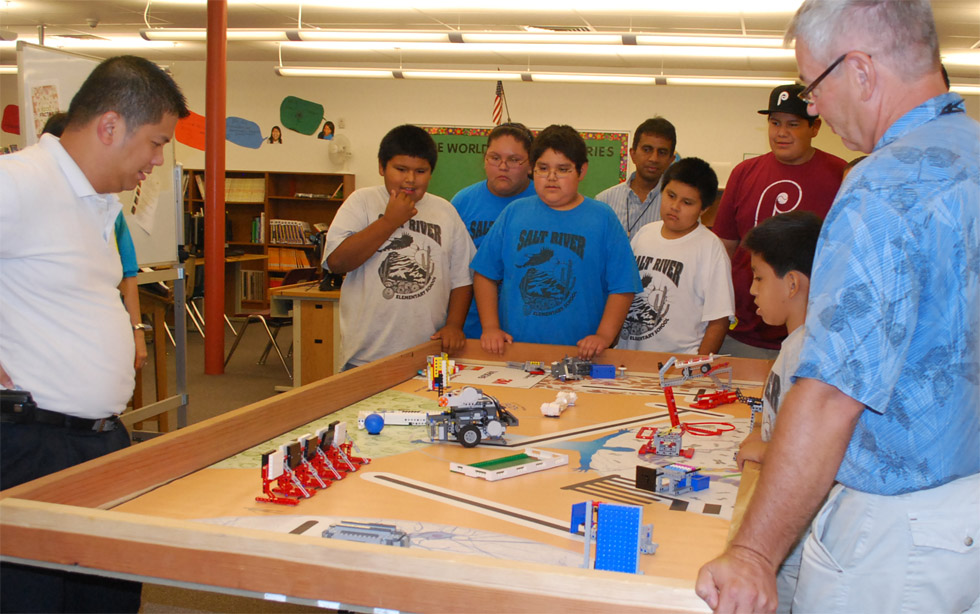
Robotics Club kicks off at Salt River Elementary

A few months ago I never thought I’d be taking on the mantle of coach of a Robotics club.

Well, that day has come!

Today, we kicked off the first meeting of the Robotics Club at Salt River Elementary School. I’m honored to be working with Dr. Bill Johnson, who could probably build one of these amazing bots (to call it a toy is an insult!) in the dark, with one arm tied behind his back.

For all those who despair about kids today being more taken up by computer games than reading and writing, I have news for you.

Salt River Elementary School, Team TitansLast year’s school team, ‘The Titans,’ (students between the ages of 9 and 11) researched the basic conditions and consequence of diabetes, then proceeded to build a robot using mathematical calculations to send it off on a ‘mission’ to solve the problem. They were so good at it and their mission was so well thought out, that they went on to represent the school at the world championships in St. Louis, Missouri.

Care to know more about this? Check out this story.  ASU also featured it here.

Today, we showed parents what humans could do to robots. I talked of the several robots we have taken for granted. Yes, you may have heard of HAL and Roomba.

But not many people have heard of Jason (doing oceanographic studies) DaVinci (performing robotic heart surgery, left), Predator (the drone, of course), Hobo (the fearless robots that disarms explosives),  Dante II (the 990 pound, eight-legged robot built to monitor volcanoes), Kurt (the sewer inspector in Germany).

But more importantly than what humans do to robots is what robots do to humans -the interdisciplinary field of robotics helps us step outside our boundaries, and rethink what seemed impossible.

Here’s one of the smart robots that Dr. Johnson has created. It responds to sound and touch. But, as he notes, that’s only scratching the surface of what these kids are capable of doing.


Dear Eric Schmidt: If I may be so impolite, our track record isn’t great, either.

Interesting to see the debate ensure, now that Google has stepped into the debate on falling education standards.

Google chairman, Eric Schmidt lectured the Brits saying “If I may be so impolite, your track record isn’t great,” noting that education in Britain was holding back the country’s chances of success in the digital media economy. His abrasive comments were made at the Edinburgh International Television Festival:

“The UK is home of so many media-related inventions. You invented photography. You invented TV. You invented computers in both concept and practice… Yet today, none of the world’s leading exponents in these fields are from the UK.”

Ouch!

But here’s the problem, Mr. Schmidt. While it might be shocking to not teach CS to students at a young age, isn’t it terribly frightening that we’re not doing enough to teach/inspire students how to read? This includes how to spend more time in a library and not in front of screens, how to look deeper and wider about a subject on ‘platforms ‘ that don’t have hyperlinks and cool info-graphics. The problem is not in the UK, but in the US!

This may sound odd coming from me, because I do promote digital literacy, integration social media into knowledge sharing etc. But I work with kids, too. I can see where we are headed. Down the cliff! I have heard people brag about how their Johnny is sooo good at computer games, and loves Angry Birds, but these same parents don’t even own a library card in the home.

It is not just low-income children who can’t/don’t read. After investing some $6 billion in such ambitions programs in the US, the nation that is producing tablets and eReaders, and the coolest reading apps, has essentially flatlined in reading scores.

Time to lecture to the home team, don’t you think, Mr. Schmidt?

Will teachers grab onto Augmented Reality?

What kind of crazy person will incorporate Augmented Reality in a classroom?

Don’t student’s already have too much of gaming and visual distraction in their lives? I hear you. But AR is a whole new system. I don’t think a teacher’s age will be a factor of adoption. I’ve met some who are willing to do anything to make text-books and charts come alive. They will be those who say ‘this is way too technical for us’ –the same ones who fear digital readers will kill libraries, or think blogs are too scary–and stick to photocopies and glue.

Unfortunately students may not agree! Many of them come to school with some digital device in their backpack. They cannot turn them on, but they sure know how to use them. Then, when they leave their analog classroom, and get back home, they become fully-engaged digital citizens. Something’s wrong with this picture!

OK, I over-simplified the problem. Classrooms are not exactly analog. We do have computers for students to use. We do have smart boards such as Blackboard and Promethean. But often, these are used to broaden and amplify what the teacher has to say, not what the student might be ready to experience.

I have covered Augmented Reality many times before, especially how it is being used in business environments. Now, as it begins making tentative steps into the classroom, we need to make sure educators understand where this is coming from, where it is headed. Many will want to understand how it might integrate with that marvelous piece of technology a.k.a the text book!

Yesterday, I interviewed Scot Jochim, from Digital Tech Frontier, a Tempe, Arizona-based company. He has some radical ideas about how AR could be embedded in educational environments to enhance ‘non-linear skill sets.’  (Stay tuned for a longer post on that interview.)

As I have moved from the digital world of business into teaching, I am exploring how schools of the future might be run.

  • Will they be something like the twilight zone scenario portrayed by Ira Glass in a recent episode of This American Life, which featured Brooklyn Free School?
  • Or will it be there be social media-enhanced curricula, such as the school profiled in The New York Times, where a teacher in Sioux Rapids, Iowa uses a Twitter-like feature in a literature class?
In an upcoming story, ‘Messing Around In Class,’ I featured how Higher Ed is moving in this direction, away from the ‘Sage on the Stage’ model to more interactive, collaborative classrooms. Truly inspiring work at Purdue, Scottsdale Community College, and Singapore Management University.

Farewell To Always-On!

Noise. We hear a lot of it. Sometimes in the form of amplified sound. Other times in a lot of useless chatter.

In the past few weeks, since I gave up my Blackberry and YES, downgraded to a regular phone, I’ve rediscovered what it means to face a day minus the noise that streams into our lives.

But there is another type of noise that’s ramping up as the US election season moves into gear. The noise of politicians trying to get  all ears tuned to their agenda.

This image tells us something about how the hoi polloi could sometimes wrestle control and ask the noise-makers to listen, for a change.

What’s the context here? The lady, supposedly, someone named Virginia Vollmer, used the bullhorn (at a rally in Tennessee)  to ‘talk back’ to the anti-healthcare reform person on the right.

There are many means to change the ‘signal-to-noise’ ratio, which refers to how much of the original signal has been drowned or corrupted by the noise.  Sometimes it means turning out the stuff you don’t need to hear or watch. At other times –and I’m not saying this is for everyone –it might mean getting rid of the amplification devices entirely.

In a great post by Josip Petrusa, he notes that we have all become willing accomplices in this noise-making, in the senseless amplification of the good, the bad and the useless information.

The resulting impact of this has glorified, popularized and hyped events, actions and individuals that were ordinary, everyday and commonplace pre-social media into something beyond wild expectations and possibility. I

…Social media itself has fallen victim and benefactor to the cruelty and kindness of this effect. 

For me, suddenly there’s a lot more time for reading, for conversations across a table or in a parking lot.  After many years of being always-on, it’s refreshing to be able to sometimes-on, and focus on what I really care about, at my own pace.

Teachers should be “more than talking heads”

You may have heard of Nolan Bushnell. No?

He founded Atari, and is perhaps one of the fathers of the video game industry. (He was named by  Newsweek as one of the  “50 Men Who Changed America.”)

He makes a point about education that is true for communicators: that the learning environment is toast, and we are competing for the minds and hearts of an audience that has moved far beyond what our established systems can cope with.

I just got done with an article for publication on why the marriage between newsletter publishers and readers is on the rocks. While researching this topic I came across a common thread between education and business communication. We are trying to pry open the new cannister (attention) with an old set of tools.

The competition for the  minds of kids is not sufficient. We have to have more than talking heads, says Bushnell. (He recommends abolishing classrooms!). The one-to-many distribution of information is fraught with problems.

  • Pace is one of those problems
  • Class size is the other.

These are connected. Altering the pace means altering the class size, he says.

I’ve conducted many webinars and workshops. Virtual and face-to-face. I can see from where he comes. The moment I become the talking head in front of a cool PowerPoint template, I lose the audience. Sure I have their attention, but I lose the connection — between my brain and theirs.

Watch Bushnell’s presentation, and even if you have issues with video games, try to see the meta discussion here. I have problems with the lure of instant gratification and the goals of education. But new media is not something we can keep locked up in a dark room. The academic response to Wikipedia has moved quite a bit from horror to skepticism to adoption. I have seen how teachers have inspired students to create a literary project using a Wiki. Social learning is here –another topic worth exploring –whether we like it or not.

But if I put this aside, I could glean some great ideas from some of what he says here.

Thanks to my friend Manoj Fernando for pointing me to Bushnell