Smarter than Google? The hunt for a ‘research’ engine

In my attempt to differentiate between Search and Research (a topic that I return to around this time in the semester) I found a current event with a point of focus: ‘Chasing an asteroid!’

As luck would have it, NASA just launched a mission, Osiris Rex, that is basically a space explorer that will be chasing an asteroid for two years, before it grabs a piece of it and hustles back to earth. Students love events like this, and quickly dig deep into finding information around it.
omnityAnd as luck would also have it, there’s a new Search engine called Omnity that promises to do better, providing ‘constellations of meaning.’ Smarter than Google, even! I wish it was true, and plan to find out shortly.

Sometimes ‘research’ involves going down that rabbit hole and unearthing nuggets of information that seldom shows up on a simple search query. Students will find out that although the mission will take 7 years the return trip will take longer than getting there. Why? What determines the timeline? Google sometimes lulls us into being content with unspectacular answers. It makes us unwilling to do probe deeper.


After all, it’s not enough to teach today’s students how to use Google and Bing, or even Wolfram Alpha, but emerging tools, as we go chasing after asteroids in class.

In the age of Shodan, cars aren’t the only targets in the Internet of Things

IOT of the Internet of Things may sound like an overblown idea. But it’s becoming a reality, despite the buzz phrase. Consider the millions of controllers in homes that are connected to common appliances such as baby monitors, security cameras, garage doors etc.

I brought this up in a class on Internet Safety, and it’s fun getting students to brainstorm what steps one could take to play it safe when you are connected to the Internet. It opens to door to discussions broader than not clicking on links and pop-ups, or using hard-to-crack passwords. There are software fixes, and there is common sense. Consider how FBI director, says he placed a piece of tape over his laptop camera, to prevent someone hacking into it.

Not many have heard about Shodan. It’s considered a search engine for connected devices – such ‘things’ devices connected to Linksys, Netgear, or Cisco boxes.

This true-life hack of a Jeep is a good way to discuss what ‘things’ might entail in the Internet of Things.

Should schools go completely digital?

Odd question. Perhaps a few years too late, but…

Would you want your children to be in a school that’s all digital? Let me paint a few scenarios.

  • Should teachers stop using handouts and publish lessons to be read, watched or listed to on digital devices?
  • Should schools have a BYOD (Bring Your Own Device) policy?

There is no shortage of  wonderful, free technologies that stimulate collaboration, and empathy. I have even used some of them in my classes! However, I also know that young people are perfectly capable of learning, creativity, discourse and group work without the help of a shiny object. We hear that ‘Digital Natives’ are wired for learning differently. But are they?

And then there’s the brain development side.

  • There are also the unintended consequences of too much screen time, warns Dr. Aric Sigman. He warns of “permanent damage to (children’s) still-developing brains”. Dr. Sigman is an associate fellow of the British Psychological Society. Read this piece published in April this year by Psychology TodayThis Is What Screen Time Really Does to Kids’ Brains.

A new book about digital natives, Screenwise, calls for more mentoring not monitoring. But we tend to assume too much about digital natives. I like the point made by Jessica Laura (in a blog post at CommonSense.Org) that calls for ongoing, explicit training of digital literacy – and not just ‘screens.’ She says:

People say, “The child’s a digital native,” but that has nothing to do with whether or not they know how to use technology well; that just means they’ve grown up with it. Just because I grew up speaking English doesn’t know I mean everything about English; we still go to English class for 13 years of our lives. 

Digital Citizenship and digital literacy is a fast-updating field. What people in their forties and fifties ‘know’ about digital is probably ancient wisdom. It may not happen in the next school year, but here’s a question for parents and teachers: What would you do if your school goes digital?

My wife runs a school that will probably never go digital. For good reason – it is a Montessori school, a place where, happily, you can’t replace such tools as sandpaper letters, sound boxes and pink towers. But before we know it, toddlers may be needing to know a thing or too about what it means to be a digital citizen – when they get home to their parents’ smart devices!

Is ‘word-processing’ a misnomer? Or old-school?

Sometimes I wish we could delete update the term ‘word-processing’ from our vocabulary. It has been ingrained in taken up permanent residence in the cortex of our brains, and needs to be dispatched to the storage unit reserved for vintage-tech such as ‘typewriting’ and ‘facsimile.’

It’s not that we don’t ‘process‘ words anymore. It’s just that we use the software to more than highlight, punctuate, or cut-and-paste. Food processors continue to grind and chop things for us, but word processors? We can use them to embedded videos in docs, or create blog posts for heaven’s sake! As far as words go, we could use Word to translate content into, say Hungarian (‘Word processing’ turns out to be Szövegszerkesztés in Hungarian.)

In my computer class at Salt River Elementary, since keyboarding and document creation are often the starting blocks, I try to inject concepts that refer to creativity and publishing in addition to content creation, when dealing with Microsoft Word.

But what else to call it? Any suggestions? 

‘Word,’ which is still listed as ‘document and word processing software’ started out as ‘Multi-Tool Word’ in the same year that Flashdance, and Never Say Never Again was released – in 1983! Today there are many more choices – niche software such as Nitro Pro, and for authors, there’s Scrivener.

So is Word-processing just old-school?

Robotics 2016 challenge guessing game begins

Each year, as we wait for details of the FLL Robotics challenge, some teams begin speculating what the specific challenges might be on the tournament table.

FLL had announced the theme, ANIMAL ALLIES. If we were to look into the crystal ball, there could be ‘missions’ around animal rescues, conservation and human-animal bonding.

Previous themes have been: Conservation, Education, Health, Ageing populations, Food, and Catastrophic Events.

Animals will certainly fire up elementary school students, especially in the research project. As for the missions, here is how one team speculates what the table-top missions could be, with detailed builds!

AS the FLL puts it, ANIMAL ALLIES season will be all about young people collaborating to solve a real-world problems. That’s the part I like about the FLL. It creates a rich, evolving context for students who could see bots as part of society they inherit and –most importantly, will influence.

A Lesson from the conflicting ‘birthdays’ of the World Wide Web!

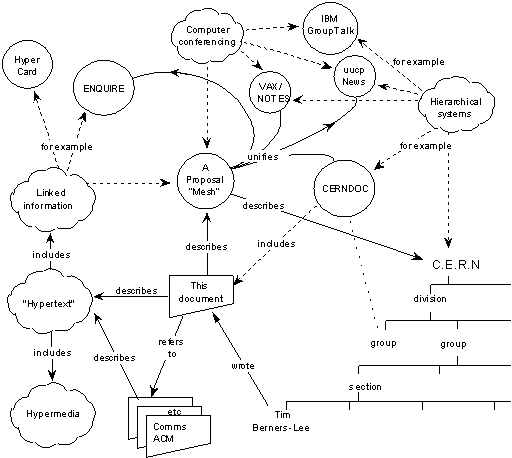
Yesterday, (August 23rd) was one of the birthdays of the Web. At least it is the day when non geeks got access to the ‘global hyperlinked information system’ that Tim Berners-Lee designed.

I began using this 25th Anniversary milestone this week in classes that introduce students to how to find and discern information on the wild and woolly Web.

When I posed this question to my 4th grade students: “What is the Internet? And where could you find out about it?” one of them responded without missing a beat, “On the Internet!”

“But,” I responded, “What if the Internet was wrong about the Internet? How would you know?”

Note I said today was one of the birthdays of the Web. Oddly, while media outlets, including the likes of Huff Post, ran features, claiming Aug 23rd as the date

So if the real birthday August 23rd, August 6th, or March 12th? Should we go to the ‘Mesh‘ to find out? Are our trusted sources wrong? Now there’s a lesson for my students far greater than helping them ‘research’ a few factoids.

Online textbooks could be fun (or completely annoying)

You’d think I would applaud the trend to digitize textbooks. After all, I’ve winced at the sticker shock of trying to busy a book for a college level class.

But the other day my daughter explained how ‘lame’ it was to have to jump through multiple hoops online just to get to a few pages she had to read for a class. The time spent would have been better spent elsewhere, she said. I had to agree. Sometimes to make things more ‘convenient’ and deliver them in a digital skin, we hide them in confounding folders, hidden behind firewalls that even the Russians my have trouble getting to.

The goal of reading is help students discover ideas and find meaning. Not to be able to check a box on a progress report. Books made from pulp have been a ‘technology’ many want to disrupt. The Nook and the Kindle made a few inroads, but could go only so far. We humans still crave the feel of paper, the tactile experience derived from objects that convey meaning.

I just ordered a book on Amazon. Indeed I read the reviews in the digital realm, but did not buy the Kindle version. Don’t get me wrong. I love reading material on the Kindle app. Just not books anymore.

If you like to read more about The Reading Brain, there’s an excellent Scientific American article which explains how paper sometimes triggers brain circuitry in a way that screens cannot.

What’s next in Ed-Tech? Wrong question!

Buzzwords and the next big thing are hard to escape. They sidle up to us when we are not watching. I get my share of these, especially in education. (Truth be told, I could not escape it even in marketing, or advertising).

So I get asked sometimes what I see as the next big thing to hit us in teaching. It’s easy to rattle off some tools, because they are touted as some form of  ‘student engagement.’ I have this feeling that Ed-Tech is going to be as passe as Social Media. Meaning we should stop talking about it as if it was some self-contained phenomenon or enigma that needs to be deciphered.

I’m not alone in having this sentiment. I’m sure many teachers are thinking the same. Andrew Marcinek has written a sensible piece about this in Medium. He goes so far as to say (“The End of Ed-Tech”) that

It is no longer necessary to say whether you consider yourself “tech savvy” or not. Essentially, “tech savviness” should be an inherent part of an educator’s educational philosophy because it will be an essential part of every student’s future. This is to say, educators should understand how active use of technology hardware and software should be led by the learning objectives and outcomes as opposed to being front and center in any classroom.

Like it or not almost anything we don’t yet consider ‘technology’ or a ‘tool’ will become so embedded in what we do that we won’t need to have a class on how to use it. I don’t think there was ever a PD session on how to use the electric pencil sharpener, or the two-button mouse.

So the next big thing in Ed-Tech will be ‘Nothing Much.’ To look out for it, is to look ponder about the wrong question.

What’s a humanoid robot doing in a STEM class?

Intrigued by robots that look less like appliances and more like humans?  Even I sometimes get a bit creeped out.

But this little guy, NAO, changed my perspective. It is a learning tool, no different from any other bot, such as a spherical bot, a drone, or an Lego NXT brick. It’s got a friendlier interface, too.

I met the company that showcased it, RobotLAB, and this week spoke to their team members about how it can help students learn programming. It’s possible to even incorporate it into some aspects of a STEAM program.

ISTE 2016 Denver (17)I found out that some schools in the San Francisco Bay area are using this NAO to support reading and writing modules. As you might imagine, the program – a software and hardware package- is a bit pricey. But they are big on year-round support for teachers. Meaning it’s not like buying some hardware and being left to figure things out, or fix something that breaks.

Fours years ago, I spoke to someone who worked on the first humanized a robot to be sent up to the International Space Station. It was clear even then that such a humanoid  ‘device’ (which could be folded into a suitcase!) was designed to work alongside a real engineer or scientist –rather than make humans redundant.