Analog-is-dead talk ignores hybrid experience

Forget the analog is dead predictions about books and newspapers. There’s a new one being resurrected, about the death of the computer mouse. Yes, indeed, touchpads have eroded the usage of mice. Pen devices and laser mice have emerged, too. But I don’t believe the mouse will “die” anytime soon, just as much as I don’t believe that analog and digital will be an either/or option. (I say this having written two letters on real paper yesterday, in addition to sending of some outstanding emails.)

It’s not just the digital versus the analog options we need to consider, but the hybrid form that might emerge. The Amazon Kindle may not replace my book – yet-  but someday something like this eTouchBook application could make its way into my life. What’s the eTouchBook? It basically in the lab stage, where a book could be printed in a way that certain elements on the page could bridge into a digital environment. Imagine being able to move from a magazine article to an online video on your mobile device, or being able to “save” a short story you just read in an airport lounge as a text-to-speech podcast? I could visualize a time when we would enhance, not kill off our analog devices.

FREE IDEA: And here’s a mouse-based throwaway idea. Rather than bury my cordless computer mouse, I would be in the market for someone who could turn it into an MP3 player that downloads content direct to it. That way, when I shut down my laptop, I can still carry my reading material and listen to it offline.

Quotes for the week ending 29 November, 2008

“The impending total collapse of the dollar will render the true value of the average savings account or investment portfolio roughly equal to a bucket of warm piss.”

Thomas J. Wurtz, CFO of Wachovia, quoted in a press release about a new, daring billboard ad campaign

“If wearing your baby hurts your back or neck, you need positioning help, not Motrin”

Josh Bernoff, on the huge headache –um, backlash–Johnson & Johnson got on account of the ad about ‘wearing your baby’ in a sling.”

“Let’s face it: your beautifully lit, ideally scouted, model-perfect spot is likely going to be consumed in a 320×240 window. In that environment, Martin Scorsese would have a difficult time distinguishing between something shot on a Panavision Genesis versus a $150 Flip.”

Lewis Rothkopf, on the need to leverage broadband to narrowcast and target messaging in the way broadcasting has never done.

“Cheer up, it could be worse: it could be flu we’re facing and not merely a once in a 100 year meltdown in the financial system.”

Comment about a six-part drama, Survivors, on BBC1 where the story involves 90% of the population being wiped out in a flu pandemic.

“You get 14-year-old boys yelling out `I love you!’ because they learn these English expressions and try to use them.”

Kathleen Hampton, a teacher, using Skype to teach English to students in Korea in a reverse-outsourcing business from a town in Wyoming with a population of just 350.

“It’s not that we now have a president who’s black. It’s that for the first time we have a president who’s actually green.”

Oakland, Ca-based green-collar evangelist, Van Jones at GreenBuild conference this week.

“It’s a terrorist strike. Not entertainment. So tweeters, please be responsible with your tweets.”

A Twitter messge from Mumbai from primaveron@mumbai as the awful terrorist attack on the city broke out. Bloggers and the media took to new media to report the standoff and rescue operation

Quotes for the week ending 22 Nov, 2008

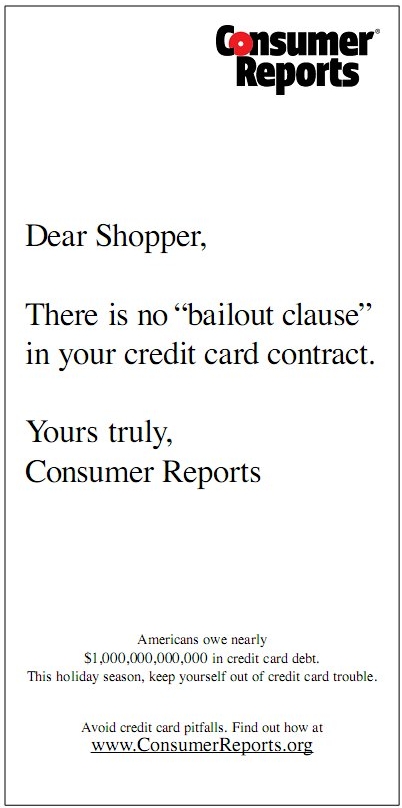
“There is no ‘bailout clause’ in your credit card contract. Yours truly, Consumer Reports.”

An ad appearing for Consumer Reports

“The greatest influencer is family and friends. The internet is second. Motor shows are third.”

Nigel Harris, the VP of Ford Motor Co. in China, on the automaker’s marketing strategy in the number 2 car market in the world.

“It’s almost like seeing the guy show up at the soup kitchen in a high hat and tuxedo.”

House Representative Gary Ackerman at the hearing of the House Financial Services Committee, commenting on the news that the Ford, Chrysler and GM top executives came to Washington in private jets, just to ask for a bailout.

“Lively no more.”

Message at virtual world site, Lively, (a Google attempt at Second Life) announcing that it was pulling the plug on the experiment.

“Have you ever wanted to mark up Google search results? … Starting today you can”

Google announcement of a more dynamic search application where users could customize and even delete the results to fit their needs.

“Frankly, Obama could appoint his dear mother-in-law as secretary of state, and if he let the world know she was his envoy, she would be more effective than any ex-ambassador who had no relationship with the president.”

Thomas Friedman on the ‘star quality’ appointment of Senator Hillary Clinton as Secretary of State.

“We are attempting a 180 degree shift in perspective: seeking an algorithm first, problems second. We are investigating core micro- and macro-circuits of the brain.”

Professor Dhamendra Mohda, a IBM scientist working on a $4.9 million grant from DARPA to replicate neural networks in computers that may be eventially applied to data analysis, decision making or even image recognition.

“Virgin launches Wi-Fi in the sky”

News that Virgin Atlantic will begin the first Wi-Fi service on ovember 24th called GoGo, with a live 30-minute inflight recording to YouTube by 30 Rock‘s Keith Powell.

“You can experience public diplomacy in real-time as Deputy Assistant Secretary of State for Public Diplomacy, Colleen Graffy, travels to Bucharest and twitters along the way.”

News at DipNote on another social media initiative adopted at the highest levels of public diplomacy in the US.

Industrial design could send a message

How could a building or  structural feature send a stronger message about what you stand for than other design elements –web site, brochures, annual reports– you put out on a regular basis?

Not everyone could build a spectacular ‘shrine’ like Apple has, in Manhattan.

At ASU, the Global Institute of Sustainability takes a more pragmatic approach, with wind turbines on the roof generating power, even while solar panels are being installed in other parts of the campuses so as to take care of 20 percent of the total energy.

And speaking of wind power, this story out of London, of designers creating a column of light using wind power is more than a fancy energy project. It demos the capacity of creativity that could be unleashed within the urban planing when you let energy send a message.

jason-brugesIn this ‘tower of power’ as it is being called, there are 120 LED’s being powered by a “gentle” wind. Nothing fancy in the set up. A laptop is the only piece of technology behind it, apart from these 1,200 tiny fans. The designer, Jason Bruges Studio, calls it a wind-light.

Maybe someday outdoor signs will be lit this way.

So that, beyond growing lettuce (watch this video!) on the vertical face of a billboard, as McDonald’s did in this very daring/cool design, existing structures could send a passive message, with some “gentle” asistance from the sun, water and wind.

Cronkite Week starts today!

The journalism school at Arizona State University celebrates 50 years this month.

A whole range of events, here. Topics cover Free Press in the Digital Age, A First Amendment Forum, TV Journalism, Business Journalism etc.

This month, the Cronkite school will also award Jim Lehrer and Robert MacNeil, the PBS news anchors, the prestigious 2008 Cronkite Award. Past winners have included Tom Brokaw, Hane Pauley and Helen Thomas

Powerful feedback loops, and why should you care

The challenge of facing the media cannot be solved by studying our talking points, and coming up with zingers. As the media morphs into a real-time machine with a Google-enhanced memory, there are forces to be aware of.

Dan Gillmor, who now heads the Knight Center for Digital Media Entrepreneurship at Arizona State University, recounts an incident that took place in 2002 that is even more relevant today. He was reporting in near real time via his blog about a panel discussion where then Qwest CEO Joe Naccio “whined” about the difficulty of raising capital.

The conference was in Arizona, but within minutes of his posting the story, someone in Florida emailed him a link to a story about Naccio cashing $200 in stock even as his company stock prices dropped. Gillmor posted that link in his next post, and almost instantly, the audience began to turn hostile against Naccio.

The feedback loop had unexpectedly given the audience –not the audience Gillmor thought he was writing for, but which happened to be sitting sight next to him– a new perspective. That audience-with-an-audience was also something the speaker never thought he would be facing.

Why should you care as a communicator or marketer?

  • The audience tends to be smarter than you think. Its demographics and psychographics can shift radically, even though no one may have left the room.
  • The back-channel is always at work. In grade school it was a piece of paper that was surreptitiously circulated among the class oblivious to the teacher. Today all it takes is a tweet, an IM, a text message…
  • Creating and encouraging feedback loops tip you off to something you may have never seen coming. People will come up with amazing ideas, if they are asked.
  • Your customers/audience could come to your rescue. Before his last podcast, Mitch Joel put out a tweet saying he had a bad cold and was ‘crowdsourcing’ his next show. The response was amazing! The audience practically ran the show.

“Martin Eisenstadt doesn’t exist” and what passes for news

News is under attack from many sides. There are digital missiles, financial grenades, dwindling readership and viewership, and the there’s the credibility factor.

So a story like this of a fabricated, unverified “source” brings up serious issues. Says The New York Times, peeling back the curtain:

“Trouble is, Martin Eisenstadt doesn’t exist. His blog does, but it’s a put-on. The think tank where he is a senior fellow — the Harding Institute for Freedom and Democracy — is just a Web site. The TV clips of him on YouTube are fakes.”

Which is to say, not just old media but new media and hybrid media tend to get taken for a ride very easily.

OK, so this was just a prank –a film maker trying to make a name, no different from say, Lonely Girl trying to make a career. But we have seen this script before haven’t we, and they have had serious consequences. Remember SwiftBoat, and Dan Rather’s “gate“, and Jason Blair, and … the list could go on.

Let’s face it. Trust, has been shifting from authority figures and truth verifiers to (drum roll…) “people like me.” But even we are easily influenced (duped?) by some digital presence from people like us. When we do our due diligence as communicators we tend to assume that:

  • Anyone with a web site is probably above board
  • An organization with a blog is actually quite real, if not transparent. Until it the blog is outed.
  • And anyone who uses Twitter, is transparency personified -until people like “Janet‘ show up

In a recent Harvard study, people trusted Cable news twice as much as Broadcast news. For print, credibility was nearly a quarter of Cable news. None of this is comforting. The Martin Eisenstadt story broke on Cable news first. But the scary part? Even bloggers were linking to the fake Mr. Eisenstadt!

fakenytFun Sidebar: If you think most of the news is made up, take a look at at this edition of the New York Times. From the cover story, you might gues it is a fake New York Times.

Quotes for the week ending 15 November, 2008

“We are now offering a 25% Discount on all Collectable McCain/Palin08 products left in inventory”

Fire sale notice from the McCain-Palin campaign store.

“Simply put, things are already close enough between Change.gov and the Google Gang.”

Chris Soghoian, at CNetNews, commenting on Google’s relationship to the incoming White House administration. He also recommends BitTorrent for Pres. Obam’s fireside chats.

massive employee raiding.”

Agency.com’s complaint that Scottsdale-AZ based agency, specifically Don Scales, a former Agency.com staffer, has been poaching its employees and clients.

“I go dark some weekends and evenings until 8 p.m. because my kids come first. It’s not easy, but I don’t need to be big on Digg.”

Jason Falls, Head of social media at Doe-Anderson, interviewd by Jason Baer

“Martin Eisenstadt doesn’t exist. His blog does, but it’s a put-on. The think tank where he is a senior fellow — the Harding Institute for Freedom and Democracy — is just a Web site. The TV clips of him on YouTube are fakes.”

The not so shocking news that an unnamed source for the Sarah-doesn’t-know-Africa-is-a-continent story a fabricated person, carefully set up by two film-makers. Many media outlets were duped.

“Create a video hub for the executive branch – call it GovTube – that aggregates all video content throughout the government in a searchable, user friendly video portal.”

One of the recomemndations by Dan Mannet, at TechPresident, for how the new administration could use multi-media.

Community funded journalism. If you write it will they come?

The concept of crowdsourcing and community funded media has always interested me. Maybe it is my roots. I grew up in an environment where community-based projects were quite the norm, long before people got wired.

So SpotUs, a community-funded journalism project by David Cohn (of NewsAssignment.net) is one of the trends I think we will be seeing a lot of, as news media cut corners and outsource the story to people closest to it. For now, those pitching stories to us (basically asking for donations or micro-funding) are few, and limited to the Bay area.

Like this one, by Aaron Crowe, who plans to investigate the cost and benefit of installing solar power in a home. The site has raised $315, with goal of $1,000 to get the reporter off and running.

You could argue that times are tough, and people won’t pay for something they could get (or at least think they could) for free, anyway. But I am optimistic. We may cut back on our lattes, and even newspaper subscriptions, but as soon as a news aggregator of relevant, timely, local news is able to deliver it in a way we cannot get anywhere else, the price may be right. Just you watch!