How “Research” helped Jobs and Woz

Steve Jobs wouldn’t have been the serial entrepreneur we knew him to be, if not for his partner in crime, Steve Wozniac

I make this point to my students, when teaching them the power of collaboration, something lost in our education system that, until now favored the individual over the group; the bubble test over the team project. Common Core standards, adopted by my school (Arizona is one of some 45 states adopting them) urge us to break out of that mindset, and get kids to discuss more, debate, confront, and work as a hive mind.

So I use this example of Woz, where he describes how he stumbled over a piece of fiction about the ‘Blue Box’, and showed it to Jobs. They wondered if this device were possible, but didn’t stop at that. They snuck into a library one Sunday, and looked it up in a stack of journals.

In other words, Steve and Steve were doing their ‘research.’  Something that sounds anathema to today’s kids who like to imagine search = research. That supporting ideas will always be within a few keystrokes or clicks.

I particularly like how the Apple co-founders got started not in a garage, but a library.

Ambient Awareness – A fancy way of saying TMI is good

I would love to see Clay Thompson and Nicholas Carr in a sparring match.

THOMPSON talks of Ambient awareness as if it were some rare gift that comes with augmenting (saturating?) our brains with feeds and Tweets. He calls it “the experience of knowing what’s going on in the lives of other people — what they’re thinking about, what they’re doing, what they’re looking at — by paying attention to the small stray status messages that people are putting online.”

CARR famously said that he’s “had an uncomfortable sense that someone, or something, has been tinkering with my brain, remapping the neural circuitry, reprogramming the memory.”

Who’s side would you be on?

I’ve got a vested interest in both sides. I teach students to use technology and computers in a way that does not necessarily outsource their thinking and memory and ideas to some machine. I also try consider extending the boundaries of knowledge, using available (aggregation, collaboration, inquiry) tools.

I’m a big fan of the Shallows. I also use the Kasparov Vs Deep Blue example now and then when discussing robotics and getting people to stop thinking in terms of a “man vs machine” debate. Thompson uses ane example —you could see it here in an excerpt— of how collaborating with the ‘machine’ rather than competing with it changed the game –for Kasparov at least.

He may have a good point.

Miley’s back-to-school lesson

In 2008, I sort of ranted about this Cyrus virus –being the dad of a child in her target group. This ‘performer’ looked like she certainly needed help, at least from a PR standpoint, if not from that of music.
 
Then there was her big move into the grownup world at the MTV VMA. Her attempt to explain it was as vacuous as the performance itself.
 
I was glad someone called it for what it is: a stunt with no depth. Camille Paglia (for TIME) looked into that space that many have tried to occupy, post-Dietrich, post-Presley, and came up with a perfect summary:
 
“Miley, go back to school!”
 
PR school, too. 
 

How do you prevent employees from reading a story? Use some nice gobbledygook

You can’t make up stories like this.

The Department of Homeland Security has sent a memo to employees that they may be violating their non-disclosure agreement if they click on a link to a Washington Post article.

It’s obviously a tricky legal thing. Employees are being asked not to use their work computers (referred to as “unclassified government workstations”) since doing so will “raise the level of your unclassified workstation to the classification of the slide…” Doing so, they warn, will cause “data spillage.” It’s also sensitive, being connected to the Edward Snowden affair.

That classified slide, featured in the Post, is about the program known as PRISM, that secretly collected downstream data about people from companies such as  Facebook, Skype, Google, Apple, Microsoft etc.

But the question remains: If DHS really fears such “spillage” why did it not block access to the site from work computers, rather than send out that lame memo? It’s as useful as telling 12-year old students “do not turn to page 296 of your reader; by doing so you will be in violation of the school’s policy.”

I find this very topical for another reason. I just interviewed a company called Safetica, about a product it  markets as ‘productivity’ solution – to monitor employees’ online behavior. It will not snoop into people’s content, it says, but collect data about the paces people visit and how much time they spend there. It gets more interesting: this data, can be viewed by both supervisors and employees!

Maybe Safetica ought to send DHS one month free trail of its data leak prevention software!

Vote For iReporter, Gerard Braud

I’ve met Gerard Braud, when I sat in a workshop he conducted some years back. He’s a reporter’s reporter, who knows the ins and outs of working ina  newsroom.

Gerard has been nominated for a CNN iReport award, and I highly recommend him. If you feel inclined, watch this video of his short, succing iReport on Hurricane Isaac. Then, please take a few seconds to cast a vote for him.

Hurricane Isaac iReport – Gerard Braud

Always on, always live

We use the word ‘always-on’ so flippantly these days, we often have no idea what it means.

We use it to suggest being tethered (“my phone is always with me”), or that we are contactable through many devices and points of contact (“find me at these various places…”).

Being Always-On means other things to organizations. They are on people’s radar, will be talked about, tweeted, linked to, photographed etc. Every interaction is an ‘on’ switch that’s permanently green.

To that point about photography, you may have come across the silly move by United to offload a passenger travelling from Newark to Istanbul, for taking photos of the digital panel on the seat in front of him. Read the story here.

Indeed, United had a passenger policy about cameras. (Just the mention of United and ‘policy’ immediately brought to my mind another kerfuffle involving guitars!). But how they exercised that policy and communicated it was just unfortunate.

I’ve travelled with a camera and taken numerous pictures inflight, as I am sure you have. Some of those pictures have been used on this blog. As a writer I use photos to record an idea or an object that I would refer to later, even if I don’t publish it. With so many billions of camera-equipped phones in circulation, it’s lame to even have a no-photograph policy –except in security-related situations.

The whole point is, we inhabit this always-on space on the ground, in the air, under the ocean and even in our work environments. (Heck, I have two installed cameras in my room, plus an SLR that I whip out ever so often; my students know that they may be on camera anytime!)

With that in mind, you may want to listen to one of my favorite podcasters, CC Chapman and his take on the United fiasco: The Always On Society.

Note: CC Chapman is one of the podcasters I interviewed for my upcoming book, Chat Republic. The book will be out in May 2013.

Update on my book: “Chat Republic”

It’s official, and I’m now ready to announce the title of my book, which is in its final stages.

It’s called Chat Republic.

Angelo Fernando, Chat RepublicI’ve been covering the intersection of technology and business; technology and culture for more than 18 years. More recently, I’ve focused on digital media and our social media-centric lives, and I wanted to put my ideas into perspective.

Chat Republic is more than a fictional country. It’s about the spaces you inhabit.  Those online and offline communities you move in and out of: conference rooms, Google Circles, IM lists, Facebook, online forums. I think of it as a ‘country’ whose fluid borders take the shape of a giant, invisible speech bubble.

The conversations and opinions pouring in and out of our republic, in real-time, are what make our communities more civil, more vibrant. Our chats are certainly not friction-free! But absent these conversations we would be one dimensional citizens, won’t we?

As of today, I am planning to launch the book in two time zones, in June.

Some specs:

  • 25 Chapters – Divided into 3 sections
  • Case Studies from the U.S. and Asia
  • Interviews with non-profits, tech companies, activists, chief execs, editors, citizen journalists, PR consultants, podcasters, government officials

More information here at ChatRepublic.net

Being Obscure, clearly. Why ‘Romnesia’ and ‘Obummer’ distort elections

They are funny, memorable, and provide plenty of water-cooler conversations.

The campaigns know it. They must have gag writers on staff to supplement their communications and marketing people. The unfortunate thing is that they work.

Not the lines, but the distraction. They provide a sidebar to the main event that eventually drowns the real issue.

When Obama, fresh from his speech in New York this week (the annual Alfred E. Smith Memorial dinner, where both Obama and Romney delivered great one-liners, a tradition of that white tie event) fired up a crowd using a coined word ‘Romnesia‘ it supposedly lit up social media. Sure, it gave the president a stick to poke at his challenger, who has been gaining ground.

But in the last few weeks to the election, it is a huge distraction from what Obama and Romney should be doing: telling voters, especially those uneasy about both candidates, what they stand for. It may have pricked the bubble about the self-created entrepreneur, but it also treats an important election as a referendum on who citizens don’t like, as opposed to what they really want. Bumper stickers are all about this. Bumper-sticker campaigning just feeds this mentality that we don’t really need to know  (or read) the candidate’s policies, so long as we keep up with the tweets, and let the one-liner define our choice.

Locally, in Phoenix, we have one of the most intellectually embarrassing senate races, by Jeff Flake and Richard Carmona. Going by their ads, I personally don’t want any of them representing me.

Like both major parties, they spend millions on tarring each other’s reputation instead of telling us why we should pay their salary. Worse, they hide behind shady organizations that pretend to represent us, who pay for these spiteful spats.

Take a guess: who might ‘Americans For Responsible Leadership’ and the ‘Committee for Justice and Fairness’ represent? They are quite opaque –by design. These political action committees (PACs) poison the waters of democracy. Why?

  • They are still stuck in the mass media mindset, imagining that he who shouts the loudest will win our vote.
  • These nattering nabobs of negativism account for 75% of negative advertisements (a tar bucket that’s worth $507,240,744.99 according to the Sunlight Foundation)
  • Their ‘message’ –a mess of pottage, really– is clear. Don’t think, just vote! Their goal is simple, as in E.B. White’s words: “be obscure, clearly”!

To think we as a country spend billions trying to introduce democracy to other parts of the world!

Context is king. Book’s web site has lesson for us

I was looking up author, David Carr, after using a quote from him in my previous post. His is a fascinating story captured in his book, The Night of the Gun.
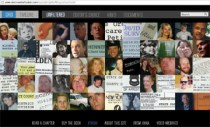
Since every book today has a companion web site, I nearly skipped it, assuming it was another content dump with blurbs and links. I was wrong!  It’s a trove of context, not content.

  • One of the tabs opens a page laid out in a grid of 60-squares. Click on each square and it takes you deeper into Carr’s story by way of candid interviews, photos, scanned documents etc.
  • Another tab has a timeline, which takes you on an online experience you couldn’t even come close to in the pages of a book.

The publisher, Simon and Schuster, notes that it created a database of content because Carr ended up with a large stack of material, recording his thoughts and interviews using many formats – video, audio, notes etc.

With help from the New York Times‘ digital guy, (a ‘User Interface Specialist!) they built a site as a multi-media backdrop, or more precisely, a back-story, to his memoir.

While it makes for a novel way to market a book, we could learn some important lessons in how to surround any other form of communication with rich, contextual information.

In the end The Night of the Gun is more than a book -a living story that cannot be contained within templates, hard covers or style sheets.

Lost in translation – when jokes go sour

With so many channels permitting us to share so much chatter, it’s alarming how people forget that what seems private could be very public. Twitter is “a village common” says David Carr, media and culture columnist for the New York Times. He considers what someone says on this channel as very public. (There is a journalistic debate on whether a tweet is actually public content.)

Humor often has a way of going wrong. If you are planning on posting a zinger remember the Aflack guy. The comedian Gilbert Gottfried, who was the voice of the duck in the Aflack commercials, made a few off color tweets soon after the tsunami in 2011. One of them was: “I just split up with my girlfriend, but like the Japanese say, “They’ll be another one floating by any minute now.” He quickly became the ex-Aflack voice.

Even a comedian ought to think before he tweets.

Speaking of humor, this joke gone wrong, involving the Dalai Lama would crack you up. Nothing offensive, but the punch line, lost in translation, just didn’t connect. Karl Stefanovic, the anchor of the Today show in Australia explains.