Is ‘word-processing’ a misnomer? Or old-school?

Sometimes I wish we could delete update the term ‘word-processing’ from our vocabulary. It has been ingrained in taken up permanent residence in the cortex of our brains, and needs to be dispatched to the storage unit reserved for vintage-tech such as ‘typewriting’ and ‘facsimile.’

It’s not that we don’t ‘process‘ words anymore. It’s just that we use the software to more than highlight, punctuate, or cut-and-paste. Food processors continue to grind and chop things for us, but word processors? We can use them to embedded videos in docs, or create blog posts for heaven’s sake! As far as words go, we could use Word to translate content into, say Hungarian (‘Word processing’ turns out to be Szövegszerkesztés in Hungarian.)

In my computer class at Salt River Elementary, since keyboarding and document creation are often the starting blocks, I try to inject concepts that refer to creativity and publishing in addition to content creation, when dealing with Microsoft Word.

But what else to call it? Any suggestions? 

‘Word,’ which is still listed as ‘document and word processing software’ started out as ‘Multi-Tool Word’ in the same year that Flashdance, and Never Say Never Again was released – in 1983! Today there are many more choices – niche software such as Nitro Pro, and for authors, there’s Scrivener.

So is Word-processing just old-school?

VoiceThread meets Ted Talks!

I wish I had heard of this earlier – Voicethread‘s answer to TedTalks. Just in time for the ISTE Conference starting Sunday.

https://voicethread.com/app/player/?threadId=7784579

It’s called ThreadTalk. Which is quite a neat play on TedTalk considering how VoiceThread is all about the Thread, more than the voice. They make the point that the quality of the conversation thread is just as important as the presentation.

In other words, it’s not about the fancy slides, but the content.

As the VoiceThread notes, we tend to stop using our voices and replace it with text communication because the Internet was not quote supportive of voice for a long time. It is now, as we know thanks to services such as Google Voice, Viber and other phone apps. But in education, we need to bring back the spoken word and student voices into the mix.

I’m waiting to see what evolves out of ThreadTalk, post ISTE2016.

Two networks our children may never know

Networks today mean something intangible. They almost always don’t involve human intervention. But there was a time when networks functioned because of people throwing switches and pulling levers.

I ran into these when visiting the old mining town of Jerome, Arizona yesterday. Take a look at two different networks, and appreciate old tech for a moment.

This model railroad, of the adjoining town of Cottonwood where we stayed in, incorporates the school, saloon, and the ‘company town’ where miners lived.  (If you are old enough to remember Johnny Cash’s song ‘Company Store,’ this is where that sentiment began. As in “St. Peter don’t you call me cause I can’t go; I sold my soul to the company store.”)

Railroad Network


This other network, telephones, were something else entirely. The switchboard ‘networked’ someone to another, thanks to an operator like this.Telephone Exchange


Little known fact: Shel Silverstein penned Dr. Hook’s “Sylvia’s Mother”

I know of many parents who have a copy of Shel Silverstein stashed away somewhere. He was a prolific writer of books such as The Giving Tree, and tomes of books of wacky, insightful poetry such as “Where the sidewalk ends.”

I was looking up the man, and discovered that one of the anthems of the early seventies, “Sylvia’s Mother” was actually a vignette from his life. he knew the original Sylvia, and if you the words of the song resonate in your brain, you’ll know he was trying to get the ‘operator’ reminding him it would cost him “40 cents more” to stay on the line.

When was the last time you had an “operator” intervene between you and the person you were calling?

Footnote: The Giving Tree has been ranked one of the top 100 books for children, beating several by Dr, Seuss, and even Lois Lowr (The Giver) and Roald Dahl’s books.

Good Apple, bad Apple: Tough call to unlock phone

Which side are you on regarding the FBI’s request that Apple unlock the phone of a killer?

I lean on the side of the agency because I would want those who protect us to have every possible lock-picking device to thwart criminal behavior. But I can see Apple’s point of not wanting to give up liberty for security, as it could tip the balance when citizens (and businesses run by citizens, never mind if they are global corporations) hand over their freedoms to the state.

Incidentally, that Ben Franklin quote, which must be resounding in your ears about how Those who would give up Liberty for safety deserve neither, is one of the best mis-quoted statements by old Ben. He actually said that “Those who would give up essential Liberty, to purchase a little temporary Safety, deserve neither Liberty nor Safety.”  (Note the qualifiers – ‘essential’ and ‘temporary.’) 

What if Apple gives up a little temporary liberty, and stop making a huge thing of this Apparently Apple has unlocked some 70 phones before, but had done it without the media baring down on it. Given that there are dozens of websites that provide back-door services, and there being ‘ethical hackers’ who could unlock phones, I’m surprised no one has offered to do it for Apple, thereby freeing them of the PR nightmare.

Perhaps the government ought to hold a hackathon and see what surfaces. After all, DARPA holds cyber-security hackathons, don’t they?

Star Wars, a gift when teaching image manipulation, animation

For the past few weeks I’ve been having a blast (and hopefully my students too), using Star Wars as material for classes on image manipulation, and color correction whether it is in Microsoft Word or Photoshop. The latter, for instance is a forthcoming 6th grade class that will be continued this year as well.

Chewey - DesireeStudents pick their favorite Star Wars image from Google, and the fun begins.

  • They learn to copy and paste (the keyboard shortcuts as well as the right-mouse commands).
  • The learn to layer an image, and color correct it – as in the example on the right
  • They learn to delete a background color using the much-ignored ‘Set transparency Color’ tool
  • They learn how to tweak the ‘saturation’ of the image, and what that means – and says. Or how to re-color an image for a specific effect.
  • It’s a good way to introduce ‘layers’ before we get to Photoshop.

Star Wars is also helps open the door to other topics and discussions about space.

Over the past few weeks, my 5th graders are working on The Moons of Mars – a PowerPoint, specifically aimed at understanding animation paths and orbits. I’m not a big fan of PowerPoint, but it’s a great canvas on which they could understand the purpose of animation, beyond the obvious wow factor.

I am now considering using Star Wars as a backdrop for a class on Digital Storytelling. Perhaps an animated cartoon strip with voice-overs matching the speech bubbles. I can see a lot of storm trooper effects, and tricks using the lovable BB8.

Start taking notes! (It’s good for your brain.)

I’ve always known that note-taking is good for you. There are plenty of stories about this, and it’s always refreshing to see research and evidence for this. Here’s Why Writing Things Out By Hand Makes You Smarter: By slowing down the process, you accelerate learning.

One theory is that introducing ‘desirable difficulties’ that challenge the user help retention. The person who introduced this idea is Robert Bjork, at the Learning Lab – interestingly called Bjork Learning and Forgetting Lab.


Of course the best example of note-taking can be seen from the notebooks of Leonardo da Vinci. His notes went like this:

“Put this in the Book of useful inventions and in proving them bring forward the propositions already proved…”

Or, in what looks like a ‘note to self, Leonardo jots down this:

“And this is to be a collection without order, taken from many papers which I have copied here, hoping to arrange them later each in its place, according to the subjects of which they may treat.”

A notebook, after all is a piece of ‘technology’ designed with a simple interface. Use often. Use responsibly!

Media Illiteracy prevails, and the adults aren’t off the hook

As our modes of communication grow smarter, we seem to be doing a shoddy job of using them. This is not just about the misuse of Twitter, of which dumb tweets are legion. Such as a Time correspondent firing off a tweet wishing for a drone strike on Julian Assange in 2013. This is about young people who have too powerful publishing tools at their disposal. If you like to know more, you will love this compilation!

This week, six High School students in Arizona got themselves and their school into serious trouble, using SnapChat. They got a picture of themselves taken wearing shirts that spelled out a racial slur. They learned, too late, that an app’s ability to ‘communicate’ should not define the message. (If none of them had data-enabled mobile devices would anyone have even bothered setting up the shot?).
An editorial in the Arizona Republic asked how students who have gone through a curriculum that probably included close reading and discussion of the civil war era, could have been so crass.

It’s hard to imagine these girls got this far in school without reading the ugly chapters in American history about the enslavement and oppression of Black people. Did they fail to pay attention? Did they fail to connect the dots to real people?

Let’s not get parents off the hook. How much time are we spending with young people to inform them about media use? It’s easy to be tool literate and media stupid.

Here are some thoughts for parents who may be considering giving a teenager (actually pre-teens, now) a mobile device:

  1. You pay for the phone and the data plan. You own the device; you set the rules. A phone is not like a pair of shoes, it doesn’t have to belong to the end-user.
  2. You better decide on the apps that get on the phone. Don’t complain later when a kid is spending too much time on Insta-brag or Brat-chat. I mean Instagram and Snapchat.
  3. Like your car keys, devices not owned by a child should be stored outside of bedrooms at night.
  4. It’s possible for homework assignments to be completed without digital devices. Really!
  5. Make sure your child makes every effort to not be in a video taken by a fellow insta-bragger.
  6. Finally, make sure your child’s school has a policy that has been updated to match the ubiquity and speed of shared media. It’s no longer valid to call it a ‘social media policy’. It’s a device use policy.

Too Much Information? Try Pottery!

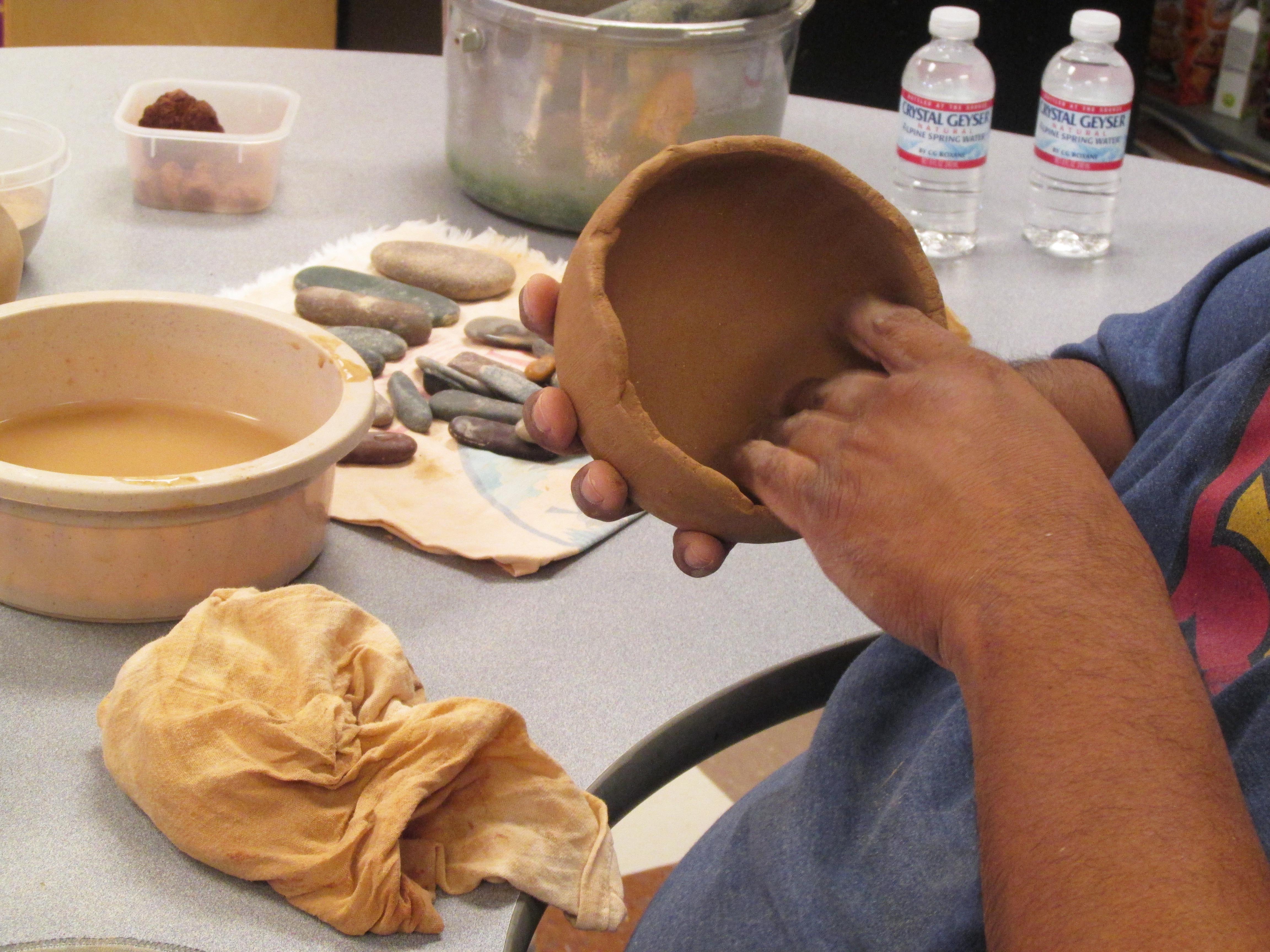
I was listening to a teacher, Ron Carlos, demonstrating pottery a few weeks back, and he was telling students on how important it is for them to stay ‘in touch with the earth’ around them. This included being aware of the natural resources they have been blessed with. Creativity, he said, takes patience, and spending time ‘tuning in’ to the material. Sometimes, he said, it’s as if the clay in his hands decides what shape it wants to be.

IMG_0565It reminded me of the craft of writing. Many authors describe how the character they give birth to, often decides where to go and what path to take. Just like wad of clay, I suppose!

How does this apply to many of us? Many of us sleep with a cellphone by our bedside, and a wi-fi-connection within a few feet no matter where we wander. No wonder it is such a challenge to find ‘think time’ and creative time. We are victims of TMI  –which is an old acronym for ‘Too Much Information’, but also an acronym for ‘Too Many Inputs.’ And we can’t honestly blame anyone for it.

In a forthcoming workshop, I am planning on bringing up this topic of how important it is to be connected, but also to often (very often) be off the grid, so to speak.

Thank God, clay does not tweet!

Baiting the media, achieves nothing – except an ego boost

Donald Trump is more entertainment for the media, than a front-runner per se. They may not want to admit this, but especially in the US, where campaigns are fought and won with war-like strategy, it’s always been useful (to the media) when there’s a wild-card.

Think Sarah Palin. 

It seems as if Trump is trying desperately to fill the void left by Sarah Palin (remember her attack on lamestreammedia?) Which is why his attack on Jorge Ramos of Univision, is enlightening. He knows it will guarantee coverage.

Sadly this is also the strategy of terror organizations, as we have seen in recent months.

Think ISIS, and its despicable acts against journalists.

Or Wednesday’s cold-blooded murder of two reporters in Virginia. The killer seemed to anticipate that this would get him media coverage, making sure he distributed the story himself, via social media. A pretty pathetic use of social media,or any media for that matter. He was just looking for attention, not change.