Speaking Out Of Turn – from Citizen Journalists to Whistleblowers

Some notes and pictures from the Chat Republic event at the American Center, on 13 June.

Organizations are going beyond the ‘blabbing’ phase of using social media, to craft more thoughtful, business-focused strategies for customer / audience engagement.

Dipnote – the State Department – and Dell are good examples of using ‘media’ to different ends. In the book, I feature Dipnote, as one of the pioneering government blogs that dared to use a format and a platform that was not exactly popular in tight-lipped institutions.

Dell, uses a Social Media Listening Command Post to be closer to its customers. It runs a virtual war room, with full-time employees who listen to the chatter.

Many people question social media as if it is some sort of object that comes in a box –and ought to also include a set of instructions. If you like to give it a tangible quality, think of it not as an amplifier, but an antenna. en, Even then, no box will contain it.

I then opened up the topic of podcasting, and how it was different from its old media cousin, broadcasting.

As this was a seminar-style discussion, there were good examples of how print media is using print and digital to create ‘breadcrumbs’ back to the readers. Also in the audience was a member from a grassroots organization I had featured in the book (in one of the Bonus Chapters at the end of the book, and he updated us on the programs involving teaching English and blogging.

And finally, we addressed Citizen Journalism. From Abraham Zapruder, one of the most remember ‘accidental’ or citizen journalists – he caught on tape the Kennedy Assassination. To the brave amateurs who risk their lives to tell a story no one else is privy to.

Oddly enough, even as we were speaking, a larger story was unfolding of someone who has dared speak out of  turn – the Edward Snowden affair. I can see this topic come up in the next two weeks, even though phone tapping is not a social media problem per se. It is, after all, related to the ancillary, hairy issues social media skeptics bring up: too much transparency, and how vulnerable it might make any institution. But that’s not what my book is about. But, hey, I’d be happy to discuss in another forum.

If nobody’s listening, why are you talking?

I just wrote a column that comes down hard on a practice many of us succumb to: Continuous Partial Attention.

We shouldn’t be surprised that, even with so many digital channels at our service,  with so many ways to communicate, few appear to be paying attention. It is an odd –but wholly appropriate– topic to take on in the few weeks before I launch a book that talks of the power of conversations.

I’m not in the news business, but I do follow some journalists very closely. So here’s a National Public Radio journo, with some great advice. he speaks of how storytellers could be paying more attention to their craft in relation to their audience’s ability to listen and remember the point of the story.

‘Guru’ – spoiler alert

I cringe every time I run into the word ‘guru,’  especially when it is used as a generic term foro someone who expounds on any topic. Just like the term ‘master class’ and ‘best of breed’ the word means nothing.

I spotted the word in an article describing my input at one of the upcoming events I am attending, so I want to get this out of my system: I am a part-time writer, full-time teacher, observer of odd trends, trouble-maker, critique, and occasional ‘help desk’ sherpa (at least in my day job) when it comes to the infuriating things we have to do with computers. However, that does not make me a guru. Please!

FOR THE RECORD, I ignore gurus. I avoid them like the swine flu. I carry a hand sanitizer to clean up every time I am introduced to someone who calls him or herself one. Social media experts/gurus/ninjas are a dime a dozen. Advertising Age recently ran a piece about there being some 181, 000 of these types.

The entry for the word guru on Wikipedia (which usually excels in dehydrated language) says it is “used to cover anyone who acquires followers, especially by exploiting their naiveté, due to the inflationary use of the term.”

There’s a deeper discussion of the term here, by author, B.R. Sharma. He says that “the absence of a guru, though, does not preclude learning and wisdom.” The corollary to which, I suppose, is: “the presence of a guru is no guarantee of understanding.”

Ok, I lied about the hand sanitizer part. But you get the point.

Meet the panel –for Chat Republic launch

It’s going to be an interesting round of conversations for the launch of Chat Republic in Colombo in a few weeks. The event, on June 18th, will focus on the power of social media across many disciplines.

The ‘knights,’ as Bates Chairman puts it, will include:

Shehara De Silva – GM, Marketing, Janashakthi Insurance

Virginia Sharma – VP of Marketing, Communications and Corporate Citizenship, IBM India/South Asia.

Dinesh Perera -Head of Digital Business / Creative Director, Bates

Nalaka Gunawardena – Citizen Journalist / LIRNEasia

Lakshaman Bandaranayake — Multi-Platform Publisher / Chairman, Vanguard Management

Shamindra Kulamanage – Magazine Editor

Ajitha Kadirgamar — Journalist, Social Media Specialist

Nimal Gunewardena – Moderator / Chairman & CEO at Bates Strategic Alliance

Here’s how the media has reported it, calling this an ‘interrogation’:

The interviewers will each straddle a different facet of the topic raging from social media’s use in marketing, adoption by ad agencies, vital value in PR, impact on mainstream editorial media, its mobilisation by citizen journalists and monitoring and analytics.

Not sure about a round table being interrogation technique. I’m there to learn as much as I could from these eminent folk. More details of the event, here.

Chat Republic – Galley Proofs today!

The metaphors for describing what one goes through when writing a book are inadequate.

Suffice to say it’s been a breathtaking learning process.

Chat Republic (Cover)_APR252013

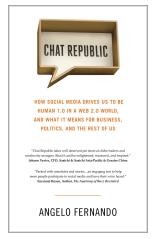
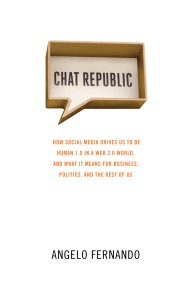
But it’s finally coming down to the moment of truth. Here’s what the cover looks like. I wanted it to be minimalistic, but communicate in an instant what it’s about.

Chat Republic, though a crowded place, is also about a call for more space – space between the noise, space between the rapid, vapid statements we send out and are inundated by.

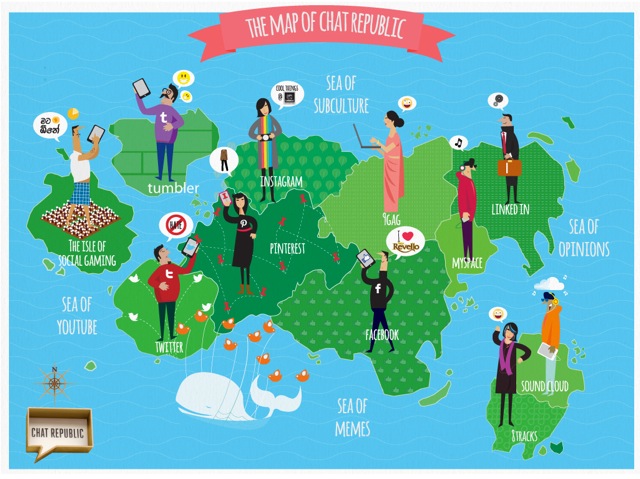
Some see this is as a ‘country’ –a map– populated by loud mouths. I see it as this giant speech bubble, we could all be sucked into (if we don’t make some sensible choices).

Let me know what you think of the cover!