Humanize Your Communication – Presentation from IABC Phoenix event

When you are online do you act like a Visitor or Resident?

I sometimes joke that, whenever I hear the phrase “If Facebook was a country (often said to impress that a huge chunk of humanity is online), I am tempted to say...“I would quickly seek asylum somewhere else!”

That was one of the points I raised at my discussion with members of IABC Phoenix last Thursday, at their luncheon meeting. The point was not just about Facebok, per se, but about what it means to be a “resident” in a hyper-social world.

Interestingly enough, it’s something I touch on now, when teaching students in the computer and technology lab –my 6th grade class– what it means to be a digital citizen: Their roles, and expectations. We often have to ask ourselves: do we trade one of these for the other?

  • Visitor or Resident?
  • Antenna or Amplifier?
  • Symmetric or asymmetric?
  • Ambient Intimacy or “Alone Together”

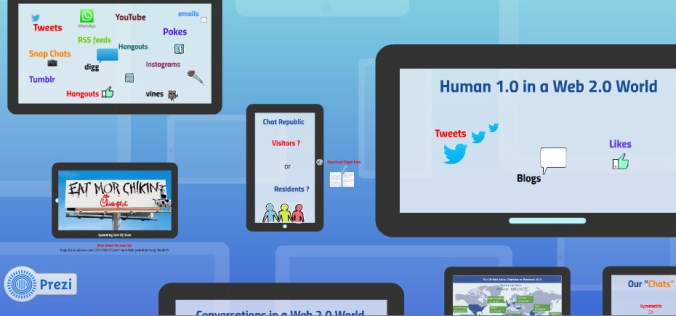
Prezi - Chat Republic - IABCPhoenix

For those who have asked: Here’s a link to last my presentation: Humanizing Your Communication.” It’s hosted on Prezi. So much more interesting that PowerPoint.

Why SoundCloud rocks

Whenever I get tired of reading the news, I switch to SoundCloud.

I’m currently doing a series of lessons with my students on audio, and having them experiment with the power of voice. (I know: It fits nicely into the theme I’ve been plugging in my book, Chat Republic.) Truth is, young people are enamored by video, and instinctively see audio as its poor-relation.

But ever so often, one of them says something in a microphone that makes them realize how simple and real an audio experience could be.

Here’s one that is part of an NPR experiment itself. An experiment to study why audio seldom goes viral.

It’s almost impossible to listen to this and not (a) feel close to the event (b) wonder how someone managed to record this near-death experience.

Chat Republic backgrounder – IABC/Phoenix

In three weeks I will be speaking at a meeting of IABC-Phoenix, and to that end, this interview by Peggy Bieniek has  just been published.

It’s a bit of a long read, so if you’ve gotten used to 140-character summaries (and that’s one of the points I raise in Chat Republic), this is certainly not for you.

It is one of the most thorough backgrounders to the book, and my take on social media.

Interview with IABC-Phoenix

Upcoming Event with IABC – Making Social Media More Human

With so much wrap-around social media in our lives (in cars, at work, while dining, and every space in-between) I often wonder if what we are doing is really “communicating.”

You tell me!

Between the ‘Likes’ (yes, the controversy seems to have grown bigger) re-tweets, text chats, instant messages, video responses and check-ins, are we adding more noise than knowledge?

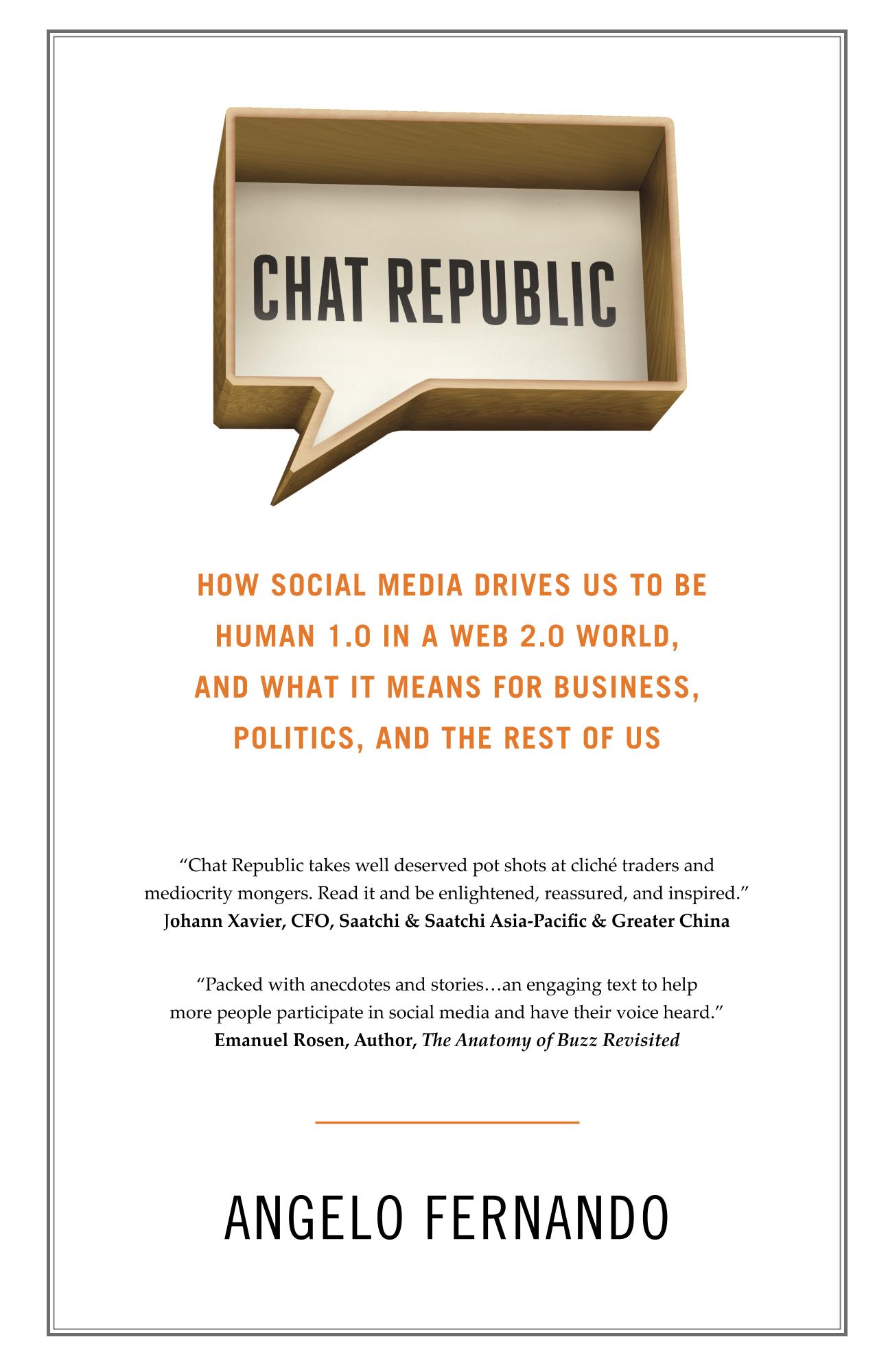
In February, I will be speaking to members of IABC-Phoenix, at their monthly lunch meeting. Specifically about some issues featured in my book, Chat Republic:

  • How do we deal with this new Web 2.0 world in our organizations? How do we accept the loss of control of our messaging, even as we have more channels through which to transmit and manage them?
  •  How might one put this thing we call social media into perspective –looking at history, including those quaint exchanges we once called ‘chats,’ at diplomacy and even street activism, at patient communities and some forms of asymmetric communication?
  • Why we need more antennas than amplifiers in this noisy world
  • What curation, podcasting, crowd sourcing, “media snacking” and civic journalism are all about, and where they might be headed
  • How to be Human 1.0 in a Web 2.0 world and why there’s a need for a new breed of storytellers, content curators and community managers

When: Feb 20th, 2014
Time: 11:30 am
Where: University Club of Phoenix, 39 E. Monte Vista, Phoenix, AZ 85004

Registration details here.

“Are We Talking Too Much?” – Theme of Tempe launch of book

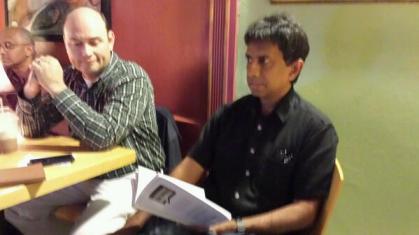
Thank you everyone who attended the second launch event for my book, Chat Republic.

The topics around the book are many, but we seemed to center on the big question as to whether social media has made us too…chatty. How real are the conversations we have, when few appear to be paying attention?

Thank you to may eminent panel who weighed in on the topic.

  • Gary Campbell, editor of ASU’s web site
  • Prabha Kumarakulasinghe – Microchip
  • Don Wilde – Intel

.Some of the topics that came up: 

  • Gold bar espresso, Tempe - Chat RepublicFace Time, Real Time. What is happening to face-time, with people busily checking their phones for possible interactions with the ‘other’? (If you haven’t seen “I forgot my phone, watch this: a statement of our times.)
  • Do we really need smart phones? Or wouldn’t ‘dumb-‘ (um, feature-) phones be adequate most of the time?
  • Transparency Vs Over-sharing. Is our ability to know so much a blessing? Yes, we want to know minutiae about public officials, but many are pulling back because of surveillance. Gary cited the example of how smart phones could help people do dumb/smart things, as in the case of the NFL Player, Brian Holloway, who tracked down the kids who trashed his home. (This story is still being played out, by the way)
  • Smart devices in the class. I enjoyed this one, for obvious reasons. There were several teachers (one principal) in the room, who face this challenge: Are mobile devices in students’ pockets going to help or hurt them?

A big thank you to Dennis and Karen Miller, owners of Gold Bar Espresso, for letting me use their wonderful coffeehouse for this event. These are the spaces –-the Kaffeehaus culture –where deep conversations have taken place for centuries!

Chat Apps could ignite true engagement

We know that Chat Apps are driving a lot of mobile service providers to rethink their once-lucrative profit center. But these apps are also disrupting traditional social networks, because providers know how important it is to keep the user engaged within the channel.

Consider our fragmented mobile experience. We toggle between Email, Facebook, Twitter (or Hootsuite), and SMS. They each have their distinctive experience. Status updates and informative mails are not the same thing; content sharing on a social network, with the ability to garner a small ‘mob’ around a cause or a pet peeve is not the same as firing off a text message to 20 people. International texts are expensive so we may tweet a message instead…

I’ve been intrigued by these so-called ‘conversations’ online, especially since many of them are not always in real-time. They are really partial dialogues, with one word (or one button) responses that are a proxy for people joining in.

That why we need to keep an eye on where Chat Apps are headed. They are simple –as in distraction free– formats that could garner true engagement.

At a recent event, I was asked where I though our social media lifestyles would be headed. My pat answer was that we might see a lot of social media fatigue. The media overload we are all facing might mean vast numbers of us will be quitting those social media channels that just don’t fit our personality. But that’s not to say that we will retreat to our caves, and get back to notebooks and pencils, or phone calls. We will seek out those experiences that help us stay connected. And that’s where I see Chat Apps gaining ground.

THE NEXT WhatsApp or Viber (the free phone app combines the chat feature– free even with people in other countries) could threaten Facebook and Twitter. It could combine elements of email and micro-blogging, so that we may never need to go to the other platforms to see what our friends are saying, and to chime in.

Multiple language chats. I fielded this question to a panel of international students at Scottsdale Community College last week:

  • How many of them spoke more than one language. All hands were up
  • How many spoke three languages. Eighty percent of the hands remained up
  • More than three? About fifty percent

What would happen if we could chat with people in different countries, in different languages, using the same app? Already WeChat, which is apparently a lot like Line, an app not known to many in the West, lets one do this.

Maybe ChatApps are where we may find the genie of true engagement. I admit I may be somewhat biased, because of the title of my recent book.

What do you think? Does social media fatigue drive you to give up on certain channels?
With so many social media ‘ninjas’ (and mavens and gurus), you’d think we cracked the code

I did a search of books on social media, and there are (get ready for this) 286,797 books out there on Amazon. That’s about 119,000 more people than the population of Tempe, Arizona.

No shortage of experts, too, in this vast field of social media.  B.L. Ochman, writing for Advertising Age recently noted that there are 181,000 Social Media ‘Gurus,’ ‘Ninjas,’ ‘Masters,’ and ‘Mavens’ on Twitter.

She rightly suggests that we are on guru overload.

“The fact remains: a guru is something someone else calls you, not something you call yourself.”

I cannot agree with her more, and made this point when I was speaking in Sri Lanka earlier in June. The media like to call anyone who address an audience as a guru and I had to debunk the notion, much to the alarm of some.

You would imagine that, with so many experts and gurus, we ought to have found the perfect recipe for using social media. But we haven’t. And will never quite get it, for the simple reason that the goal posts are constantly being moved. There are no seven golden rules. There is no no lost manual

I address this because whenever I am asked what Chat Republic is about, I could come up with a pat answer that might fit onto the back of a business card, or make a nice elevator speech. But I try to resist this. I’m sorry, I don’t give that elevator speech, because:
(a) That would imply this is a one-size-fits-all book
(b) That something as wide –and murky–as social media could be given the Cliff Notes treatment, or be condensed into 140-characters

If someone is looking for that, I could refer that person to an afore-mentioned ‘ninja. There are plenty of them to outnumber the population of Belgium, Portugal and Greece combined!

Book Signing this week: Tempe, AZ

Following last week’s launch and panel discussion I’m attending another book signing event in Tempe, Arizona.

This one will be at my favorite coffee shop, Gold Bar Espresso.  The coffee is truly out of this world.

Gold Bar Espresso. Chat Republic launch

The owners Dennis and Karen Miller run a quintessential mom-and-pop business, where customers are friends. Dennis is also a prolific author, with some 6 books and counting.

PANEL DISCUSSION:
Join us for a panel discussion on the Digital Vs Analog lives we balance with our use of social media.

Address
3141 S McClintock Drive, Tempe, Arizona 85282
(NE Corner of McClintock and Southern – behind a Starbucks!)

Time:
6:00 pm

Stay on after that, for live Jazz with Jazz Alliance.

Gold Bar Inside

Launching Chat Republic – Today in the US

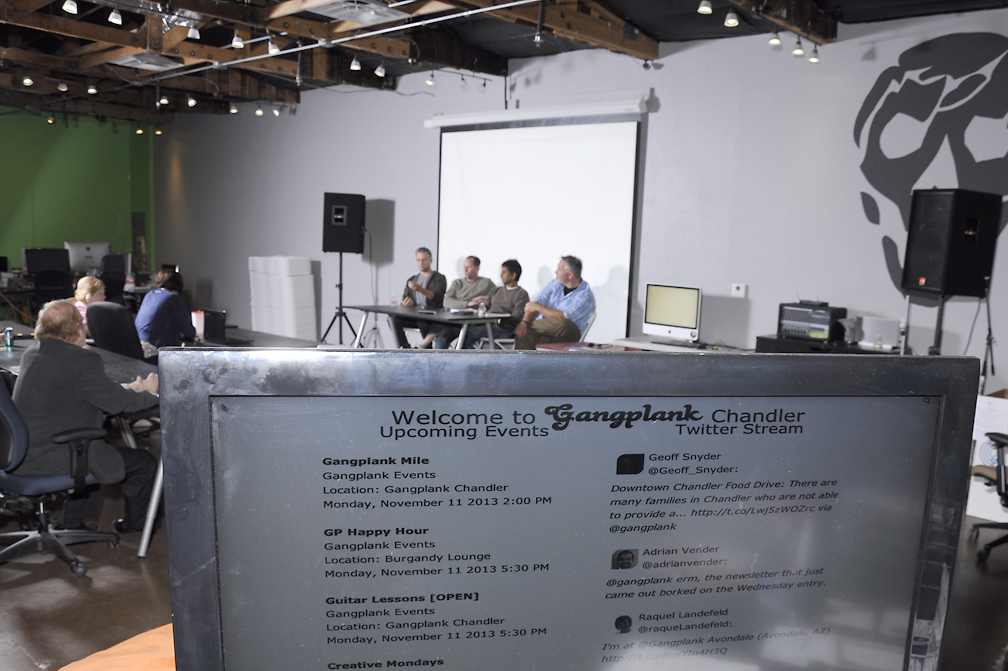
Angelo Fernando - Chat RepublicIt’s finally happening. My book, Chat Republic, launches today at an event in Arizona.

Venue: Gangplank, Chandler

Time:   6 – 8 pm

A panel discussion on social media.

Chat Republic - Panel Discussion at Launch - Gangplank, Chandler ArizonaWe will be live streaming the event here:

Updated: Panel discussion on privacy and over-sharing in a social media era.
Panel:    Dan Wool, Len Gutman, and on my left, Derrick Mains

http://www.ustream.tv/search?q=chat+republic

Live streaming video by Ustream

My book, “Chat Republic,” is now available at Changing Hands Bookstore

Changing Hands Bookstore, Tempe. Chat RepublicI’m happy to announce that this month, Changing Hands bookstore is now carrying my book, Chat Republic.

Changing Hands, a community bookstore since 1974 has stood up to the big-box stores very well, and is the kind of place you would want to hang out at, with family or friends.

True to its community roots the store features ‘indie’ authors, and holds events such as poetry readings, music and foodie events, and something for tweens, freelance writers, and philosophers.

I like the deep selection of books and periodicals they carry, and of course they also have a terrific used-book section.

If you’re looking for a copy, and like to support your community, please pick up the book there.