Upcoming Event with IABC – Making Social Media More Human

With so much wrap-around social media in our lives (in cars, at work, while dining, and every space in-between) I often wonder if what we are doing is really “communicating.”

You tell me!

Between the ‘Likes’ (yes, the controversy seems to have grown bigger) re-tweets, text chats, instant messages, video responses and check-ins, are we adding more noise than knowledge?

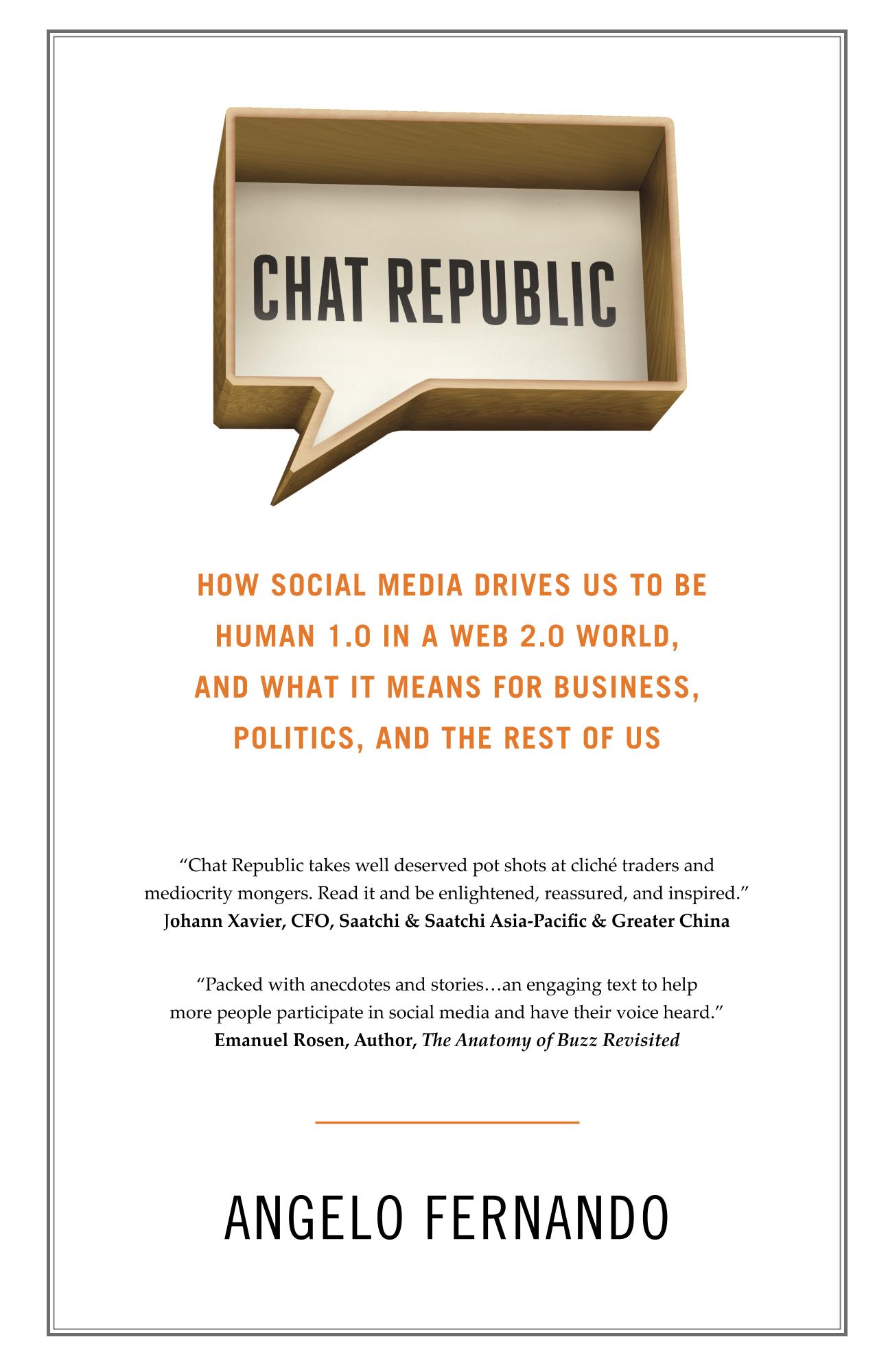
In February, I will be speaking to members of IABC-Phoenix, at their monthly lunch meeting. Specifically about some issues featured in my book, Chat Republic:

  • How do we deal with this new Web 2.0 world in our organizations? How do we accept the loss of control of our messaging, even as we have more channels through which to transmit and manage them?
  •  How might one put this thing we call social media into perspective –looking at history, including those quaint exchanges we once called ‘chats,’ at diplomacy and even street activism, at patient communities and some forms of asymmetric communication?
  • Why we need more antennas than amplifiers in this noisy world
  • What curation, podcasting, crowd sourcing, “media snacking” and civic journalism are all about, and where they might be headed
  • How to be Human 1.0 in a Web 2.0 world and why there’s a need for a new breed of storytellers, content curators and community managers

When: Feb 20th, 2014
Time: 11:30 am
Where: University Club of Phoenix, 39 E. Monte Vista, Phoenix, AZ 85004

Registration details here.

“Absolute Value” confronts traditional marketing theories

We’ve all been influenced by customer reviews, right?

Whether it’s a low-ticket item (ordering food online) or not we use the “knowledge” gleaned from other users as a habit before we make up our minds.

Is this  new? Not exactly, because in the pre-Internet era, we bumped into this information in a haphazard way — chance conversations  during our commute, by trading opinions over our fence etc.

But it’s less haphazard now. It’s ingrained in our purchasing behavior.

In the just about to be released book, Absolute Value, by Itamar Simonson and Emanuel Rosen,  we see how this stream of information is what marketers must now lose sleep over.

I just received an advanced digital version of the book from Rosen, and I have to say it is a compelling idea –the idea of how “nearly perfect information” could disrupt the pillars of marketing we know of as segmentation, positioning, promotion etc. And if course the whole basis of branding and brand value would be in question, if their thesis is true.

The New York Times described it as a book that deals with the power of online reviews, based on Dr. Itamar’s decades-long research at Stanford, prior to this.

Here’s how they summarize how the power of information from ‘other people’ tilt the balance.

Customers’ purchase decisions are typically affected by a combination of three things: Their prior preferences, beliefs, and experiences (which we refer to as P), information from marketers (M), and input from other people and from information services (O). …

…If the impact of O on a purchase decision about a food processor goes up, the influence of M or P, or both, goes down.

For those whose business is all about the M — the marketing push and the brand strategy, you better start paying attention to how the hoi polloi, those “other people” might matter, after all.

“Are We Talking Too Much?” – Theme of Tempe launch of book

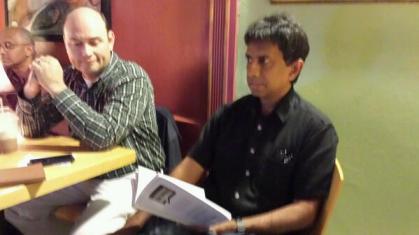
Thank you everyone who attended the second launch event for my book, Chat Republic.

The topics around the book are many, but we seemed to center on the big question as to whether social media has made us too…chatty. How real are the conversations we have, when few appear to be paying attention?

Thank you to may eminent panel who weighed in on the topic.

  • Gary Campbell, editor of ASU’s web site
  • Prabha Kumarakulasinghe – Microchip
  • Don Wilde – Intel

.Some of the topics that came up: 

  • Gold bar espresso, Tempe - Chat RepublicFace Time, Real Time. What is happening to face-time, with people busily checking their phones for possible interactions with the ‘other’? (If you haven’t seen “I forgot my phone, watch this: a statement of our times.)
  • Do we really need smart phones? Or wouldn’t ‘dumb-‘ (um, feature-) phones be adequate most of the time?
  • Transparency Vs Over-sharing. Is our ability to know so much a blessing? Yes, we want to know minutiae about public officials, but many are pulling back because of surveillance. Gary cited the example of how smart phones could help people do dumb/smart things, as in the case of the NFL Player, Brian Holloway, who tracked down the kids who trashed his home. (This story is still being played out, by the way)
  • Smart devices in the class. I enjoyed this one, for obvious reasons. There were several teachers (one principal) in the room, who face this challenge: Are mobile devices in students’ pockets going to help or hurt them?

A big thank you to Dennis and Karen Miller, owners of Gold Bar Espresso, for letting me use their wonderful coffeehouse for this event. These are the spaces –-the Kaffeehaus culture –where deep conversations have taken place for centuries!

With so many social media ‘ninjas’ (and mavens and gurus), you’d think we cracked the code

I did a search of books on social media, and there are (get ready for this) 286,797 books out there on Amazon. That’s about 119,000 more people than the population of Tempe, Arizona.

No shortage of experts, too, in this vast field of social media.  B.L. Ochman, writing for Advertising Age recently noted that there are 181,000 Social Media ‘Gurus,’ ‘Ninjas,’ ‘Masters,’ and ‘Mavens’ on Twitter.

She rightly suggests that we are on guru overload.

“The fact remains: a guru is something someone else calls you, not something you call yourself.”

I cannot agree with her more, and made this point when I was speaking in Sri Lanka earlier in June. The media like to call anyone who address an audience as a guru and I had to debunk the notion, much to the alarm of some.

You would imagine that, with so many experts and gurus, we ought to have found the perfect recipe for using social media. But we haven’t. And will never quite get it, for the simple reason that the goal posts are constantly being moved. There are no seven golden rules. There is no no lost manual

I address this because whenever I am asked what Chat Republic is about, I could come up with a pat answer that might fit onto the back of a business card, or make a nice elevator speech. But I try to resist this. I’m sorry, I don’t give that elevator speech, because:
(a) That would imply this is a one-size-fits-all book
(b) That something as wide –and murky–as social media could be given the Cliff Notes treatment, or be condensed into 140-characters

If someone is looking for that, I could refer that person to an afore-mentioned ‘ninja. There are plenty of them to outnumber the population of Belgium, Portugal and Greece combined!

Book Signing this week: Tempe, AZ

Following last week’s launch and panel discussion I’m attending another book signing event in Tempe, Arizona.

This one will be at my favorite coffee shop, Gold Bar Espresso.  The coffee is truly out of this world.

Gold Bar Espresso. Chat Republic launch

The owners Dennis and Karen Miller run a quintessential mom-and-pop business, where customers are friends. Dennis is also a prolific author, with some 6 books and counting.

PANEL DISCUSSION:
Join us for a panel discussion on the Digital Vs Analog lives we balance with our use of social media.

Address
3141 S McClintock Drive, Tempe, Arizona 85282
(NE Corner of McClintock and Southern – behind a Starbucks!)

Time:
6:00 pm

Stay on after that, for live Jazz with Jazz Alliance.

Gold Bar Inside

Launching Chat Republic – Today in the US

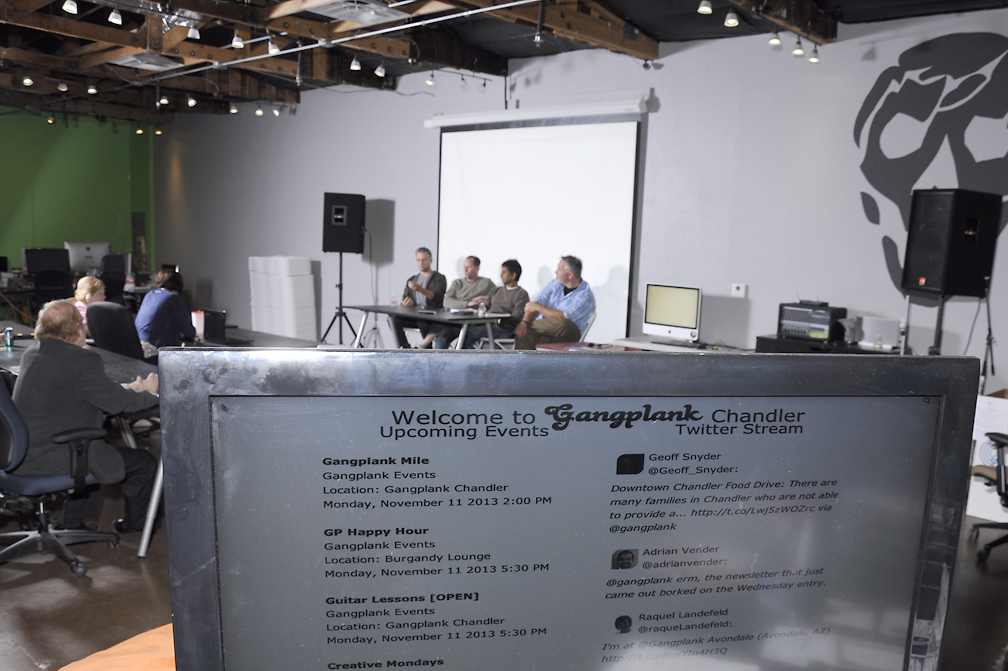
Angelo Fernando - Chat RepublicIt’s finally happening. My book, Chat Republic, launches today at an event in Arizona.

Venue: Gangplank, Chandler

Time:   6 – 8 pm

A panel discussion on social media.

Chat Republic - Panel Discussion at Launch - Gangplank, Chandler ArizonaWe will be live streaming the event here:

Updated: Panel discussion on privacy and over-sharing in a social media era.
Panel:    Dan Wool, Len Gutman, and on my left, Derrick Mains

http://www.ustream.tv/search?q=chat+republic

Live streaming video by Ustream

“Chat Republic” launches at Gangplank

It has been a few months since I launched Chat Republic in Asia. It’s now time to roll it out, State-side.

So on November 7, Chat Republic will be launched at Gangplank.

Never been there? Gangplank has the fitting ambiance  –a cross between a very spacious coffee shop and a technology incubator. I have previously written about it, conducted a live radio show from there.

If you like to attend this launch event, leave me a note here, or use this link to RSVP.

Address: Gangplank, Chandler
260 South Arizona Avenue, Chandler, AZ 85225

Time: 6.00 pm

Review: “Chat Republic: A welcome change from the American-centric view of social media”

Review by Linda VandeVrede

Now that Twitter and Facebook have been around for several years, the ability to communicate with strangers and mobilize crowds seems an accepted form of crowd communication. Younger generations who are extremely good at texting have emerged as so-called “thumb tribes.” Yet as these voices continue to emerge, some corporations are still fearful of these public conversations and their implications.
Angelo Fernando’s new book, “Chat Republic,” provides an overview of social media, including how it has evolved and continues to be a work in progress. It acknowledges that social media poses a threat to those who once controlled the conversations that took place within and without an organization. It acknowledges that social media has challenged traditional ingrained ideas about marketing and management, with some taking to it with abandon, some approaching it with a measurement of decorum, and some sniping from the sidelines without partaking. Angelo reminds us to consider communities in terms of what gets shared, not how. He points out that conversations between humans are inherent in our society; even FDR had “fireside chats” that made listeners feel as if they were participating, even through a one-way radio medium.

This citizen journalism scenario is messy but informed. This is not a bad payoff, Angelo observes. The hoi polloi, rather than a filter, decides on which media they will believe. Citizen journalism isn’t merely reactive now. It is becoming more proactive, where people proactively seek stories that interest them and share them with others.

Chat Republic is full of examples of times through world history when people have networked around monolithic authorities in small clusters, from homeless groups decades ago to the Middle East most recently. Still, there is a discrepancy in how people view social media. “There are those who see social media…as a transparency filter to let the sunlight in. There are also those who decry it as a lever that unlocks the floodgates to an unwanted stream of information and/or trouble.” The positives are that it improves trust and reputation. This is the new face of PR, crisis management and advocacy.

One of Angelo’s interviewees observes that people’s habit for deep reading has eroded: “Once I was a scuba diver in the sea of words. Now I zip along the surface like a guy on a jet ski.”

If you ever wanted a view of how social media has changed us for good, this is the book. Best of all, the data presented is multi-cultural, a welcome change from the American-centric view of social media that dominates most books. Angelo’s book is full of tips and case studies about how these concepts have been implemented effectively. I’ve always been impressed with his ability to pull in examples from all walks of life, and analyze the hoi polloi response to social media.

(Disclosure – Angelo was part of the group blog Valley PR Blog, with whom I blogged from 2007-2010, and I am one of the many people interviewed for and quoted in the book).

Picture Copyright: Adam Nollmeyer

Microphones or Hash Tags?

Last evening, at the Sri Lanka Institute of Marketing event for Chat Republic, we tried to get the audience to chime in.

Some of the areas covered by the panel, which included representatives from a Leading Ad Agency, a Telco, a Research company, a Digital Media company and a Multi-Media publisher were topics that were outside the comfort zone of marketers. We did have some good questions, especially from someone who represented a startup digital shop, and those that came via Twitter.

But it makes me wonder about what compels someone in the audience to not pick up a microphone and ask a question, but instead do it in 140 characters. There is no right answer. It could be that for Gen Y, a hash tag is a more ‘authentic’ way to ask a question, since it is also in a public space. (We requested the use of the hash tag #ChatRepublic). Or are mics, sort of passe? Too much a left over from old media?

I tried to make my keynote less of a lecture and more as a conversation. In fact, on impulse –believe me, it wasn’t planned — I decided to step down from the stage as I tried to make the point of how social media, just like in education today, is all about getting off our soap boxes: Getting the sage off the stage.

In the end, I would have liked more tough questions. I am sure the panel would have liked to hear contrarian view points. The most contrarian one actually came from the least expected source – the moderator, Nimal Gunewardena.

Unrehearsed Conversations, often most poignant

I just got off a Google Hangout with a group of dynamic new media folk, who interviewed me about Chat Republic.

It’s odd, and so appropriate to have these well moderated chats about a book that makes a big case for  inviting the unscripted, un-fettered conversations.  We had to pause  whenever we ran into a glitch – technical issue, human error etc — but as the moderator, Adnan, told me at the end, he leaves the glitches and silly mistakes.

I try to respond to the famous questions about ‘over use’ or ‘dangers’ of new media by saying that this thing called social media is not one thing, with a handbook. To expect it to have a set of rules is like expecting there to be a set of rules for how to use the telephone or how to speak to your neighbor.

There’s a good column in the New York Times today on the downside of email, and how in interrupting us all day, it interferes with thinking time. It ends with a line that echoes something I touched on a few days ago, when speaking of Content Curation and TMI.

“And let’s never forget the value of face-to-face, or voice-to-voice, communication. An actual un-rehearsed conversation — requiring sustained attention and spontaneous reactions — may be old-fashioned, but it just might turn up something new.”

Indeed!

In a time when we could bypass human interaction with a messaging device, an app, or a process, let’s not forget that it’s the spontaneity of being ‘social’ that makes it such good ‘media.’