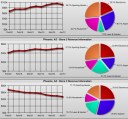
Digital dashboard serves data right

Gone are the PDFs that used to be the static receptacles of data. Now there’s Dashboard. A way to show data as gauges, charts and tables in a more dynamic way

At ASU, we’re moving into this more dynamic format so that a media person, a student or a researcher may be able to get to see the university not as a list of numbers, but by seeing these numbers map out a context.

It’s called ASU Dashboard. Some data like this is public. Other areas require a student/staff/faculty login. The data can be exported to an Excel file, or converted to a PDF.

Visualization and data and using it for decision making has come a long way since PowerPoint. You begin to respect data when you can see business intelligence in a dynamic state. On Corda, the company behind Dashboard, you can track such things as campaign finance by state or zip code, and see up to date results. Or you could see gas prices or unemployment numbers charted out.

How does it work? The application pulls raw data from a variety of public sources, some of which is accurate up to the day.

Cameras kill participation

The pastor at a church in Pinetop, Arizona made a point that got me rethinking the role of photography. “Like the Pueblos and the Navajos ask,” he said, “come in and join us, don’t observe us…please no photography.”

I’ve been into photography for a long time. At conferences, weddings and children’s school events I switch between participation and observation, making an effort to blend in and be as non intrusive as possible. Maybe I’ve been fooling myself that I could make the switch.

Photo journalists face another part of this join-us-don’t-observe-us dilemma when covering events: should they stop what they came to do and get involved, or stand back and be objective? Through their lens, they see monks getting tear gassed, accident victims traumatized, children fleeing attacks, and natural disasters. Often see journalists among the first responders. Minutes after Nik Ut captured the Pulitzer prize winning photograph of children fleeing a North Vietnam attack on a village, he and another journalist poured water from their canteens on the burned child. He then drove her to hospital.

Where does the word “engagement” stack up in this line of work? Read this story and you will realize it’s not a black and white issue. Marc Halevi of the Eagle-Tribune went to cover a rescue on Plum Island. He first saw the took pictures of a woman on a sand bank of the stormy ocean. “Seconds later as he was looking through his viewfinder, he saw a wave crash against the embankment on which she was standing, knocking down the sand and pulling the woman into the water.” So he did what any photographer would do. He clicked. He also shouted to the rescuers on the scene. “Rather than do it myself,” said Halevi, “I just made this immediate decision that (these people) would be better than I (at rescuing her).”

Participation or Observation?

Quotes for the week ending 5 April, 2008

“So why not bridge the gap between reader interest ad reader engagement by adding SMS codes, 2D barcodes, coupon codes and keyword search?”

Copy in Google ad about the value of adding encoded 2D bar codes (left) in newspaper ads that could be photographed with a mobile phone, and link reader to a virtual bookmark.

“During the inadequate training days prior to the opening, any staff questions were bounced back with ‘I don’t know’ “

British Airways baggage handler, quoted on BBC, about the chaos in Heathrow’s Terminal 5.

“Between information overload, globalization, and the sheer complexity of modern business, we’ve got to be more visual and less language dependent in communicating ideas.”

Dan Roam, visual consultant and author of The back of the napkin.

“Virgle”

Google’s April Fool’s joke (complete with maps and a Press Release) about Virgin founder Richard Branson and Google co-founders Larry Page and Sergey Brin enabling users to colonize Mars.

“Simultaneity of input.”

Mark Vacay, director of the architecture firm, SmithGroup, on the need for builders to take into account the Millennial generation’s use of space, and using electronics for multiple inputs and interaction.

Should web brands reflect the mother ship?

Lots of discussion around the new AZCentral web site. It’s a discussion around whether the new site reflects the newspaper brand. It doesn’t, and I wondered if that was accident or intentional heresy. Take a look at AZCentral. If you’re in Arizona, you probably remember the cluttered site that bore no resemblance to the newspaper it was an extension of — The Arizona Republic.

We all worry about two things when it comes to online presence: Usability and Branding. Often we get all fired up over the latter, and pay lip service to the former.

The rhetorical question I often ask is, does an online product need to reflect the branding of the mothership? And often the answer is, “Yes of course!” But if we probe a bit deeper, we may find that the audience for the online product may be looking for a different experience than the audience of the physical product. Even if some part of the audience patronizes both. Do users walk away from an online experience because it is different from the physical entity? Will a McDonald‘s user walk away from the site because there is no giant golden arch on the landing page? The McDonald’s.com site is quite plain in comparison to the physical store. Mcdonald’s USA on the other hand is a lot more interactive than its mothership.

If we design web sites based on who our users are, and how they visit us, maybe our online brand deserves its own identity. Ikea is one huge confusing place that encourages people to get lost, and find plants and window drapes when they only came in to buy a ice bucket. But the Ikea site is organized by the way people search, not the way store customers go to get lost. There are just seven tabs for seven rooms, and one more for three others. It’s that simple. The store is supposed to slow down customers. The site is supposed to speed things up. Usability took home the trophy, for a good reason.

Visualizing intangibles, a huge marketing opportunity

We writers tend to think that anything can be explained away with a sentence, a headline, a turn of phrase.

But I am also a huge believer in information graphics and icons. Often a few lines with a Sharpie on the back of a napkin can tell a story much, much better than a few PowerPoint slides. Or an ad. (seen the napkin visual in a Saleforce.com ad?) The downside to this is I have a growing collection of napkins from coffee shops and restaurants.

I picked up a brilliant book that deals with just this –throwing light on complex problems using pictures– called The back of the napkin by Dan Roam. “The best way to see something that isn’t there,” says Roam,” “is to look with your eyes closed.”

Visual thinking is the more intuitive way to understand and crack problems, he says. Couldn’t agree more, being (or in spite of being) a writer. That’s why we still need white boards, Visio, and of course napkins.

On a larger scale I see visualization at work everyday when dealing with intangibles –essentially data– involving complex issues such as epidemiology, environment, performance figures, underground water etc. And the trick is to put visualization at the service of problem-solving and make people “see with their eyes closed.”

Marketers have not tapped into this type of mapping, visualizing and problem-solving. Their ‘maps’ are still connected at the hip to org charts, flow diagrams, spread sheets and supply-chain matrices. The intangibles tend to get lost in the forest of data. When you learn to visualize intangibles, a whole new world opens up.

Spreading a little darkness in Phoenix

Tonight here in Phoenix, at 8 pm Mountain Standard Time, we were one of the four cities in the US that went dark for one hour to commemorate Earth Hour. Dubai, Melbourne, Copenhagen, Tel Aviv joined in too. Candle light dinners and waiters wearing glo-sticks were expected to compensate for the darkness. As Erin Zlomek of The Arizona Republic observed of the Chase ballpark, “Tonight, the well-known circular landmark melted into a sky of black.”

Another “landmark,” the white Google.com home page, turned black for that hour. Online, one Wikipedia editor whined that doing this for one hour was of no value. “Think of Earth every minute not just once a year for an hour! Take your bike, turn off lights whenever possible… There’s so much you can do every day!” Said the Googleplex: “we strongly support the Earth Hour campaign, and have darkened our homepage today to help spread awareness of what we hope will be a highly successful global event.”

Nice job, Phoenix.

Rapp Collins’ scrambled print ad drives web traffic

Rapp Collins epft tuvoojoh xpsl. That’s “does stunning work” in case you didn’t quite decipher that.

It ran a double spread ad with 53 names of ad people –scrambled. The only way to unscramble the names that turned out to be one Matt Jacobs, Nancy Vonk and Christian Barnett and others, was by looking at a web address at the bottom of the ad, and figuring out the letter substitution needed. The url itself was not the company address, but ‘greakfuckingplace.com’ which leads you to greatfnplace.com, which lets you type in a first name and last name to see a customized message.

Type a wrong name (you have to be pretty dumb to check if you’re not one of the 53 being poached) they allow you to contact them –basically apply for a job. But hey, this is Direct, so it’s no sin to ask directly, I suppose.

But in spite of the clever approach of going after creative officers and strat planners, and the trouble to encode their names, they do a poor job by making everyone of the 53 people being targeting see the same message –even traditional variable data printing does a better job of varying the fields and responses. But it does the job of driving traffic to the microsite, and maybe the main web site. Which justifies the expensive double spread in Advertising Age.

And speaking of Rapp Collins’ regular website it’s a tuvoojoh experience –unlike any other agency site I have seen.

My Social Bookmarking project

In the last two weeks I have been adding Del.icio.us tags at a rapid clip for my work at ASU’s Decision Theater. The initial purpose was selfish. I read a lot, and access content at a variety of locations –a laptop at work, at the library, at home, and very often at someone else’s workstation. I have grown tired of telling people to “send me a link to that article.” Tired because people sometimes forget, which then means a lot of back and forth emails etc.

Social bookmarking solves a lot if this. The quick easy was would be for me use and encourage other communicators across our four campuses to use my delicious tag “decisiontheater” when they see something. (Yes they could use others like Newsvine, StumbleUpon, Redditt and Technorati etc.) That way it shows up when I login to Delicious from any location, and I don’t have to look up different lists of Favorites on different browsers. Reciprocally, I have been asking colleagues to tell me what tag they use, so that I too could be their eyes and ears, and create social bookmarks for their school, business unit, faculty etc.

There are other movements attempting to formalize the business of link-sharing. Publish2 is one of them. It’s mission is:

“to bring all of the world’s journalists onto one common web platform and community, one that empowers journalists to discover, organize, and rank the most important news — to benefit your own reporting, your newsroom, and all news consumers on the web.”

The project is still in beta, and it will be more than Digg or Delicious. I like the crowdsourcing flavor it brings. Which is what my mini project is all about –tapping into the wisdom of the ASU Communication crowd, so to speak.