Do we trust journalists?

I spoke to someone whom I thought might be interested in a Media Training session today. His reaction was “I don’t talk to the media. Nothing good ever comes out of it!”

Wow!

I was slightly taken aback, even though I have heard something like this before. (No, it was not Sarah Palin.) In fact, I have a mailer on my wall that announces “Don’t talk to the media…” On the reverse, is the line “until you talk to Gerard Braud.” Gerard is an IABC member I met earlier this year, who conducts this kind of thing, and his point is that you could tell an honest story, stripped of spin, and still have a great media experience.

Which brings me to the whole point of this. A survey of journalists just out (Bulldog Reporter/Techgroup International) on media relations practices. It’s an excellent insight into how journos think, what they do to connect (or avoid) PR spin, and how they stay on top of stories using social media. Among the findings:

  • Only 29% of journalists read 5 blogs or more to keep up with their beat. The positive side of this is that 75% read one blog or more. One year ago, about 26% read 5 or more blogs.
  • RSS usage us low (58.4% don’t use it), journalists abhor phone calls from PR people, and those not familiar with their media outlet.
  • Interestingly, newspapers are still a key source of news for them (so will all those newspapers-are-dead promoters stop making it seem worse than it is?), and a large number of them are big on Electronic News Kits.

So if you don’t want to share the same oxygen as journalists, at least try to make it easy to let them suck in your RSS feed from a distance. And that’s not just your from press releases, and your ‘about us’ page, but from your white papers, interviews, podcasts, blogs & thought pieces (same thing, huh?). We may not trust them, but we could trust them to do their ground work if we give them less puff pieces.

Hey, I can afford to say this because I wear two hats. I communicate with the media on behalf of whom I represent, but I also interview companies for my freelance writing.
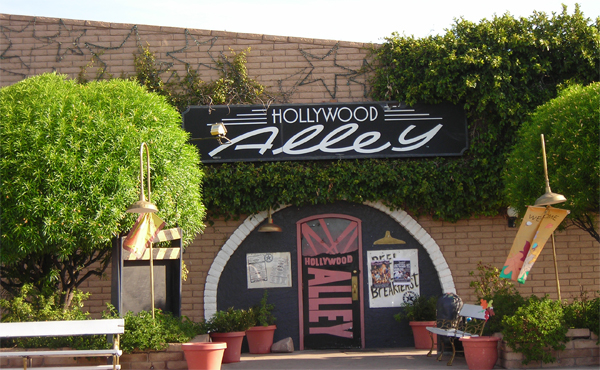
Hollywood Alley’s advertising: no agency required

Advertising is much more than a clever slogan tacked to the back of your truck. Branding is certainly more than a logo. I’ve regularly discussed this here and in my other writing –about experiential branding, and grass-roots marketing.

So I was glad to hear back from a company I had written about here on the blog. It’s a long comment, but fully worth a read. It’s about a form of “advertising” – a simple $12 dollar sign printed at Staples — people normally might dismiss as pre-Web 2.0.

Hollywood Alley is a family-owned restaurant in Mesa, (NE corner of Baseline Road and 101)  For weeks I had noticed the signs were getting really creative –or at least intriguing. Yesterday I heard from John Wincek, who gave me the scoop about how a restaurant with “a kitschy style, and an off-kilter outlook on life-but other than that, we’re actually totally and completely normal!” created its own brand personality. He doesn’t use ad jargon like that, but that’s just what it is: DIY branding. No agency required.

The restaurant’s sign connects with customers, flagging them down, getting them to even come up with ideas for the outdoor signature. “We were suggesting food, but without screaming it at them. better yet, we were connecting through a common interest,” said John. It was not just a sign, but a game, something that made people think about the  movie, the pun, and keep the restaurant in their minds.

But the sign can only get people in. The people and the product had better deliver. It is working. Check his story. It’s a great example of how to be creative to keep business humming in spite of the recession.

In tough times job seekers need to expand job description

One more follow up to my post about what communicators could do during these tough economic times.

Annie Waite at Melcrum has an excellent post on how to look for interim positions during the downturn. The key seems to be flexibility.

I used to put it another way: that old line “It’s not on my job description” is an attitude  that we need to expel. You can’t blame people who started checking all the boxes on their job description, just to get a great performance review. But in doing this, we box ourselves into our jobs, not realizing that over a few months that job has changed.

While doing a good job of communicating how good we are in what we do, we should not unwittingly communicate how unwilling we are to do something different, daring, unexpected. It’s easy to communicate you are an out-of-the-box type of person without using that tired expression.  Here are a few simple ways:

  • Read something new. Completely outside your sphere of interest. Ask someone with that expertise to clarify what it says. It will stretch your mind, and make you more accessible should the need arise.
  • Try something different every month. It could be a tactic, a piece of software, or sit in a meeting you might normally avoid. If you’re not sure what’s possible, check Managing The Gray, an excellent way to stimulate your marketing ideas. CC Chapman’s podcast is like a Red Bull for your mind.
  • Get feedback. It’s tough for someone who  thinks he/she is an expert to ask others to give some honest feedback, but asking for feedback communicates that you are willing to learn.
  • Hang out with some really ‘weird’ people. I say this in a good way. Don’t just socialize with people like yourself. Try attending a Podcamp (there’s one this weekend in Phoenix). Have lunch with a journalist or a geek. It’s amazing what you will learn in 15 minutes! I met some retirees over coffee this morning at Einsteins, and was introduced to The Black Swan, and epistemology!

Josh and Charlene named “Visionaries” for Groundswell

Congratulations to Charlene Li and Josh Bernoff on being named ‘visionaries of the year‘ by SNCR, the Society for New Communications Research (whose founders are the who’s who of social media.)

By many standards, Groundswell is the most imortant book of the year that answers the Why and How of social media. It’s hard for me to stop talking about it –my upcoming article in IABC’s Communication World is about it.

The authors have demystified the social media hype and given every practitioner something substantial to turn to: case studies, ROI calculations the online Social Technographics tool etc.

Creative visualizing of data

We just had a group at the Decision Theater inquiring how our visualizations, which are being linked to data sets, could be used in a Creative way. Creative with the capital C, that is.

So I am thrilled to promote a cool new interface launched today yesterday at Arizona State University’s Global Institute of Sustainability.

It’s called the Campus Metabolism project. Specifically, a web-based tool (a richer experience than Dashboard) for displaying real-time energy use in several buildings across the Tempe campus.

For anyone managing gobs of data and has a hard time getting it to mean something, this is cutting edge. What’s most interesting is that the Campus Metabolism concept was created as a student project – A bottom-up process, if you will. Also, this is the kind of data that makes people feel a real connection to how we relate to the network, the grid, the eco-system. It was initiated with the purpose of looking at “the hidden connection between the impact of the actions in our daily lives and the natural world.”

Sidebar: The folks behind it:
Campus Metabolism brings out the collaborative force behind the work going at at the Global Institute of Sustainability. This one nvolved: ASU Facilities Management, The National Center of Excellence on SMART Innovations, University Student Initiatives, Barrett Honors College, University Architects Office, College of Design, Ira A. Fulton School of Engineering, Psychology, the student chapter of Engineers Without Borders, and APS Energy Services.

Read more about the project here.

Rohit Bhargava in Scottsdale

Rohit Bhargava, author of Personality Not Included (he is VP of strategy at Ogilvy PR’s Digital 360 group) will be doing a book signing in Scottsdale, Arizona this week.

Date: Thursday, October 23, 2008
Time: 6:30pm – 7:30pm
Location: Borders – Waterfront Street. 7135 E. Camelback Rd., Scottsdale, AZ

Drinks afterward at: 7.30 pm Bungalow Grill in Scottsdale. Tel: 480-994-1888

The book is about brand authenticity, and how to move away from the faceless, personality-free corporate image, and using social media to give employees a voice.

The book is about brand authenticity, and how to move away from the faceless, personality-free corporate image, and using social media to give employees a voice.

IABC members speak up on the financial crisis

Happy to note, following my post last Friday, that IABC members have been blogging this very subject, making themselves heard. Maybe I missed some of these in by newsreader, but ideas have been coming in.

Fabio Betti Salgado -from Brazil

Chris Grossgart at IABC International

Natasha Nicholson –my editor at Communication World

Shel Holtz – his blog, and also in episode # 388 of For Immediate Release

Wilma Matthews –in Phoenix calls for a teleseminar on the crisis

I just heard from Barbara Gibson, the IABC chair that a webcast and teleseminar will be soon announced, among other initiatives.