“This award celebrates the fact that, in today’s world, a brave bystander with a cellphone camera can use video-sharing and social networking sites to deliver news.”
Judges for the George Polk Awards in journalism who honored a work produced anonymously, in a new category (videography) the video, of Neda Agha-Soltan, the young woman who was shot during antigovernment protests in Iran. This was the first time in the 61-year history of the awards that an anonymous person was recognized.
“You won’t be set up to follow anyone until you have reviewed the suggestions and clicked..”
Google. in a blog post on the buzz about Buzz. It said the company had heard the feedback –outcry, really– loud and clear about what Gmail users thought of the new social media feature. Google immediately changed the ‘auto-follow’ model to ‘auto-suggest’ and apologized.
“misleading, confusing and disingenuous,”
Plaintiff’s claim against Facebook’s new privacy settings –in a lawsuit filed in US District Court for the Northern District of California in San Francisco
“My real apology to her will not come in the form of words; it will come from my behavior over time.”
“Ask etymologists who work for any common language dictionary … and they will tell you that all dictionaries cannot Prescribe means, but instead only Describe meanings that are already being ascribed through common usage.”
“For those who don’t find that good enough or revealing enough at this point, well, maybe they have their own issues.”
Michael Wilbon, sports reporter for the Washington Post about, commenting on Tiger’s apology, calling it ‘pretty powerful stuff.’
Russell-Oliver Brooklands, responding to a discussion in Melcrum’s Communicators’ Network (via LinkedIn) about the use of the word “fulsome”
I think it’s a fair question, and one I raised in my second podcast for GreenNurture.
If you only read the tweets and sites that conform to your interest, you’d miss the contra views. As a writer, and practitioner, I keep an eye on those other points of view. (I get the usual snarky comment: “I don’t want to hear that someone’s having carrots for lunch”)
And there are mixed reviews pouring in every week about what social media is doing to employee productivity, with millions of employees taking to Facebook, Twitter and online games.
I put the productivity gains question to Derrick Mains CEO of GreenNurture to find out what a CEO –who tweets much more than I– has to say. Mains has two words to describe its value: frontline intelligence. To him it’s a remake of that old static engagement tool –the suggestion box.
“Social media simply blew the sides of the suggestion box,” he says.
On this podcast Mains talks of how organizations that frown on online social activity are missing out on frontline intelligence.
So many Super Bowl ads, so little attention to go around. I’ve always been saying these ads are a total waste of time. Do you really care if the Clysedales didn’t appear in a spot? (Apparently we do. They polled that question -and created a Wikipedia entry for them. Really!)
So, speaking of polling, I have to say that the $130 million Census campaign –never mind the cost of making the Bowl ad– is worth a second look. Especially with the cost of running the ad being in the neighborhood of $2.5 million.
“We’re advertising again,” the Census chaps say, observing what we all know that the Bowl is “rare, in that viewers are just as tuned in to see the commercials as the program itself.”
And yes, there’s the media-relations effect: Run the ad, get editorial comment. The famous carrot that says viewers will rush online once they watch the ad, because it that’s how TV –practically on life-support, tethered to the Net –works today.
But after they dispense with the popular wisdom about buzz and multiplier effects (perhaps after so many meetings with its agency, DDB) they note in true Census-boys style that “If just one percent of the folks watching the Super Bowl had their minds changed to mail back a census form they would have otherwise ignored, it helps save the taxpayers between $25-30 million in expensive follow up costs to collect these forms later.”
???
Translation: Watch ads, adjust your attitude toward being asked personal questions, save the country a boatload of cash, help us pay our agency.
I get that, Department of Census. No need to repeat this point about 3 times in your blog and press releases.
Yes, I mentioned a blog. This is where this campaign gets interesting because the obscenely expensive ad is supported with richer slices of content, some of which is embedded in social media channels. I like the fact that the Director of the Census is blogging, that there’s a Road Tour Blog and lots of space devoted to answering the questions people ask that make of break a census. The Flash site may be a tad too addy, but it documents stories, a la Story Corps, of ordinary people. The YouTube channel has plenty of video outtakes. The Flickr site has snapshots of an America few of us see every day. This one on left is supposedly at a Lutheran Church in Richmond, California. Thai dancers! The 5,000 fans on Facebook must mean something. and there’s Twitter just in case you miss all other channels.
So with all of this content so well thought out, is the cost of a Super Bowl ad really worth it? I liked the ad, but the greatest ad is not worth being tossed into a space filled with products and services that only seem to lust for eyeballs and water-cooler talk.
There are plenty of other ways to get buzzy, even if that was the objective. As Erik Qualman observes, why not use Facebook and Twitter to GET people to answer those darned 10 simple census questions, and not be entangled in “a $340 million boondoggle“? Because that not feasible, why not use social media to incentivize people to fill out their forms. If the media-as-a-repeater argument is important, why not let 300 million people start something that the media will talk about. (Rather than feed this controversy.)
“Reverse Psychology: Chinese Knock-Off Firm to Sue Apple Over iPad”
Fast Company, on Shenzen Great Long Brother Industrial company claim that the iPad is a knockoff of its P88 model, presented six months prior at the IFA
“It’s time to find your voice and get an online printing press.”
The first two things people think of, when following breaking news is Twitter, or Google Alerts. No doubt about it, these are great.
Ever considered ‘following’ a Wiki?
I do it all the time, because I am the kind of person who’s not content with the echo-chamber headline stuff (you know: “OMG there’s been a plane crash in…”)
Even if you’re interested not following the relief ops, and are just curious about how social media works in these extreme situations, wikis and maps are great. check it out. As we have begun to see, maps are being used more and more by media orgs and journalists to report on details of a story.
Now people can help map the relief operation in Haiti – at Ushahidi, a crowd-sourcing site I love to support.
It’s got links to video, news, pictures and ‘Todo’ lists. The site pulls together urgent need requests and status updates.
Like this desparate request:
@MelyMello @WFPlogistics so clos 2 airprt, can u help get help? 18°35’36.24″N, 72°16’40.37″W Othopedic clinic,needs narcotics,IV antibiotics,diesel,gas
I’m sitting here with a cup of tea, and it gives me great satisfaction to link to this article on the company behind it.
Dilmah tea has been a long time favorite. Enjoy the story of the underdog who excels in this commodity business with dedication to not just branding, but the details that make up the tea experience.
“This isn’t actually an article form a newspaper. It is part of the ad…”
Copy from a fake piece of editorial that’s part of a creative ad buy for Aflac in The Wall Street Journal, linking to the microsite, getquack.com
“They just had a name that was hard for Chinese to pronounce and harder to spell.”
Kaiser Kuo, a Beijing-based consultant and former head of digital strategy at Ogilvy & Mather in China, on Google’s decision to pull out of the country.
“I don’t think it’s wrong to take chances …Sometimes they work.”
Jeff Gaspin, of NBC, on the network’s decision to move Jay Leno back to his original slot –11.35 pm
a “pact with the devil”
The reason, according to televangelist Pat Robertson, why he thinks Haiti is cursed.
“Our alleged “pact with the devil” helped your country a lot.”
This is about the first of the 4Cs –the power (and the potential) to collaborate.
Like you, I occasionally come across people who find it hard to work in the same sand box. But the good thing is these people and these instances are few and far between.
They are typically suspicious of newbies, protective of their work (or job description), or have an inflated opinion of their contribution to the big picture. (Someone down the road handed them the biggest crayon in the box, and they’re still holding onto it!)
But just looking around, we see plenty of examples and tools that enable collaboration. My favorite examples are how easy it is to work together on a document, via a wiki such as WetPaint, or a sharing tool such as Google docs.
Collaboration is much more than the ‘two heads are better than one’ concept, even though that’s at its core. It’s not something that only came about with the Facebook generation, either.
Two very different examples:
1. Butterflies:
I recall a project called Journey North that began somewhere in 2002. One of the collaborative projects involved students from Canada, the U.S. and Mexico collaborating on collecting data to track the journey of the Monarch butterfly. Some 300,000 students from 6,000 schools have taken part in this!
2. Media coverage
In 2008, for four days gunmen took over and terrorised hotels and other building sin the heart of Mumbai, India. Cell phone networks were overloaded, media were unable to get close to the shootings, and the bets reports were coming via text messages and via Twitter.
Within minutes, a journalism professor Sree Sreenivasan from Columbia University pulled together a radio show via a blog platform called BlogTalkRadio to cover the event using Mumbai-based media people, experts on Homeland Security and others.
So whether it is GoogleWave today, or BlogTalkRadio last year, we know that we all have the collaborative gene in us. The organizations we work for often urge us to be involved. In the past that has meant ‘anything but PR/marketing, corporate communications’ since they employed special people for that. Today, many employers —and government–realize that unless they tap into the collective brainpower through collaborative policies and tools, they could be left behind.

 “This award celebrates the fact that, in today’s world, a brave bystander with a cellphone camera can use video-sharing and social networking sites to deliver news.”
 “My real apology to her will not come in the form of words; it will come from my behavior over time.”
 I think it’s a fair question, and one I raised in my second podcast for
  The YouTube channel has plenty of video outtakes. The
  “Was he a talk-show host masquerading as a politician? Or a politician masquerading as a talk-show host?”
 It’s at the MADCAP Theater.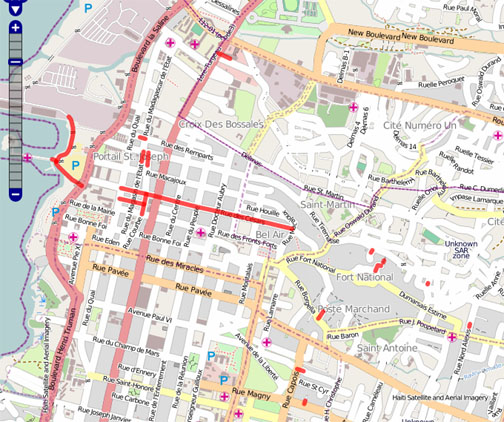
 Now people can help map the relief operation in Haiti – at Ushahidi, a crowd-sourcing site I love to support.
 I’m sitting here with a cup of tea, and it gives me great satisfaction to link to this article on the company behind it.
 This is about the first of the 4Cs –the power (and the potential) to collaborate.
 1. Butterflies:
 2. Media coverage
 Hoipolloireport