As a new batch of eBooks begin to roll out, the excitement is palpable.
A stark historical record of an event largely forgotten.
It’s that time of the semester, when my 7th graders begin to write and publish their eBooks. The idea of being a ‘published’ author fires them up. They have stories waiting to take flight, and I see my job as a technology teacher paving the runway.
Consider these titles in the works:
‘The Hotel’ — About a boy who gets trapped in a hotel and uncovers its dark secrets.
‘Thalassophobia’ — Yes that obscure fear of the ocean, in a twisted story.
‘Racetrack’ — The diary of a ‘newsie’ in New York City’s past. Sounds like I’ll discover a historical fiction writer.
‘Cinders and Scales’ — A fantasy novel about a girl named Cinder, and the ‘scales’ seem to imply something else.
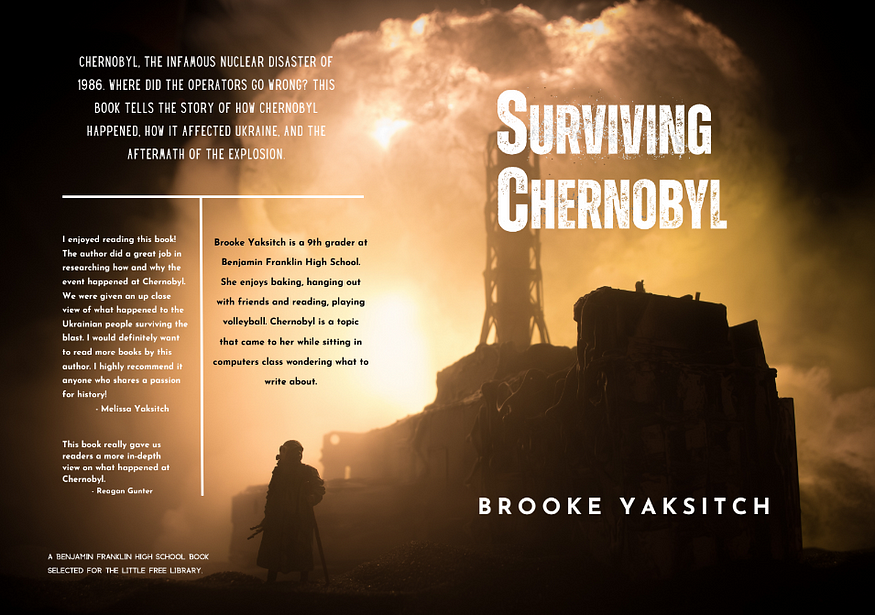
‘Surviving Chernobyl’ — About the radioactive accident in Ukraine in April 1986. The student wrote this book two years ago, and today came in ask me to help her print 10 copies. The above image was the cover we uploaded.
There are more! So don’t let anyone tell you that Gen Z can’t write. They can, if we get them off their phones. Working in a classical school, this I know: Good writers become good consumers of content; Good readers develop good communication skills whether it’s a science report, or a paper about the ghost in Hamlet.
If you’re reading this, you already know the value of cultivating writers and readers. Someday their books will be on the bookshelves of my local library. Until then, they’re on the shelves in my Little Free Library at school.
Answer me this: QR code or printed menus? The smell of newsprint, or a PDF on your phone?
I only ask because I’m conflicted too. I use both. That PDF file on a six-inch screen is annoying to read, but is easily magnified with a two-finger ‘pinch’ of its vector format. A newspaper, however (folded and crumpled and even slightly out of date) still draws me in. I keep old copies of the Wall Street Journal in my magazine rack in my class (Note to Gen Z: Yes, magazine racks were once a thing!) This means reading material is just footsteps away from my students. No need to click, mess with captchas, or try to dodge that paywall.
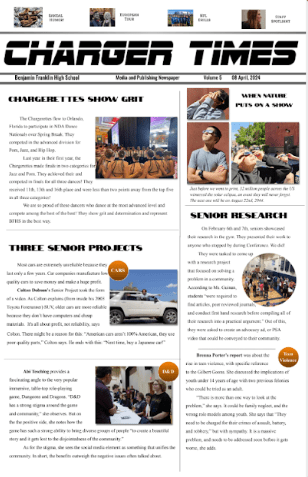
There’s a deeper reason I ask ‘who reads news?’ I want to know who reads beyond the clickbait headline and the first graph? Video clips are the boss of news. At least in my network. Which brings me to the existential question for a teacher: Should we teach writing? If a newspaper falls in the forest of TikToks will anyone look? Meanwhile, here’s what we publish — both in print and as a digital version. Click on the image or this link and you will see what my students put together.
As I buck the trend I give my students my spiel about about story craft. And voice. And that old-school who-what-when-where-why model which never gets old.
Despite what you may hear, we do have a critical mass of readers today who will consume original news — as opposed to screenshots and opinions. (That, I fear, is dwindling faster than the number of pictures of avocado toast that spiked during Covid.) It just depends how they read. At the close of 2023, The New York Times grew to 10.36 million subscribers, 9.7 million of them digital-only. Print subscribers have been dropping!
We are now living in ‘news deserts.’ Just the term News Deserts is disturbing. In February, during News Literacy Week, I ran into some disturbing facts via The Medill School of Journalism about the crisis in journalism. Some highlights:
Since 2005, the U.S. has lost nearly 2,900 newspapers. Of about 6,000 newspapers left standing (600!) most of them are weeklies.
228 counties are now at an elevated risk of becoming news deserts in the next five years.
Let’s start by addressing where do we get our first frame of news? Is it (a) Our network? (b) An app on our phone? (c) That 30-minute TV news segment with a talking head?
For years I have been getting my news via Google News. It always felt slightly unethical since I know Google doesn’t pay news organizations to carry the stories. I don’t want to cry at the funeral of newspapers, while carrying the coffin nails in my pocket. Neither do I want my students to do so, if I can help it. I now pay for an online news subscription to a major newspaper, and have an annual subscription to two magazines.
Perhaps they would one day reach for the dead-tree version in my magazine rack.
Now for the rest of the story. Podcasting is nothing more than a person with a mic and a story well told. But, on a production level, it could get complicated when you add stuff like a ‘DAW’ or a digital audio workstation – a fancy term for a recording and editing software. Or multiple guests.
I love the spontaneity of podcasting, letting guests be themselves, warts and all. Yet I like to edit much; tighten things up, with intros, outros, multiple tracks for voices, and occasional sound effects etc. I use Hindenburg Pro for a bulk of the work, and Anchor.fmto upload the finished product to Apple Podcasts, Spotify and the likes.
The more ‘guests’ you have, the complexity ramps up. There’s overlapping audio when someone occasionally talks over another (a good thing?), bloopers that could be left in –and sometimes should – but at the expense of duration of the podcast. And sound levels to adjust, especially if you have a mic that allows for switching between cardioid (for voices directly in front), and omnidirectional. When I have forgotten to switch modes, the results have been…meh!
Some history here: There was a time, c. 2011, I when Derrick Mains and I hosted a radio show out of Phoenix we called Your3BL (listen here!) which stood for ‘Your Triple Bottom Line.’ It was out of KFNX studios hidden away in a nondescript strip mall. The man behind the glass did all the mixing and sound balancing, so it was pretty easy for us hosts. But Derrick and I liked to shake things up a bit now and then. Sometimes, we recorded the show elsewhere. Like one at Gangplank, a co-working space. There was a time I hosted it on a laptop in a classroom at Clark University in Boston with Derrick in Phoenix. We called in, through a dedicated phone line to the studio. That was one of the ‘live’ events that stretched my capabilities, but the recording taught me a lot about podcast production.
Recently I decided to interview two guests in school, and thought of upping the ante a bit. We recorded it in the gymnasium. That’s asking for trouble, if you know something about the cathedral-acoustics in a gym. Especially, when it’s the first time.
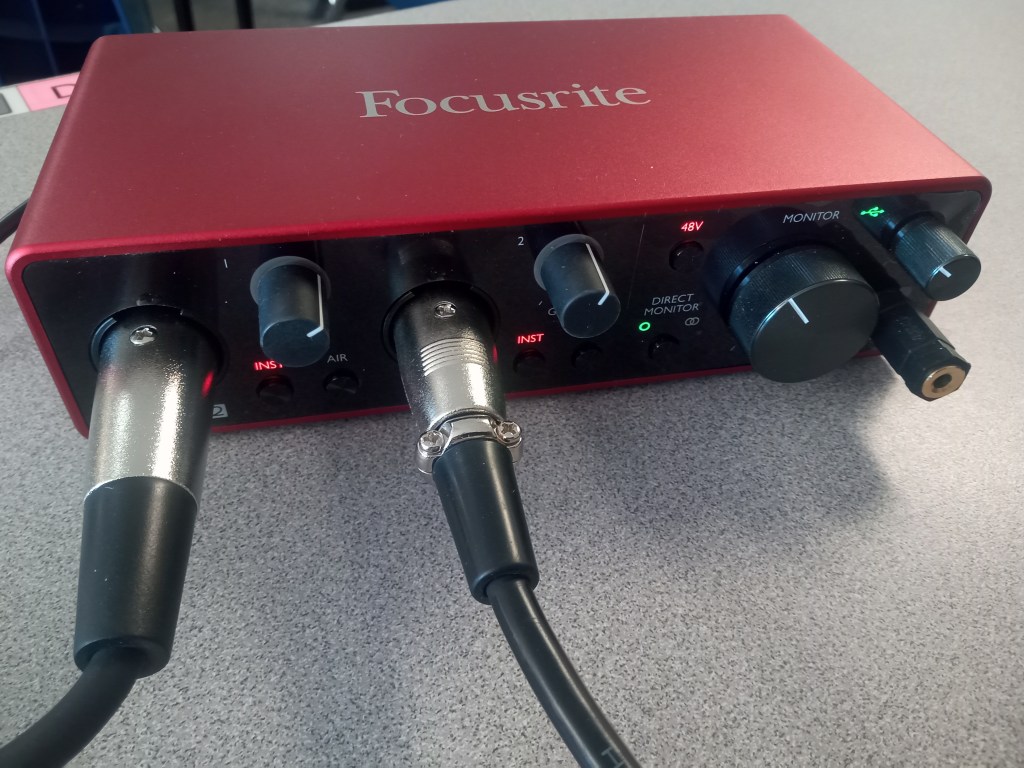
I wanted the acoustics to feel like it was a large space. Then there was the fact that we had two audiences: the ones in front of us, and the ones who would listen to the recording. The student audience in the bleachers came through loud and clear, cheering wildly when our two guests were introduced. But would the recording pick up the exuberance? To compensate, I had a back-up recorder on the desk, my trusty ZoomH4N Pro. I could grab that feed if I needed in editing. There was also a video camera at the back of the gym, hooked to a wireless lavalier mic which I placed next to our guests. This and the desk mic were plugged it in through the Scarlett Focusrite mixer. (That video mic feed came handy in editing, since one of our guests, an awesome pianist, played the theme from Pirates of the Caribbean which overpowered the desk mic. I was able to splice the better audio in later.)
You learn something! Like wishing I had two clip-on mics for the guests. I know, overkill! Or testing sound levels in the vast space before the real thing.
As for our guests, they were freshmen Reina Ley and Landon Madsen. A few weeks before, (Sept 2022), Reina had auditioned on NBC’s The Voice. That same month, Landon, the pianist, had given a stunning performance at our talent show, Franklin’s Got Talent. The podcast were were recording, was a way to celebrate our student’s achievements, as we often do during morning assembly. Moments like this not only memorialize these particular achievements, they reveal something about all our students. The often unspoken talent hurrying through these hallways, toting trombones, football gear, trifolds, and other paraphernalia.
Here’s where the learning gets more interesting. This experiment in podcasting doubled up as an assignment for students in my class on Writing and Publishing in the Digital Age. I got them to help me set up the hardware in the gym. They were the ones manning the video camera, and doing the sound checks. Another was the photojournalist, with a regular camera. After fall break, these students will take this video feed and turn it into a news story, worthy of television. We have practiced with a green screen, so there will be an anchor, a reporter on the scene etc. Who knows where this will go! This, to me is what makes learning more hands-on, and lets them apply the theory of storytelling to real work they could publish (On Medium, the class website, and elsewhere) and see their output. Next month, they will be recording mock political debates in a history class, and produce a newspaper with many of these stories.
They, like me, love the challenge. After all, much of this (and the podcast) takes place in the Computer Lab. I remind my students, ad nauseam, it’s after all a ‘lab’ –where we are supposed to experiment!
I may sound like a panjandrum (a word that rear-ended me the other day) because I’m not a huge fan of neologisms. Some of these recent words seem to be arriving by the truckload. It’s one thing to say ‘nonversation’ and ‘hangry’ — at least they mean what they sound like. But when did staycation and mansplaining become OK? Who comes up with this stuff? The Atlantic ran a piece that sheds some light on it.
There was a time when we had to explain (geeksplain?) what webinars, and dongles, and hashtags were. [Webinar, let’s face it, is a horrible word that should have been excommunicated with words like optics and more recent ones like spreadneck. Never heard of the latter? I’m glad.]
As for that Dongle? This was the name for that device you had to stick into your computer when you needed Internet access abroad. What an obtuse word! Hotspots probably severed our connections with the dongle world. We have other things we still plunge into our ports: thumb drives, also known as flash drive, USB drives, or stick drives.
Did you know that smellifungus is not what it sounds like? It would be perfect for describing the bacterial residue in your gym socks, but unfortunately it describes a person — a super-annoying whiner who bickers about inconsequential things. It’s female equivalent is someone social media labels a Karen.
Language, you see, is a collywobble, especially across the culturescape of english language speakers. We make things up — and repeat them — as we go. A breve, served at coffee shops in Tempe, Arizona could mean nothing to a tea drinker in Haputale, Sri Lanka which serves delicious kahata — a word thatcould flummox any tea drinker in Kensington palace, whether or not she uses the word flummox, which showed up in Tolkien.
Neologisms like kerplunk and digerati are all over the place. I recently heard that based is supposed to mean what teenagers in the Grease era considered cool. My daughter tells me that she abhors the term spinfluencers which is a subset of influencers, thatwacky Insta label for people once known as ‘thought leaders.’) WIRED just ran a cover story on micro-influencers, and nano-influencers, so there may be a whole new species out there about whom I know diddly-squat.
By the way, panjandrum is one of those delightful made-up words from 1755 with a humorous origin. Webster’s best explains it here.
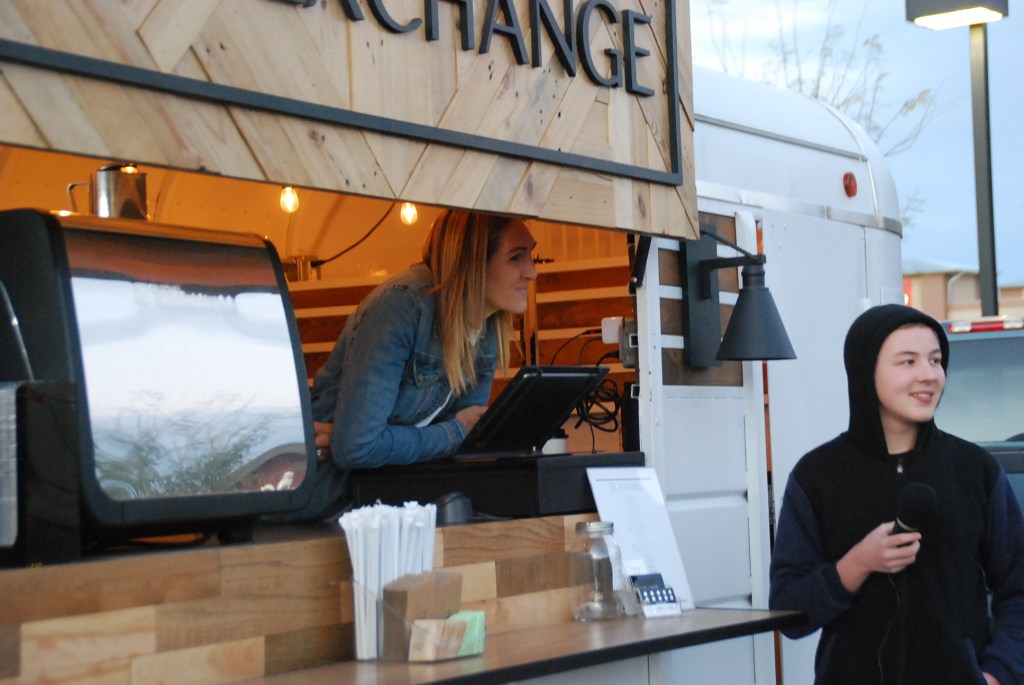
Today, no sooner I got to school, I saw an email to staff about a coffee truck stopping by. A fundraiser for the school’s Cheer team. Not your common or garden food truck (a converted horse trailer) Exchange Coffee is a company with an interesting origin story.
So as my students came to class — my Writing and Publishing class –I nixed the day’s assignment on my lesson plan and asked them if they like to work as an impromptu news team. Grab a camera and some mics I told them. Someone needed to prep for the story, to look up some background information of the owners of Exchange Coffee. Another began to write down possible questions on a small white board while two others tested the audio, and if the clip-on mic units were charged. Clip-on mics aren’t the best for impromptu stories, so one student, adapted our ‘dummy’ mic to the Hotec clip-on, so that it communicated back to the camera. We rushed downstairs. I asked the owners (who also make and serve the coffee) if it was OK to do a story about them.
Once that was cleared, I got the students to shoot some B-roll. A school bus rolling in. A weird half moon was rising as the sun came over the Queen Creek horizon. An engine roared –possibly a train or a noisy aircraft from the nearby Phoenix-Mesa Gateway airport. Sound engineer? Check. Camera person? Check. Reporter? Check.
As we began to roll, Don Meyer, an English teacher unexpectedly wheeled into frame, in full biking gear. Perfect! (I’ve featured Mr. Meyer on a podcast and blog post so I was confident this ‘customer’ would agree to being in the story.) The story was suddenly growing more legs. The ‘reporter’ began describing the scene, and got a interview with the owner/barista.
The audio quality turned out better than we expected. More than that, our reporter sounded like a reporter, despte just having 5 minutes of planning the story. The camera person got her right shots. Fifteen minutes to the bell, we switched off the tech and headed back to class to review the work.
NOW COMES THE LEARNING PART. I will play back the recording, and over the next few days and have the students critique their work. Could they have done anything different? What about lighting? What about camera angles? What if this was an ‘incident’? How would they handle it? Could they have interviewed customers? Could they have got a different camera angle – say from inside the truck?
Publishing in a digital world is tricky business. It’s never static. Stories, like lesson plans are always in flux. The best lessons are learned on the job. We are often poised at the top of the Bloom’s taxonomy pyramid, ‘creating original work,’ investigating, revising, reconstructing knowledge in the moment. Sometimes a coffee truck hijacks the lesson plan. You adapt and run with it.
Tomorrow I have invited an author, Jessica McCann, talk to the class about the writing craft, about fiction, and picking out details for a story. Does a video story or podcast have something in common with a novel? We’ll ask!
NEXT WEEK, my students will be working on podcasts. Who knows where this –and what unplanned events – will take my class. Stay tuned. Didn’t I mention – my class starts at 6:30 am? I might need more coffee!
This year too I am so inspired by the work that students in my computer class have produced. Their capstone project is a 24-page eBook, and this year I relaxed the guidelines and let them choose any topic. I wanted to see how they use this moment in time to come up with ideas, rather with no boundaries.
I wanted to see what has been brewing in the minds of young people. I was in for a shock! This semester, I noticed more fiction emerging than all the semesters before, combined. Even the non-fiction was telling. Topics include, “The most tragic events in history,” the solar system, and one on somewhat gruesome events of World War II. But the outpouring of fiction made me have to allow them to go beyond the 24-page requirement.
Here are some of the topics:
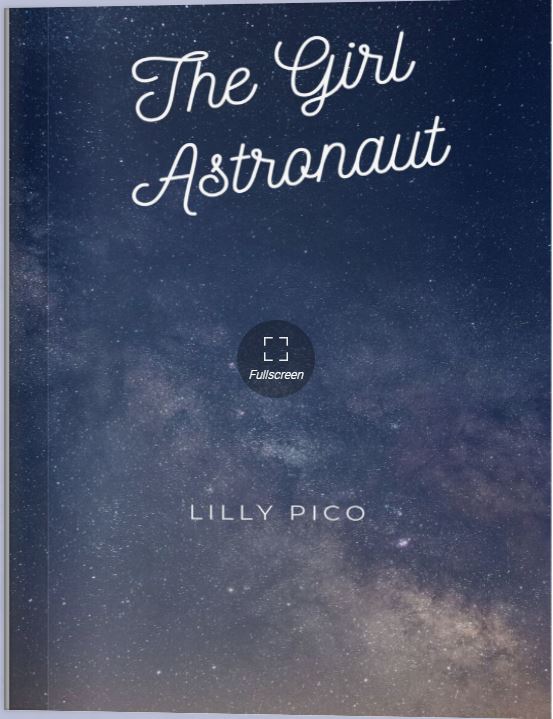
“The Mind Traveler,” “The Girl Astronaut,” “A Vacation in the Woods,” “The Mystery Letters.” Two books on Softball as a backdrop to drama, two on dance techniques, a romance, one on the harmful technologies affecting young people, and one two on mental illness. There’s more….
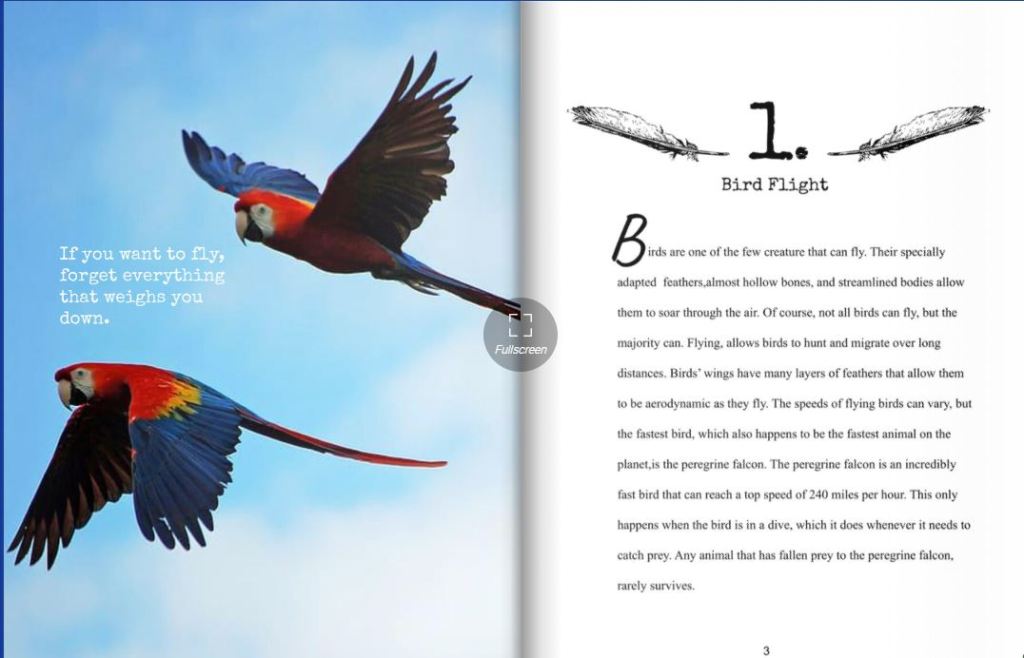
My students design the front and back covers using only copyright-free images, they control margins, and on my insistence, ad nauseam, use plenty of white space. Take a look at these, and let me know if what we are seeing an explosion of creativity in 12 and 13 year olds. Perhaps this year with so many ups and downs has rekindled the urge to read, imagine and tell stories. I hope I am right.
It makes being a teacher so rewarding!
Click on the images and they link to actual eBooks.
One of my colleagues at Benjamin Franklin High School, is a pro at the Socratic seminar. The onus, he says, is on us teachers to make sure we aren’t just encouraging idle passengers on their educational journey. There needs to be a ‘method’ to help them interact with the material we teachers present.
That method, says Jason Klicker is the Socratic seminar. Here’s his fascinating example, Klicker-style:
Image, courtesy Jordan Nix, Unsplash.com
“A student wants to know how to make a grilled cheese sandwich. Instead of telling them how to make (or even worse, just making it for them), I ask them if a grilled cheese sandwich is like other sandwiches they know how to make. When they say yes, I ask them what is similar and what is different. Over the course of the discussion, the students learns for themselves how a grilled cheese sandwich is different from a BLT, and knows how to make one. After they think they are ready, I watch them do it, giving them pointers along the way. The sandwich might not taste delicious the first few times they try, but their knowledge allows them to have confidence to try in the future.
“While we don’t discuss grilled cheese in my class, we do ask questions like “what is justice?” or “how do you secure your freedom that you have been given?”. Both are important questions for important times. It’s frustrating for the student at first, as it should be. I’m not giving them the answer, they have to find it for themselves. In the end, They have a deeper understanding of justice or freedom than they could ever get if I just simply lectured at them.”
Most importantly, says Mr. Klicker, “They have taken charge of their own education because they were in the driver’s seat instead of being an idle passenger. They are also much better people for it.”
Despite the disruptions we have had since March this year –indeed because of the having to adapt to COVID — all teachers have had to turn up the creativity thermostat in how we engage young people. Many of my students in the computer lab are remote, or have moved between in-class and online. Using higher order thinking and engagement techniques are di rigueur. Nothing like a 2,500 year old technique to motivate the mind.
One of the long, ridiculous exchanges in the presidential debates last night was on voter fraud, a perpetual conspiracy theory of president Trump. “This is going to be a fraud like you’ve never seen,” he said.
Courtesy, Noah Pederson -Unsplash.com
Whenever I see the word ‘fraud‘ in the same sentence as ‘ballots‘ I wonder why software companies haven’t stepped in to fix this. With some of the best software companies addressing all kinds of threats, whether it’s banking or homeland security, why has ballot encryption been on the back burner?
It appears that the software solution has been in the make-up room, but has never made a grand appearance on stage. About a decade ago, there was a suggestion that we might have ballots that use invisible ink that ‘code’ a ballot as well.
“…instead of filling in a bubble next to a candidate’s name, the voter uses a special pen that exposes a code printed inside the bubble in invisible ink. A voter can write down that code, along with the serial number of her ballot, to later verify the results online.”
Larry Hardesty, MIT News Office
Encryption is all grown up now. There is a product, according to a recent WIRED article, called ‘STAR‘ developed out of an initiative in Travis County, Texas. Benjamin Wofford’s article traces the path of the development, the ‘secure, transparent, auditable, and reliable encryption solution (hence the STAR acronym) of the software.
To summarize it, STAR converts a person’s vote at the voting machine into a ‘hash code‘ that could be printed out and taken, similar to how we leave a grocery store with a receipt of our transaction. Voter impersonation with this system is very easily detected. The best part is, votes can go back and check or track if their vote has been cast and counted.
It’s about time. We have turned to encryption for everything from text messages and financial transactions. It’s time we encrypt the vote.
So what’s the Facebook-fueled fad about ‘pandemic pods‘ all about? As with many fads, it’s something that’s been around for more than a century. Since 1906, to be exact.
And the model? A small house –a casa. Basically a ‘house of children’ or ‘Casa dei Bambini.’ That was, of course, the first successful hands-on school begun by Maria Montessori. If Facebook had been around, someone would have called these nano-schools, or a ‘practical life pods.’ Maria Montessori didn’t need likes. If she had followers, they included poor and working-class parents with challenged kids. Oh, and there were folks like Alexander Graham Bell, an early promoter of her method when it came the America.
This prolonged pandemic, and the need to isolate ourselves has thrown a large curve ball at us parents, business owners and most importantly, children. Suddenly the large ‘campuses’ with sometimes 3000 students are frightening. The home-school model or the Montessori ‘house’ clearly addresses many of the concerns parents have. Not the masks or no-masks, or 6-foot-rule question. But questions and concerns such as:
What’s the alternative to sticking my child in front of an iPad?
My child needs to be outdoors as much as academics. More trees than apps!
Social media is killing socialization. I need a school that is ‘offline’ for eight hours of the day.
As schools get ready to make the large-school experience more engaging, and personal, more of these models will crop up. Maria Montessori would be pleased. Children need a safe place to learn, exchange ideas and socialize not something akin to an office space, where everyone’s glued to a screen.
On 11th July, we lost one of Sri Lanka’s premier creative spirits, my former boss and old friend Lilamani Dias-Benson.
There are so many facets of Lilamani, it would take a book to document her work and legacy. But as many people remember her she infused indefatigable creative energy into advertising from the moment she stepped onto the scene. You could say she metaphorically dominated the room she entered, whether it was an uncomfortable client meeting, a photo-shoot, or a ‘plans-board meeting’ as we called it at JWT. She would not initially say much but with a few words made everyone reconsider what was at stake. With a few flourishes of a pencil she would coax you out of your comfort zone and revise the pathetic radio script you brought in on deadline.
I grew up as a cub copywriter at JWT when she took over the reigns in 1986, I believe. For whatever reason my art director friend Rhizvie Saldin and I came under her wing, attending high-powered client briefings, and strategic planning sessions that were above our heads at that time. I was just out of college, and had to bone up on ‘T-Plans’ (the Thompson planning document), and layout theory she made us imbibe late into the evenings. She would cite poetry, refer to advertising legends such as George Lois, and challenge us to “come to the edge”.
That was a favorite poem of hers that she would quote, ad nauseam. It went:
“Come to the edge. We might fall. Come to the edge. It’s too high! COME TO THE EDGE! And they came And he pushed And they flew.”
(I am sure many of you in advertising who passed through her doors have heard her on this.)
I remember Lilamani recite this poem at a JWT creative workshop somewhere in Bentota, and then at a client meeting at John Keells. She pushed, cajoled, inspired, and delighted everyone around her to recognize creativity, whether they approved of the idea or not. Unilever meetings were bristly, but we came away with brand managers signing of on creative concepts they rejected a few minutes before! As a boss, she defended our work with a passion. (A perfectionist, if she spotted a tiny spelling error or a layout glitch, we would hear it on our way back to the office!) When I left JWT for studies in England, Lilamani invited me to an Unilever meeting in London, making sure the corporates met someone who worked on their brand. I couldn’t figure out why that was necessary, but in hindsight it was her way of giving me wings.
Lilamani was someone who spoke of something that is oddly relevant for our times – the idea of being ‘infectious‘ long before the tired phrase ‘going viral‘ came into vogue. You can hear her expound on it in that hilarious sitcom episode withNimmi Harasgama (Aunty Netta)
“Infectious is different to infection,” she explains, because “what I do you catch,” especially something nice. And if I am to paraphrase what she was getting at, she was expounding on how creative ideas circulate, inspire, and return in ways you can never control. This is probably what many of her students experienced, and now continue to spread the Lilamani Dias-Benson brand of creativity whatever they touch.







 On 11th July, we lost one of Sri Lanka’s premier creative spirits, my former boss and old friend Lilamani Dias-Benson.
 Hoipolloireport