Beijing Olympic Report: Branded Entertainment

By amazing coincidence, I heard a bit of Rush Limbaugh this morning, philosophizing on the reason the Olympics attracts a female audience, and his theory was that the Olympics is a hugely ‘chickified’ event filled with stories of rags-to-riches and oppressed people overcoming the odds. They dig it not for the sports, but for the emotion, he went on. Limbaugh is famous for this kind of nonsense, but he’s going to feel vindicated because of how Kleenex plays into this angle.

I’ll leave it to Rohit Bhargava, my guest blogger from Beijing to take it from here.

If you are one of those people that gets in front of the television every evening with a box of tissues to get ready for the melodramatic overload that is the American television coverage of the Olympics, then you’ll be thrilled to know that as part of their sponsorship of the US Olympic team, Kleenex commissioned a documentary to take an inside look at some of the most powerful tear-jerking moments in the Olympics over the past few years. The film is mostly focused on the US (to match their sponsorship) and takes you on a hosted journey with a nameless host who plays the part of “good listener” as past and future hopeful US Olympic athletes are interviewed on a blue couch about their Olympic moments and aspirations.

I had the chance yesterday to go the film premiere at the USA House here in Beijing and it was a well attended affair with lots of recognizable US Olympians, including Julie Foudy, Scott Hamilton, Lenny Krayzelburg, and a few others (see my photos on Flickr). The venue was “homebase” for USOC team members and lots of American gear was available for sale. It was the perfect venue for the premiere and a well put together event. The film itself is a really nice piece of branded entertainment and does well to promote the role of Kleenex brand in the Olympics and in each of our lives, encouraging people to “let it out” without being overly branded. Great job by brand manager Anya Schmidt and the rest of the Kleenex team to keep the branding soft on this project.

I am a fan of Kleenex brand, but I do think that they have a larger strategic problem that likely won’t be solved by a campaign like this or even through an Olympic sponsorship. One of their biggest challenges surely must be the commoditization of their brand. The fact is, people call every kind of tissue a Kleenex. They own the category, but need to continually explain to people why it matters that you buy Kleenex instead of the cheaper store brand. Just once I would love to see them take the road of comparing their brand’s superiority to cheaper imitations. I can already picture the thirty second spot. Guy and girl on a first date go to see a sappy movie. Girl is crying and guy tries to be smooth by handing her a “Kleenex.” She blows her nose, the tissue rips and she messes up her expensive “first date dress.” The ad ends with her looking at him angrily as the tagline fades in: “Kleenex … Because Everything Else Blows.”

Damn, I’m good. I should do this for a living.

PS – Check out the trailer for the film below – its actually really good and will be premiering for a limited engagement in theaters in 25 cities starting August 13th across the US. It will also be available on www.letitout.com from August 14th.

To read more real athlete’s stories, visit Lenovo’s Voices of the Olympic Games!

Billboard campaign minus Clear Channel costs

There’s a ‘billboard’ outside Hollywood Alley, a restaurant in Mesa that’s doing something really creative. It changes every week day, with a funny, punny line from a movie, adapted to say something about food.

Yesterday it was “I see fed people” (wouldn’t be such a bad pun if it was a restaurant in Washington DC); Some days back it was more clever: “Houston, we have a pickle!

It’s an interesting experiment, reinventing the tried and tested media vehicle (literally), to display more than a name, or a logo. Even if the lines are too obscure or pun-dependent, there’s evidence of smart brand thinking. Too often people assume ‘branding’ is something you have to do with your logo, when it’s all about the experience.

If you’re in the area (NE corner of Baseline and the 101) look out for the featured movie of the day! Or heck! Call them up and suggest a line.

‘Janet’ in Twitterspehere prompts urgent CPR

CPR is not what you think. I will get to that later.

Common sense tells us that the time to start monitoring a brand is long before the sushi hits the ventilator. But social media always blindsides us. It’s called a Brand Hijack for a good reason. Brand Hikacking, described asthe consumer‘s act of commandeering a brand from the marketing professionals and driving its evolution,” could be “the employee‘s act of commandeering” as well.

Interesting to see how Exxon Mobil will handle what appears to be an employee micro-blogging without been anointed by the PR and marketing department. Someone going as Janet has been sending Twitter updates, but the blogosphere, including Shel Holtz figured out it was not an official Exxon Mobil tweet.

Jeremiah Owyang has been in touch with Exxon Mobil, whose comments, as they seem to wrestle with way to handle this, are enlightening. Especially if you are doing top-down CPR (Communication/PR) in the organization. I am reminded of Alan Jenkin‘s observation that “The shelf life of any “tweet” is about 20 minutes. But tweets are carved in stone.”

The bottom line of course being the need constantly to monitor your brand in the blogosphere.

Quotes for the week ending 12 July, 2008

“He brought wit, grace and a great love of country to his work.”

President Bush, on Tony Snow, former White House press secretary who died today.

“But Obama is not just tacking gently toward the center. He’s lurching right when it suits him, and he’s zigging with the kind of reckless abandon that’s guaranteed to cause disillusion, if not whiplash.”

Bob Herbert, syndicated columnist for The New York Times

“Wake up and smell the rice Mr. Ploom! Im tired of Americans who don’t know a thing about the beauty, complexity or richness of Chinese culture.”

Online reader comment to a story about Ambush Marketing at the Olympics, by Businessweek. The story turned into an ugly exchange between readers from Japan and China.

“…it’s not the story about of the burglar who fell asleep on the resident’s couch that matters. Instead, it’s the everyday news affecting everyday life that we hope keep you coming back.”

Jacqueline Shoyeb, Online Editor, Mesa Republic

“As a metaphor, it’s strained. As a narrative –well, it has none.”

Bob Garfield, in Advertising Age, on the ad for HP’s TouchSmart PC, that he calls a large step ahead of the Mac.

“Together, they represent the real stories of the Games.”

Lenovo launching a web site called “Voices of the Olympic Games” featuring 100 athletes, from more than 25 countries.

Apple’s glass shrine beats all billboards

Grand Central Terminal and the Apple store on 5th Avenue in Manhattan have one thing in common. They suck people in!

Grand Central terminalThe former is 95 years old, and the latter is just two! One has utilitarian value the other cult value. Whereas more than 25,000 people pass through Grand Central each day, thousands of people come to the Apple store on 5th Avenue to go nowhere fast. They caress the iPods and gaze at other cool people.

Like the station, the 32-foot glass cube that sits on top of the store is open 365 days of the year. When I visited it seemed that people were treating this like a piazza, or park. Some were engrossed over their Macbooks, some having conversations and others seemed transfixed around the huge ‘genius bar’ waiting for their turn to be delighted.

Apple store - 5th Avenue, ManhattanIt struck me that like the station, there could very well be a ticket counter, and the people would pay to get in. Not that this is even necessary. Apple devotees are actually paying to be there –with their attention. Today. In a time when people are largely ignoring brands and blocking out branded messages, getting people to walk in (opt-in?) to an environment that’s eighty percent logo is pure genius.

A few blocks away, there’s a Best Buy right next to a Circuit City. I didn’t see young people sitting outside their sidewalk with open laptops, or taking pictures of the Best Buy logo. Apple has cracked the code of branding and billboarding by not simply slapping a logo onto a large (expensive) flat surface, but by building a shrine that pretends to be sign that pretends to be a store.

Quotes for the week ending 14 June, 2008

“Today, it has become an economic, environmental and brand liability for the company.”
Advertising Age’s jean Halliday, commenting on Hummer, and GM’s CEO Rick Wagoner suggesting the company may dump the brand.

“Scott McClellan is having a ‘Matrix’ moment.”

Mark Dery, who teaches journalism at NYU, on former White House press secretary’s book, and waking up for the dream made up of a media fiction.

“Prime time is still the right time.”

WIRED article on why broadcast ad sales are strong, in spite of the economic slump and other woes.

“Hi. My name is Steve and I suffer from Shiny Object Syndrome (SOS for short).”

Steve Rubel, on how to sift through shiny objects in social media sites such as FriendFeed, that he is bullish about.

This is more than a facelift.”

Facebook spokesperson, about the new, improved Facebook with added vitamins 🙂

“Britannica goes wiki without actually admitting it.”

One of the many (in my opinion mistaken) responses to the news of Encyclopedia Britannica shifting gears into a more collaborative model.

“One of the premier political journalists and analysts of his time.”

Tom Brokaw on NBC’s Tim Russert who died of a heart attack.

Coke side of the Olympics through arty microsite

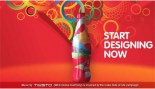
Coke’s move before the the activity ramps up in China next month for the Olympics, includes this wonderful microsite tied to collaboration.

The site and the project is called we8 –uniting 8 of Chinas musicians and design firms with 8 musicians of the West -as the pitch goes.

A very slick site, with a design your own bottle invitation. But what’s up with the eight themes such as optimism and healthy world? By the way, very clever we8 logo, based on east-meets-west.

Honda’s live TV ad demonstrates what?

I often state that I am turned off when a company tries to make an ad out of a logo, because it demonstrates (a) that the strategy is based on an inflated sense of the mark, and (b) an assumption that we consumers have this great love affair with a company’s name and logo.

This execution from Honda Accord in the UK is admirable, because it tries to demonstrate the tagline (“The power of dreams”) and the slogan “Difficult is worth doing” using not the logo but the brand name.

What was unusual was that this TV ad was broadcast live yesterday at 8.10 PM on Channel 4, using 16 skydivers who form the five letters H-O-N-D-A during a free fall. Before the ad ran, an announcer prefaced it by calling it a ‘live break.’

But while this is entertaining, un-commercial like, and creates some buzz, what exactly does it demonstrate about the car? That difficult challenges are something you could overcome while driving an Accord? It doesn’t compare it to other stunts such as Adidas’ Imposible is nothing work on the vertical face of buildings (during the Olympics). To me it seemed more like “Honda is so cool, we thought you’d skip the bathroom break and see our name in the clouds.”

Avoiding product, hiding logos gain vogue

There used to be a backlash against showing the huge ugly logo of a company in the ad …in the late eighties, I believe. That was a reaction to the ‘branding’ mantra.

Now there’s a return to stealth branding, thanks to YouTube and viral distribution.

This ad –if you can call it that — for Levi’s features no close-up shot of the label. Just a few guys doing stunts, diving into their brand, that make it extremely watchable. It has been viewed over two million times todate.

Gawker makes an interesting comparison between Levis and Ray-ban about how the stunt is such a formula for going viral today.

Looks like the idea of hiding the logo has gained vogue, telling us something: People are tired of logos masquerading as ads. A logo is nothing, if it does not give you a reason why to buy or subscribe. I don’t use Skype over Google talk because of the cool blue logo. They can hide it from my call interface for all I care. (It’s so tiny, I don’t even notice it is there.) They have made the experience worth coming back to, and paying for, in my case.