A working model of ‘Social Capital’

I’ve been indulging in Wikis a lot this year.

I wrote quite a bit on the topic here and elsewhere, recently. And his Monday I was in charge of the wiki portion of what amounts to the launch of the first open source business development plan in Sustainability, for Arizona. More about this here.

So on Wednesday, when I visited Gangplank to get a better sense of this remarkable working environment I could not help notice the parallel.

If Gangplank is a piece of software, it would most probably be a Wiki!

It’s a a true collaborative space, whose ‘permanent residents’ (independent businesses) don’t pay rent, though they get to use the utilities, the workspace, conference rooms, wifi etc for no charge. Derek Neighbors, co-founder of Gangplank and our guest on the radio show this week, prefers to call this an investment in ‘social capital.’ It reminded me of another semi-financial term used in the book Groundswell –how collaboration earns a person ‘psychic income.’

But to get back to the topic of wikis, if you consider how much time has gone into Wikipedia –approximately 1 million man hours, according to Clay Shirky-– it is a model that works even among largely anonymous people. So of course it world work when you get a room filled with creative people.

Just step into Gangplank, and you’ll see a working model -or a ‘use case’ if you prefer another geeky term!

Think local, buy local, says Park&Co

You’ve probably seen how some cities (like this and this) have attempted to rein in local dollars and boost their economies with campaigns for buying local. We have our own push here with Local First Arizona, a non-profit group promoting your support of locally owned businesses throughout the state.

But apart from this move to nurture small businesses such as nurseries, nail parlors and ethnic restaurants, there is a lot of money moving out in terms of … advertising. Park & Co have put together a microsite featuring nine agencies (apart from Park&Co), with a push that urges companies to rethink where they s(p)end their dollars.

“You buy local produce, seek out locally owned stores, and drink local wines. So why go to other markets like L.A. for your advertising? Phoenix agencies offer a wealth of talent, from brand strategy and development to internationally award-winning creative, as well as innovative interactive campaigns and Hollywood-caliber film and video production. And you don’t have to look far.”

Park and CoAs Time magazine once put it, the buy-local trend “enhances the ‘velocity’ of money.” But most people only think of products, not services, says Park Howell, who says that it is time to focus on buying local business services, specifically advertising, creative and communications. “We’re promoting our competition because we’re big believers in a rising tide lifts all boats. There’s plenty of business to go around, so keep it local.”

When you can’t broadcast, why not podcast?

A funny thing happened on the way to the radio station this week.

We had a great guest lined up, but were informed a day before that that time slot –7 PM Arizona time — was being preempted because the station, KFNX, had a prior commitment to carry the University of Arizona basketball game.

Rather than take a hiatus, I decided to pull out my trusty Zoom H4N and record a podcast with my co-host Derrick Mains. It happened to be a fitting week to talk of the launch of a baseline study by his company, GreenNurture and Miller Consultants. (More details here at the show web site.) This podcast also includes a report from Heather Clancy, our second on-the-ground correspondent.

The irony of this is, the radio show grew out of a weekly podcast! So, using social media-based format to broadcast a ‘show’  is more than a fall back. It’s an integral part of what I’m doing in radio in the digital era.

Fear of Wikis may grow after Wikileaks

Have you ever edited a Wiki, let alone created one? It’s a lot of work at the front end to start one. I used to create small wikis on WetPaint for projects just to let a handful of people collaborate, since it eliminates the back-and-forth emails, and the friction that may arise about editing rights to a document.

But each time I recommend creating a wiki, I see a lot of blank stares; eyes begin to roll. No surprise. After all, it still involves understanding a bit of code, and is not as sexy as say a blog platform. But I suspect that the fear-and-loathing factor will now come into play, with the latest round of Wikileaks.

The media covers it more as a cat-and-mouse game with Julian Asange on the run. The Wikileaks.info site itself has been under attack appareantly, and is being mirrored elsewhere.

The site carries this line, “Have documents the world needs to see?” which is all about contributing and sharing. Wikipedia, whose central tenet is centered around sharing (“People of all ages, cultures and backgrounds can add or edit article prose, references, images and other media here.” ) is all about creating information that people may need to access.

There are other Wikis worth taking a look at, if only to diffuse the anxiety about sharing documents online.

  • Take Open Congress. It claims to be “an online encyclopedia about Congress, but more than that, it’s built entirely by readers like yourself. You can write about the importance of a particular vote on a critical piece of legislation, or document your senator’s position on issues like foreign policy, taxation and the environment.”
  • There are Education Wikis like this, created by Librarians, Charter schools, drama teachers. There are platforms such as Knol, and Open Education Wiki.

And I am only scratching the surface of how wide and deep Wiki use is. I just hope, once the WikiLeaks rumpus blows over, we will see a lot more valuable work on wikis.

Do HR Managers ‘get’ social media?

“If somebody in your industry becomes responsive to social media,” observed Jay Baer,  “then your silence becomes deafening.”

He was talking of how listening in for customer feedback, and hiring employees who are attuned to these kinds of feedback mechanisms, have huge implications for business. “Everybody in your company is in ‘marketing,’ whether they are in Marketing or not.”

Jay, a social media strategist, much sought-after keynote speaker, and author of an award-winning blog, Convince and Convert, was our first guest on the show.

We paired him off with Patty Van Leer, Exec/ VP. and Chief Strategy Officer of NAS Recruitment Communications.

We decided to do a show to talk about HR practices, and how talent acquisition (and retention, and employee engagement!) has changed and is changing. Employees today live a greater part of their personal and professional lives online. “HR is still process driven, she observed, so resumes are still used because of application tracking systems. “We still live in two worlds,” she admitted, but also recognized that for generations coming out, building a resume isn’t the first thing that employees do. Building an electronic profile is going to be their gateway to introductions with companies.”

Great show, touching on the hot-button issues of branding, customer service, marketing, and workplace behavior.

At the front end of this show, we also launched On The Ground With Abigail Rethore, a new segment, that will become a weekly sustainability report from different parts of the country.

In the last 10 minutes of the show, Derrick Mains officially announced the launch of a Sustainazility grass-roots movement, and the launch of the wiki -at www.Sustainazility.com.

The podcast is now available on iTunes.

Cross posting this from www.your3bl.com

My graduating Class of ‘digital citizens’

Just got off from the awards ceremony in Colombo, where I spoke, via Skype, from a spare bedroom, to a gathering of 35 attendees who qualified for a certificate.
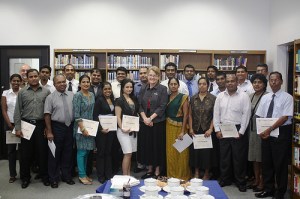
This was the conclusion of a 6-part series of webinars I conducted for the US State Department, at the USIS in Colombo, Sri Lanka. The series was called Passport To Digital Citizenship.

Ambassador Patricia A. Butenis who addressed the group after me spoke of the ‘Republic of the Internet’ –a very fitting reference, considering the times we are in as nations and communities meld together into a global community that is at once powerful and complicated –as Republics are!

Many of the graduating class are already very active members of this diverse, passionate Republic, using  social media that is becoming their glue (to hold things together) and the thread (an infinite, unravelling ball of thread, that is) that binds us all together. See larger picture here.

Some of you in my class are already moving forward, collaborating and connecting across your specializations, ethnic communities, employee networks and global and local communities.

First, to all of you in this graduating ‘class’ of digital citizens, congratulations! But as I mentioned in my address, don’t just hang that certificate on your wall.

Put it to work. Go light a fire under a sleepy old organization that is stuck in ‘anti-social media’! Show people the power of collaboration and digital storytelling through social media.

Because this blog, Hoipolloi Report, is all about those voices out there, I am taking a step to add a few guest bloggers over the next few weeks. The first of them will be two people from the Class of 2010 Digital Citizens. Who will they be?

Stay tuned!

End Note: A big thank you to Steve England, Dan Wool, Gary Campbell, Derrick Mains and Dave Barnhart who were my co-presenters in this series.

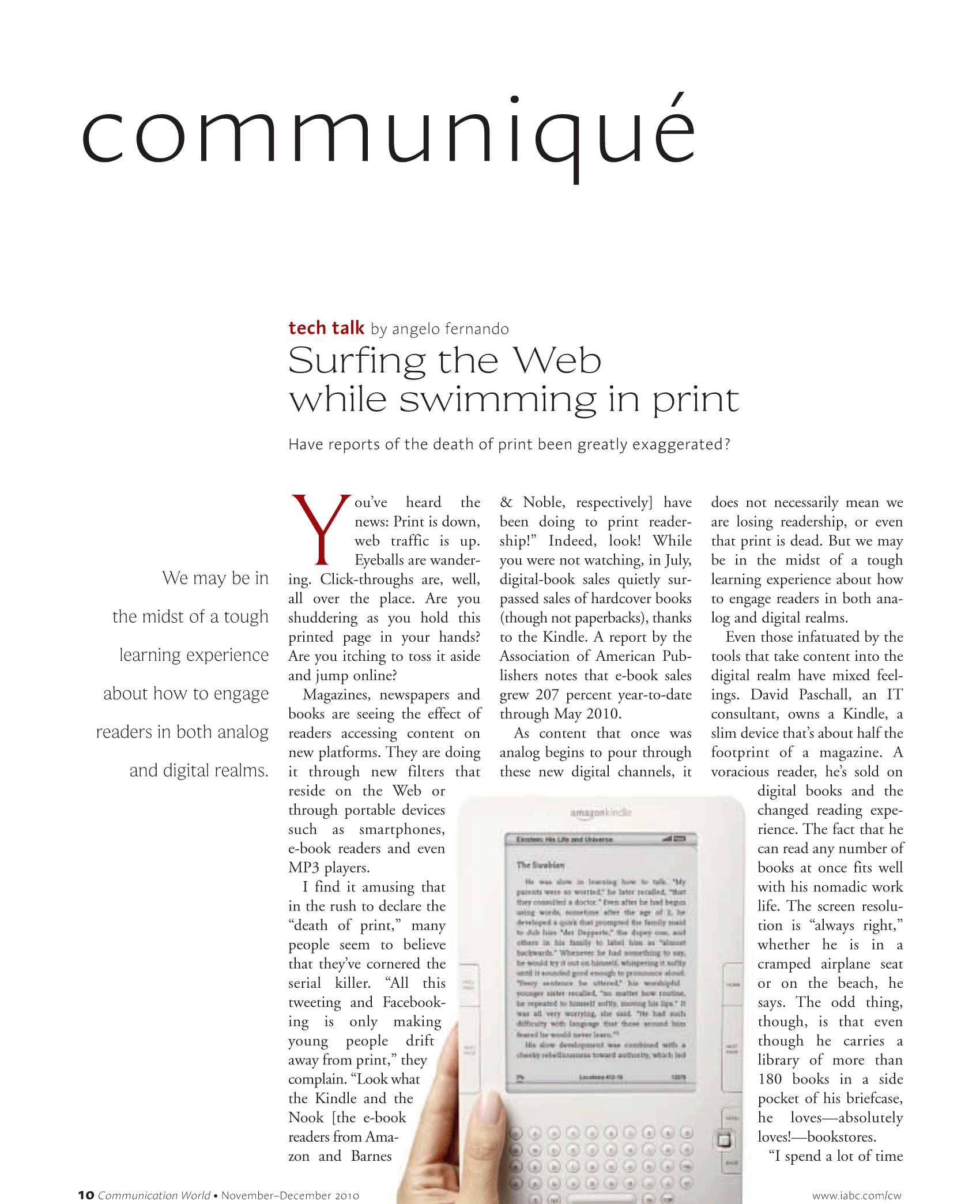
Are you surfing the web or swimming in print?

My recent column in CW (Communication World) magazine is the beginning of what has become an introspective view of where we are headed with all this digital content seeping out of every pore. I borrowed the headline from a campaign for the magazine industry that uses the word ‘swimming’ (in print) to compare it to what they suggest is a less engaging online experience of surfing.

The point I suggest is that we are creatures (and should be connoisseurs) of both worlds.

Download the article here.

The follow up to it will take it further – dealing with ‘Content Snacking!’

If you think that’s a fascinating phrase, consider the phrase ‘Micro Boredom.’ I had not heard of it before. Apparently it had been used by Motorola a few years back. 

As recession eases, time to hire Misfits, Troublemakers, Square Pegs

I have been talking to a potential guest (for an upcoming session on my radio show) on HR practices and social media. She’s Patty Van Leer, Chief Interactive Strategist at, NAS Recruiting, a division of McCann Worldgroup, advises companies on how to motivate and engage employees.

Most HR agencies are also asking their clients to plan for a new wave of  talent that only know (and will certainly expect) to have access to a range of engagement tools. Gone will be the days when you walk a person over to a desk and give her a notepad, some pens, and a login for an email address. The picture could be scary or exciting, depending on your perspective.

As the gears of our economy begin to re-engage, and talent acquisition becomes a priority once again, what will we do with these always-on employees?

Park Howell makes an interesting point. He applies the lens of ‘Rudolph Thinking’ to look inward for managing business tough times. Park’s blog post, “The 15 characteristics of Rudolphs and how they can help steer your company thru the fog of the recession” refers to one of our favorite books on the show, The Rudolph Factor. (Its author Cindy Laurin was a guest on our radio  show.)

You see, Rudolphs make great employees despite the fact that –or perhaps because –they are a bit ‘weird.’ They are weird to most people who are just doing their thing, doing what they are supposed to be doing according to their job description.

Rudolph’s are also the ones who defy their job description, stick their snouts out, and are quickly labeled misfits.

It reminds me of the line Apple used (‘Think Different’) when it celebrated the ‘rebels’ and misfits’ who believed in the personal computer back in 1997. The narration went:

“Here’s to the crazy ones. The misfits. The rebels. The troublemakers. The round pegs in the square holes.”

Where do you find these  ‘square pegs’ and Rudolphs?

And when you do, what must you do to motivate them, and unleash their creativity?

Luckily I’m also having Jay Baer as a guest on the same show. He’s dealing with some of these prickly issues in a chapter in his upcoming book, The Now Revolution.

If you like to get some answers to some of these questions (or have some of your own), ping us via Twitter at @your3bl, or email me here: angelo AT hoipolloireport dot com