I’ve always been tempted to play with IABC‘s tagline, “Be Heard.” Do we business communicators really want to be the noise makers and talking heads? Or do we rather want to be the ‘inside voice’ of business strategy?
That’s why when I first began paying attention to the ‘Occupy” movement (OWS and its franchises Occupy Oakland, Occupy Denver, Occupy Phoenix etc) I argued that we shouldn’t be too hasty to think of them as a fringe movement craving just to be heard. Hard to pigeon hole, it was too easy to dismiss them because they didn’t fit the model of activist movements. I was reminded of something innovators have reminded us from time to time. Disruptive ideas do not stem from existing templates. Marshall McLuhan put it well when he observed “I don’t know who discovered water, but it wasn’t a fish.”
Watching OWS evolve, it is interesting to see how they are inventing a new template for being heard. Make that being taken seriously. They may be leaderless, but have found ways to have their own media team, financial system, and trademark bids. And I don’t mean media in the way we tend to think of it -the kind that come with a lens, a ‘like’ button, or segmented followers.
 Much of the media we see being used in these movements are crude hand written signs.
When OWS group figured out that since electronic speakers and microphones are banned in public places (or require special permits) they created what’s known as the ‘Human Microphone’ –basically humans, en mass, repeating something a speaker says so that the sentences get carried across vast spaces of crowds. It sounds like a messy echo, but it is richer than the echo-chamber.
They have also begun another remarkable project in amplification: they are printing their own newspaper. Ok, that’s not new media. But it’s old media in a brand new way. (The fact that it is called, provocatively, the ‘Occupy Wall Street Journal’ may be a brilliant stroke of creativity.) But what really interests me is how they could do it with no real editorial hub, no newsroom, heck, no editor! (CORRECTION: See comment from Jen Sacks, below.)
 There’s a livestream, of course, and someone who amounts to a news anchor.

How will this change media? Even if you’re not directly working in the media how this movement works with the groundswell will become one of the most lasting tutorials for anyone wanting to be heard.
 knows enough to get itself out of trouble, even when its handlers are not in the next room —let’s say 34 million miles away! This was the Mars Rover, at the
 It is unpopular to say this, not just as a communicator, but as a parent. Adults have gotten so used to using television as a baby sitter –and as a back seat pacifier in the SUV — that it offends them to hear the contra view. So here are two recent reports that makes you realize that there are better ways to engage our kids.
 There has to be a downside of where we are headed. Think about this one fact: The Kaiser Family report found that young people have increased the amount of time they spend consuming media by one hour and 17 minutes daily –up from 6:21 to 7:38. That is almost the amount of time most adults spend at work each day! TIME magazine did
  But what does Big Brother look like today? What would George Orwell have railed about if he wrote about it now?
 But Amazon
  People are
 Now there are so many info-graphics, I found this infographc about infographics!
 Here’s what it looks like.
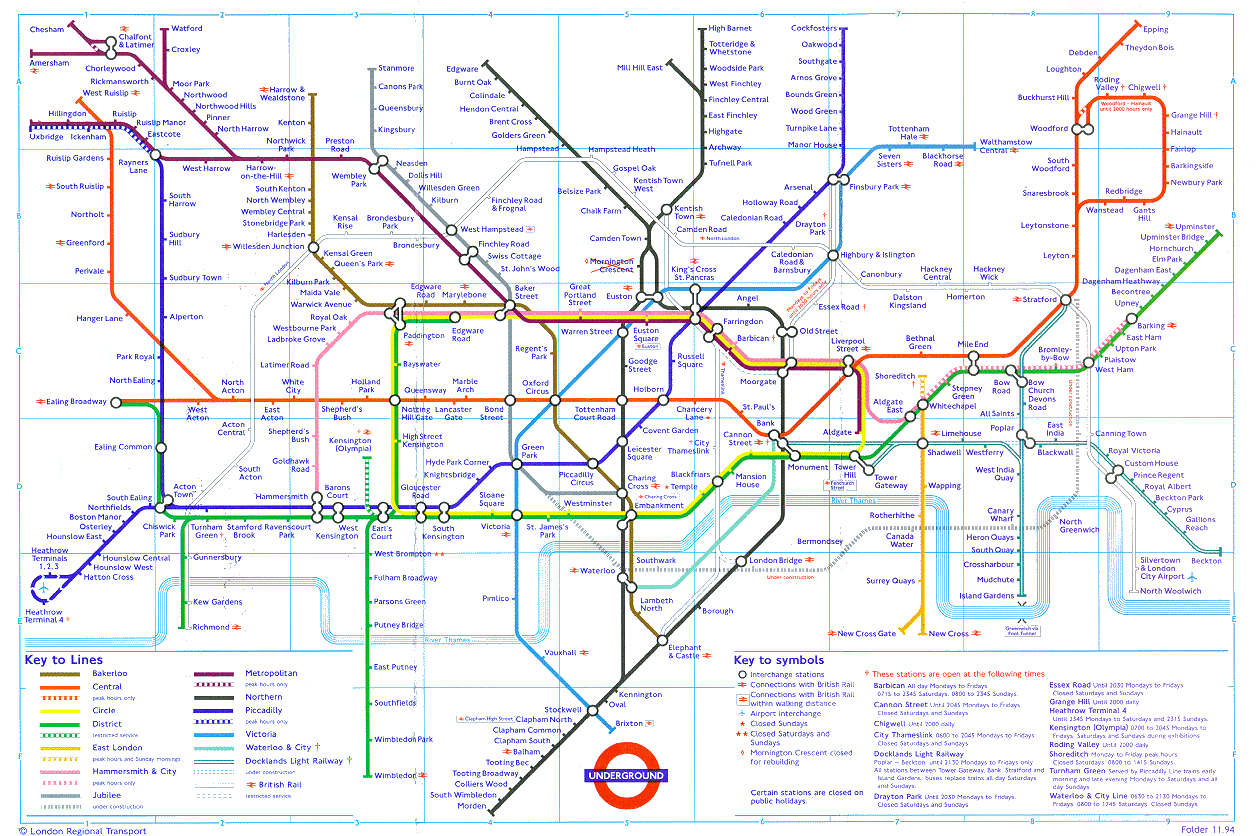
 It provides direction, and relationships of where that direction might take you. The simplest info-graphic for me is the compass. I do not need to know the ‘degree’ of the direction, as long as I have the four data points. The best known inf-graphic in this category is the
  Hoipolloireport