How “Research” helped Jobs and Woz

Steve Jobs wouldn’t have been the serial entrepreneur we knew him to be, if not for his partner in crime, Steve Wozniac

I make this point to my students, when teaching them the power of collaboration, something lost in our education system that, until now favored the individual over the group; the bubble test over the team project. Common Core standards, adopted by my school (Arizona is one of some 45 states adopting them) urge us to break out of that mindset, and get kids to discuss more, debate, confront, and work as a hive mind.

So I use this example of Woz, where he describes how he stumbled over a piece of fiction about the ‘Blue Box’, and showed it to Jobs. They wondered if this device were possible, but didn’t stop at that. They snuck into a library one Sunday, and looked it up in a stack of journals.

In other words, Steve and Steve were doing their ‘research.’  Something that sounds anathema to today’s kids who like to imagine search = research. That supporting ideas will always be within a few keystrokes or clicks.

I particularly like how the Apple co-founders got started not in a garage, but a library.

Media Literacy, Sorely Needed (Don’t blame the Digital Natives!)

Is Tool Literacy overshadowing the need for Media literacy?

I’ve registered for one of those so-called MOOCs, and the topic of Media Literacy* is the subtext of a lot that is being discussed when it comes to technology in education.

In one of the forums, the question on ‘digital natives’ (a.k.a. students) comes up, and many educators are wondering how to best engage these tool-literate natives.

Because I teach a computer and technology class I see a large cross-section of tool literacy alongside media illiteracy. This is in no way meant to blame the digital natives as much as put the ball back into the court of educators. There are no Media classes in a typical elementary school because we always thought that Media was something people opted in to learn later.

Today the very concept of what Media constitutes has been muddied. We create lower-case ‘media’ (content) that happens to hitch a ride on upper-case Media (channels), but this gets complicated when we begin to also own some of these media channels.

No wonder the kids are confused.

Educators, too. When did someone update teachers with the new ‘rules’ of creation, curation, fair use etc? This cannot be done in a one-off professional Development seminar, but has to be something done on an ongoing basis.

If our students have mixed (or rigid, or even outdated) ideas of what they could do online, if our students think that all the information in an article on The Economist could be gleaned by a 140-character summary…we have ourselves to blame.

Before we address technology in Education, we need to take a deep breath, back up, and address media literacy. (Like we have time for all this – considering our super-busy lives that involve non-stop status updates.)

* The ‘Massive Open Online Course’ for Educators is held by the Friday Institute for Educational Innovation at NC State University’s College of Education in collaboration with Project 24 –the Alliance for Excellent Education.

Ambient Awareness – A fancy way of saying TMI is good

I would love to see Clay Thompson and Nicholas Carr in a sparring match.

THOMPSON talks of Ambient awareness as if it were some rare gift that comes with augmenting (saturating?) our brains with feeds and Tweets. He calls it “the experience of knowing what’s going on in the lives of other people — what they’re thinking about, what they’re doing, what they’re looking at — by paying attention to the small stray status messages that people are putting online.”
CARR famously said that he’s “had an uncomfortable sense that someone, or something, has been tinkering with my brain, remapping the neural circuitry, reprogramming the memory.”

Who’s side would you be on?

I’ve got a vested interest in both sides. I teach students to use technology and computers in a way that does not necessarily outsource their thinking and memory and ideas to some machine. I also try consider extending the boundaries of knowledge, using available (aggregation, collaboration, inquiry) tools.

I’m a big fan of the Shallows. I also use the Kasparov Vs Deep Blue example now and then when discussing robotics and getting people to stop thinking in terms of a “man vs machine” debate. Thompson uses ane example —you could see it here in an excerpt— of how collaborating with the ‘machine’ rather than competing with it changed the game –for Kasparov at least.

He may have a good point.

Review: “Chat Republic: A welcome change from the American-centric view of social media”

Review by Linda VandeVrede

Now that Twitter and Facebook have been around for several years, the ability to communicate with strangers and mobilize crowds seems an accepted form of crowd communication. Younger generations who are extremely good at texting have emerged as so-called “thumb tribes.” Yet as these voices continue to emerge, some corporations are still fearful of these public conversations and their implications.

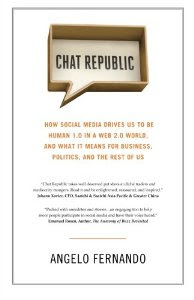
Angelo Fernando’s new book, “Chat Republic,” provides an overview of social media, including how it has evolved and continues to be a work in progress. It acknowledges that social media poses a threat to those who once controlled the conversations that took place within and without an organization. It acknowledges that social media has challenged traditional ingrained ideas about marketing and management, with some taking to it with abandon, some approaching it with a measurement of decorum, and some sniping from the sidelines without partaking. Angelo reminds us to consider communities in terms of what gets shared, not how. He points out that conversations between humans are inherent in our society; even FDR had “fireside chats” that made listeners feel as if they were participating, even through a one-way radio medium.

This citizen journalism scenario is messy but informed. This is not a bad payoff, Angelo observes. The hoi polloi, rather than a filter, decides on which media they will believe. Citizen journalism isn’t merely reactive now. It is becoming more proactive, where people proactively seek stories that interest them and share them with others.

Chat Republic is full of examples of times through world history when people have networked around monolithic authorities in small clusters, from homeless groups decades ago to the Middle East most recently. Still, there is a discrepancy in how people view social media. “There are those who see social media…as a transparency filter to let the sunlight in. There are also those who decry it as a lever that unlocks the floodgates to an unwanted stream of information and/or trouble.” The positives are that it improves trust and reputation. This is the new face of PR, crisis management and advocacy.

One of Angelo’s interviewees observes that people’s habit for deep reading has eroded: “Once I was a scuba diver in the sea of words. Now I zip along the surface like a guy on a jet ski.”

If you ever wanted a view of how social media has changed us for good, this is the book. Best of all, the data presented is multi-cultural, a welcome change from the American-centric view of social media that dominates most books. Angelo’s book is full of tips and case studies about how these concepts have been implemented effectively. I’ve always been impressed with his ability to pull in examples from all walks of life, and analyze the hoi polloi response to social media.

(Disclosure – Angelo was part of the group blog Valley PR Blog, with whom I blogged from 2007-2010, and I am one of the many people interviewed for and quoted in the book).

Picture Copyright: Adam Nollmeyer

SMS as a crowd-sourcing channel for… farmers

Remember when Short Codes were all the rage? That was a few decades (in Internet years, that is) before QR codes walked into the bar and stole the limelight.

I’m still a big fan of SMS, even though I use QR Codes for all manner of things. More on this later.)

We in the West are all enamored when we hear how a majority of the world is now mobile. 91 Percent of Americans own mobile phones, according to a Pew report in May.

When I was visiting Sri Lanka I ran into some interesting uses of Information-Communication Tech, I touched on ICT in a passing way in Chat Republic, only because I was making the case that social media users need to understand that the new, new thing they stumble upon is based on some very old concepts –crowd-sourcing being one of these.

I met the folks at Sri Lanka’s Information Communication Technology Agency, and they talked about a lesser-known project that enabled rural villages to use of ‘short codes’ via mobile phones to provide what amounted to SMS-enabled commodity trading.

Yes you read that right: Commodity trading for farmers for farmers!

It worked like this: A farmer sends an SMS to a knowledge hub using a particular short code, providing details of what he has to sell. Buyers or whole-sellers also subscribe to the service, and the portal matches the buyer and seller. The mobile device is just the tool that enables that digital hand-shake between these two groups of people.

They may never meet, but have learned to trust each other because of a secure network, and their comfort level with short codes.

Trust is a rare commodity in the social media space we inhabit. There are workshops and books on building trust, and I’ve read a few. But in practice, the ease of use, and the ability to fake it on social media is causing a backlash. We have become more skeptical of those who push links at us. Our digital handshakes, though instantaneous, and seamless are fraught with problems.

We may be all Web 2.0 but we tend to forget the basic tenets of being Human 1.0. Just ask those farmers who are using basically 1.0 tools.

Note: The image, above, is from a similar project in Bangladesh.

Miley’s back-to-school lesson

In 2008, I sort of ranted about this Cyrus virus –being the dad of a child in her target group. This ‘performer’ looked like she certainly needed help, at least from a PR standpoint, if not from that of music.
 
Then there was her big move into the grownup world at the MTV VMA. Her attempt to explain it was as vacuous as the performance itself.
 
I was glad someone called it for what it is: a stunt with no depth. Camille Paglia (for TIME) looked into that space that many have tried to occupy, post-Dietrich, post-Presley, and came up with a perfect summary:
 
“Miley, go back to school!”
 
PR school, too. 
 

Chat Apps don’t just destabilize business models, they ruffle governments

All this chatting is taking us somewhere, right?

Ever since I stumbled on Chat Apps, and discussed it toward the end of my book, I knew that this thing curiously called Over The Top applications (or OTT), could tempt some to see us, chattering masses, as instruments of mass disruption.

I was bemused to hear that the Vietnam government is trying to reign in the OTT business.  Wassup Mr. Nguyen Tan Dung? Worried about the revenue loss of telecoms or worried that the hoi polloi will be talking on their own terms.

Governments famously refuse to engage citizens, while pretending to call their system a participatory democracy. Some have suggested that the Internet disconnects as much as it engages people from public life. I was reminded of my conversation in April with Indi Samarajiva (on ‘Machine Readable Democracy’) when I saw this discussion.

It’s a tantalizing question. Could a participatory democracy be nurtured? Or should it be left to evolve organically?  Or as Jos Zepps puts it, could we build a digitized, engaged democracy from scratch?

Technology with a sense of humor (and humanity)

So much of tech in our lives is about inanimate objects that deliver some convenience.

Maybe they animate our lives a bit: Typewriters helped us write better reports. Levers helped us move large rocks. Microphones and memory devices) helped us record and preserve important  moments.

I’m becoming more steeped in the four S-T-E-M areas, because (a) that’s where all education is headed, and (b) I run a computer and tech lab for a school where students from Kindergarten to 6th grade come to experience computers in education.

So it’s always refreshing to be able to focus on technology that is not a computer, or at least one that NOT rectangle-with-screen. I have robots, of course (a big ‘Aha’ for third graders): rectangle with wheels and sensors, and a few other objects.

But where could you take (or hide) a computer, to make our lives more interesting?

I found a great example of a ‘technologist’ who comes from an a non-tech space, and adds a layer of humanity to objects. She’s not from Silicon Valley, and I don’t believe she’s been featured in Fast Company. Bangalore-born Aparna Rao infuses technology with a sense of humor and humanity, letting us find our own meaning in inanimate objects such as a phone, a typewriter etc. The one on the left, for instance, was designed so that her uncle could send email, making him feel he was typing a normal letter on a piece of paper. But it gets funnier, and, deeper, such as when she uses a camera to make people disappear — the reverse of what we do now in our desire to put ourselves into every conceivable screen-captured image of life.

This is probably one of the best reasons why the arts –and the capital ‘A’– cannot ever reside outside the S-T-E-M areas everyone is so focused on.

This is the best example I’ve come across for encouraging schools to add some S-T-E-A-M!

Curation of Mixed Media memorializes painful past in Sri Lanka

I never discuss openly the events we went through in July 1983, when an ethnic violence broke out across the country, part-sponsored by sections of the government at that time.

I’ve shared some details with my children, but have tended to focus on the positive — the people who spoke out against the madness, the safe houses I stayed in etc. Perhaps it is one’s way of compartmentalizing the horror; of forgetting…

This week, in Colombo is a series of events around the theme “Thirty Years Ago.” Two days of dialogue, art and memories.

Sanjana Hattotuwa, TED Fellow and new media entrepreneur who has made this happen, puts it this way:

The project is an attempt to remember and probe Sri Lanka’s epochal anti-Tamil pogrom of ’83 through perspectives rarely, if ever, featured before. The producers have used a wide range of media and methods – from a mixed media triptych to info-graphics, from audio podcasts to video, from photography to compelling write-ups.

That’s right, a way of putting this ‘pogrom’ in context, by capturing the “anxiety, fear, violence, courage, love, sacrifice, of opportunities lost as well as well-springs of hope.”

The Web now provides us with new ways of dealing with history, and not just in real-time. We have become accustomed to seeing how shiny new tools and apps can help raise money, provide relief, or report on events. Dealing with the past takes more thoughtfulness. This is a mixed media project that not only informs us of where we have been, but where we might go.

Do visit the site at ThirtyYearsAgo.Asia

In Sri Lanka, these are the upcoming events

Sat 24 August

10am – 11am:    Reflections of ’83: Plus change?

4:00 – 5:00 pm    Art and Memorialising
Looking at how art plays a role in memorialising violent events

Sun 25 August

10 am – 11 am   Frames
How do we see our past, and thereby choose to learn from or repeat that which gave rise to violence? In framing histories, what are the politics of selection and exclusion?

4 pm – 5 pm   Media Matters
How did the media cover 1983, and why is it so difficult to find archival material on Black July?

Will there be a backlash against the Cloud?

There’s this amazing device sold on Amazon: a two-pack outdoor waterproof surveillance camera, for just $19.50 (with free shipping is you use Prime). Menacing looking. But it has one problem.

It’s fake.

Its a deliberate fake –supposedly for people who want to pretend their property is under surveillance.

Don’t you love it? We love to be watched so much we will pay money to pretend we are doing it ourselves. Couple that with the NSA-Snowden scandal, and this story about a Houston, Texas family’s baby monitor being hacked, and it’s enough to make some people long for the pre-digital age.

The Snowden scandal has new embarrassing ramifications, in the UK. The Guardian reporter’s partner was detained in Heathrow, and had his digital devices confiscated.  But it got worse. The British government demanded the newspaper smash its hard drives in the basement, under supervision. The Guardian called it “a pointless piece of symbolism.”

Which makes you wonder if people’s social media habits are going to nose-dive when they realize that we do pay a price for a surveillant society. Do we really need this darn euphemism called the Cloud? For every good story we get about being able to track down the bad guys (the Boston bombers were, after all, tracked down within a few hours because of …cameras) you get a surveillance-off-the-wall story. Incredibly worse than the baby monitor hack.

Presence Orb, is a British company that conducts what it calls “presence analytics” happily reported that hundreds of thousands of pedestrians who walked past recycling bins in London had been ‘stalked’ by the bins, which recorded the unique ‘MAC address’ of their smartphones. A bit of a hue and cry, and the government demanded it stop doing this. It did. Surveillance of people bad, bad, bad.

Smashing hard drives, very, very, good.

There’s a good reason (I now discover) I carry a small, scruffy notebook. My useful stuff is in the Cloud. My important stuff is in my pocket.