Speaking like Jobs – Presentation tips from 10 years ago

Exactly 10 years ago this week, Steve Jobs took to the stage –a technique he would go on to perfect — to launch the iPod Shuffle.

That was Jan 11th, 2005.

I often do ‘anniversary’ events in my class, to get young people to think about where we are now, in relation to where we and the technologies we take for granted were once at. After all, this is a Computer and Technology Lab, and I don’t want to get into the trap of always featuring today’s shiny new object, or the hottest new parlor trick in digital media. We often need context, and it tends to fly by when we refresh our feeds, doesn’t it?

Back to Jobs. His presentation trick was to use insanely simple devices. Well rehearsed, and well timed but simple. Which made him very different from his tech contemporaries, who revel in Silicon Valley argot. (Yes, I listen to ‘This Week in Tech, to catch up with the other kind of tech-talk!)

Listen to how he works up the crowd, and keeps them hanging on for that characteristic”One more thing.”  Fast forward to 1:35, and see what I mean.

  • He uses words like ‘noodled’ (He “noodled on it” not “researched it”)
  • He uses unexpected pauses, and slows down and speeds up suddenly
  • He uses home-spun images – comparing the iPod Shuffle to a pack of gum, and contrasting it with four quarters

Notice how he also stays away from big words, using words like “easy”, “simple,” “thing,” etc. (And yet, peppering his presentation with keywords!)

Even if there was no YouTube, I bet we would still listen to it.

“This is Salt River Radio!”

Audio is a powerful medium. Overlooked, but extremely powerful.

While video gets all the attention, audio programs –basically podcasts — have been steadily growing recently. This week, I began the new semester by upping the ante for 5th and 6th grade students, showing them how to become producers of content. To start off, I got them to think of themselves as owning their own radio show. A news show, a sports show, or a show about events in the community.

How do they plan and create content? What are the elements of a good show? Good information? A nice pace? A strong personality? Music? Sound Effects?

I plan to use some of my prior radio experience to get students to create their ‘shows.’
Audacity-2.0.png
The software we will be using is Audacity, which is really powerful software. All computers in the Computer and Technology Lab are now loaded with Audacity, and we just got started understanding how  tracks and buttons work, and how to export an editable audio file, to work on it as we move along.

I’m sure you’re wondering: how could digital natives get so excited about ‘old media’? You would be surprised!

‘Salt River Radio’ is the tip of the spear of something bigger I have in mind. I am also looking for input from anyone with radio experience, who would like to be a part of this project, either as a guest instructor, or otherwise.

Stay tuned, if you’ll pardon the pun.

Fun way to ‘warn’ drone enthusiasts

I’m impressed at how the FAA decided to educate would-be drone pilots. They partnered with The Association for Unmanned Vehicle Systems International (AUVSI), to release this video.

It sure doesn’t look like a government agency production.

It’s mainly about the 400-foot rule, but also ‘gently’ warns about invasion of privacy.


The body as a machine – works fine on Earth, but…

Since I write mostly about technology issues, I was struck by this description of how the body as a machine works.

The human body is a purpose-built machine, designed for the one-G environment of Earth. Take us into the zero-G of space or the 0.38 G of Mars and it all comes unsprung. Bones get brittle, eyeballs lose their shape, hearts beat less efficiently since they no longer have to pump against gravity, and balance goes awry.

Jeffrey Kluger, in TIME – story about Mark and Scott Kelley. The latter astronaut will spend one year on the International Space Station.

We take gravity so much for granted, don’t we?

When “Off-the-Record” is suddenly not

The ‘microphone is always on’ rule has always applied, whether you worked for the media, with the media, or anything in between.

The story unraveling the uber-weird story of ride-share company Uber and an off-the-record meeting, gives us something to chew on. It is a gray area, with journalist Michael Wolff observing (or at least respecting) the rules of engagement in off-the-record agreements, while one of his colleagues Ben Smith does not.

The PR industry makes a better distinction of not just off- and on-the record, but ‘attribution.’ This is worth a read in case you are speaking to anyone, and are tempted to say “don’t quote me on this.”


Sometimes technology is NOT the answer

You might be surprised to see me talk about this topic here.

Though I’m a computer and technology advocate, (and teacher) I do make jabs at tech. Technology is meant to serve us, not the other way around. I’ve lately seen how completely ridiculous Instagram has become as pre-teens overrun the space. Classic example: a handful of 11 and 12 year-olds at a party, sending each other status updates. From within the same room!

I thought this was an age thing, until I read this thought-provoking piece titled “Technology is Not The Answer : A Student’s Perspective.” It was published in Education Week in October this year.

By a high-school junior.

He cites cases of why students need to develop personal relationships, and not just on-screen button-pushing skills.

Back to Instagram.  This is how WikiHow recommends how to gain followers.

Like and comment on pictures. Once you start following some people, take some time to Like and comment on their photos. Not only will this make the other person feel good, but other people may see your name or comment and check out your profile. If you stay active, this can lead to a steady stream of new followers.

It’s all about making others feel good?

It may be time for schools to require any student who has a phone in their backpack to  take a digital literacy 101 lesson. Maybe this is harsh, but some parents need this too.

If you don’t believe me:

  • Google the words Instagram, stupid, and people and check out sites such as damn cool pictures.

The Internet of Things – Cool or Creepy?

Just putting the final touches to an article on the biggest, hyped concept –the Internet of Things.

It’s not difficult to grasp what this is supposed to mean –after all the Internet as we know it is nothing more than a collection of billions of things such as servers, routers, ATMs, satellites, and devices that send and receive data.

But I came across a few interesting ways this IoT space is developing, sometimes in a quiet, boring way. By invitation, or by accident we subscribe to (and nurture) the Internet of Things. Not many people have heard of the use of Near Field Communication (NFC) by some hotel chains in (get ready for this…) bed-sheets and pillowcases! Soft, fluffy things, in other words, can provide data.

Sure, in the post-WikiLeaks world, many of us are extremely skeptical about where this data will end up. There’s a bumpy spot in our passport cover that I am told is an embedded device. It is one of those ‘things’… But what about biometric wristbands? How about license plates with RFID tags?

You would be surprised what people surveyed (by Pew Research) have said about what to expect.

Screens come under scrutiny – again!

I knew we’d be talking about this sooner or later: Do touch screens reduce how much we absorb, while paradoxically increasing ‘engagement’? Or, are the dumb things that happen in Real Life better teachers than VR, or smart screens?

Researchers have been warning us –from pre-Internet days–  that excessive screen time was having negative effects on children’s attention, learning (cognitive skills, language development), and sleep.

A screen is a two-dimensional (2D) experience that is hard to resist, across all age groups. Yet, a recent report tells us that screens “do not inherently provide (children under 3 with) rich opportunities for whole mind-body learning.”

For instance, it says:


“Researchers who study how children learn have concluded, however, that it is easier for young children to comprehend information from real-life experiences with people and objects compared with information delivered via a screen.”  (“Screen Sense. Setting The Record Straight”)

No one is asking us to eliminate screen-time. But we could rethink how creative thinking, problem solving and experimentation could work without pixels.

Communicating with crew on ‘Mars’ – Text-To-Speech

Those who know me, know I’m a follower of all things in space – from watching the International Space Station fly by, to the latest maneuvers of the latest Mars Rover.

So this week, it was a chance to communicate with Jocelyn Dunn,one of the 6 inhabitants of a Mars simulation mission, going on in Hawaii. The project, is called HI-SEAS (which stands for Hawaii Space Exploration Analog and Simulation).
The reason: I’m putting together Mars Day a now-annual event at my school. I thought my students would get a kick out of talking to the folks who are paving the way for humans on the red planet. Or, to put it another way, they’ve seen a lot about the bot that got there; now it’s time to communicate with Homo sapiens!

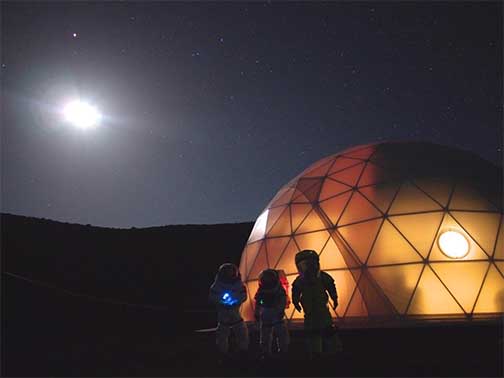
Jocelyn and the rest of the HI-SEAS crew began their ‘analog simulation’ last Friday, inside a 1000-square foot geodesic dome.(Another crew member, Zak Wilson is also blogging the stay.)

HI-SEAS Dome

Image, courtesy hi-seas.org

So what is it like to be practically isolated from the rest of the world? Isolated as in no phone calls. Now they do have access to the Internet (!) so I will be asking her these questions in a few days. Yet, to simulate the real thing, the crew’s email is subject to a 20-minute delay.

The fun part is planning for Jocelyn and her crew to answer questions from my students. After a couple of back-and-forth (time delayed) she came up with a good solution: We would send her the questions via email, and they would record their answers on a video, and send it back to us in time for Mars Day!

It will give new meaning to ‘Text-to-Speech’!

Here are links to other crew members

Besides a pencil sharpener and white board, the new must-have: 3D Printer

File this under ‘Disruptive’

It’s stunning to see how far we have come with 3D printing.

I don’t know about you, but when the little things break down –the arm of your reading glasses for instance — I wish I had something more than super glue to fix it.

I’m looking forward to a time when we will get back to being fixer-uppers, and print the part that was nicked off our desk, or died right in front of our eyes.

What’s even more disruptive is how Public Libraries are getting into this arena, with the maker-space phenomenon taking root in cities.