Quotes for the week ending Feb 09, 2008

“The business of delivering content and the art of creating content.”

Robert Redford, who will keynote a one day conference-within-the-conference titled Mobile Backstage, on the important of mobile platforms for independent filmmakers.

“Take a look, cruise around our digital scrapbook, and maybe even add your own story.”

Tom Freiman, GM lead on the new Generations of GM Wiki that launched this week.

“Is GMnext and other GM marketing initiatives corporate greenwashing?”

Christopher Barger, GMs Director of Global Communications Technology, on the GM Wiki, about the company hosting ‘environmental chats’ about topics such as alternative fuel and battery life.

“Blogging is as much about reading as writing, as much about listening as talking”

A paper on blogging (titled: Blogging as Social Activity, or Would You Let 900 Million People Read Your Diary?”) by Bonnie Nardi, Diane Schiano & Michelle Gumbrecht of University of California, Irvine and Stanford University.

To “bring the expertise of specialists, sophisticated medical imaging, and the world’s libraries to a community reachable only by airplane or boat.”

Intel Chairman, Craig Barrett, quoted in Fast Company, on its “World Ahead” program in Brazil.

“When did the measure of conservatism, when did the measure of success, when did the measure of progress, when did it become reaching out to Democrats?”

Rush Limbaugh, on his inability to understand why John McCain is ‘reaching out’ to the Democrats.

“Web, Web, Web — if you ain’t walking onto the stand hand in hand with a Web guy you ain’t no one”
Ben Wood, chief analyst of CCS Insight, on preparing for a battle at the 2008 Mobile World Congress in Barcelona next week. More than 55,000 atendees are expected to be there.

Just saying “No” – two ways to advertise

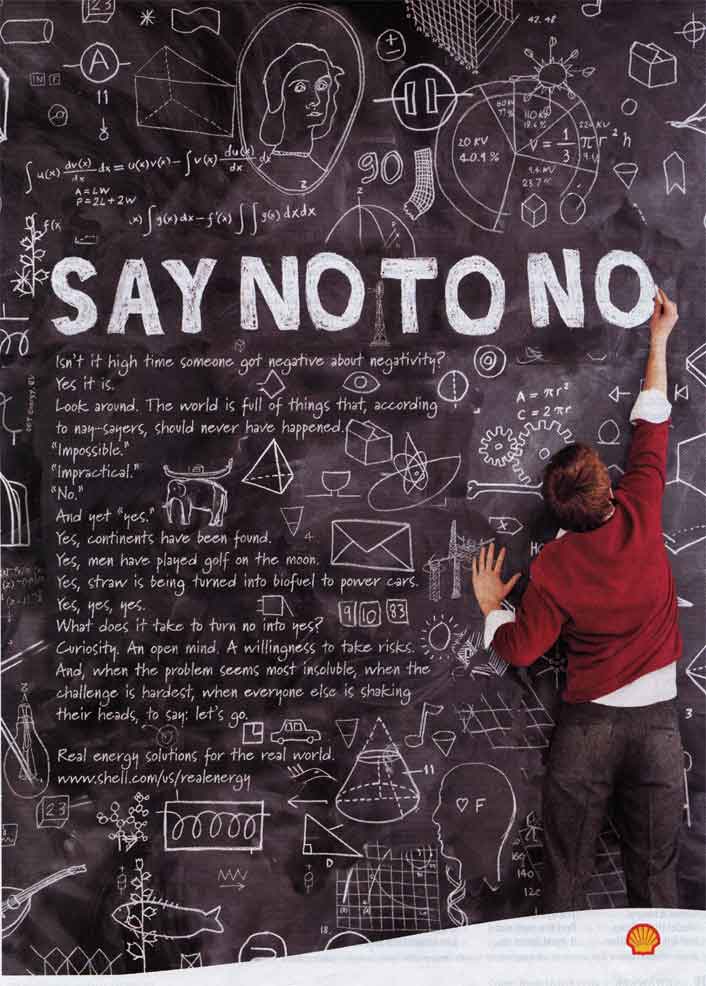
shellad_tn2.jpgHave you noticed how the word “No” has gained currency in advertising?

This ad from Shell has been running in some magazines and tells of how the world is full of nay-sayers and those who put down ideas as impractica.l “What does it take to turn no into yes?” it asks. “Curiosity. An open mind. A willingness to take risks.” Somewhat buried in the copy is a link to Shell’s microsite.

But close upon the heels of celebrating “No” is another great execution by BMW, featuring an ad and an insert in WIRED. This time it takes the opposite side, celebrating the word No. “No closes doors… but when used to break convention, it opens more,” the copy reads. As in: “No, we will not compromise ideas. No, we will not do it the way everyone else does it …the ability to say No for all the right reasons.”

To Shell’s credit, it’s not all ad copy. In a report last year, president John Hofmeister blames the oil and gas industry for the “public policy deficit” with regards to energy. “I do not blame the elected officials. I do not blame the American people. I blame the industry for not having spoken of this issue…” he says. At the site, they talk about the energy crisis as a “crisis of inertia.”

Say what you will about Shell, but at least its marketing is in sync with its president.

Citizen Journalism’s stamp of approval by Arizona Republic

Once again the Arizona Republic has taken a stand on something that some news pundits have been queasy about. Citizen Journalism.

As Paul Maryniak, General Manager of the Arizona Republic’s Southeast Valley section wrote last week, the paper welcomes the trend. The “malcontents” and critics of the trend are flat-out wrong.

“At The Republic, we call our citizen journalism News By You. I hope you consider it if you’re trying to publicize any number of good or worthy things that are happening in your life.”

News By You is for clubs and organizations, proud parents and businesses, he says. Yes, he admits there are limited resources, broaching the topic of the economics of delivering the news. But the ability to feature reader-generated content allows the paper to feature stuff that even the pros could miss out, he says.

Last month Dan Shearer, senior editor of the paper also acknowledged the trend, mentioning how a citizen reporter had been the first responder to report a local church fire.

What do “edgy” Super Bowl ads say about the brand?

If the definition of being edgy is a naughty reference to body part, then you could say GoDaddy, the domain name registrar in Scottsdale, Arizona has passed the anatomy test.

But what does it tell you about the service it offers or its the customer experience? I have dealt with the company many times on domain issues, and I can tell you it does have an excellent customer experience. But I would have never understood that, or even thought it was the company’s core strength on the strength of its expensive, pathetic Super Bowl ads. Even the one that shows off a wild ‘marketing’ department.
Besides, the category of edginess is so old (remember the 2003 “catfight” spot from Miller light?) in advertising terms, you’d be forgiven if you mistook them for running a commercial made in the late nineties. Its recent ads have featured racy racer Danica Patrick.

In 2004, Anheuser-Busch tried irreverence with a flatulent horse, a big flop. More recently went on to do humor a different way, with “Language Course,” where a teacher instructs Hispanic students about how to ask for a Bud Light. That one, latching on to the simmering immigration issue, topped the list of the most replayed ads on TiVo last year. The fatulent horse, rightly went down as one of 10 worst ads of all time.

In “Catfight,” two guys watching the two mud-wrestling girls comment that it’s what they would call a great commercial. Yeah right. That one too, went down in flames. BUT –in a move that proves those in the “marketing department” just can’t get enough of this stuff — there’s a (groan!) sequel to the catfight. Featuring to fat guys.

Adjust the script a bit and change the logo at the end and it could easily pass for a GoDaddy ad…

Quotes for the week ending 2 Feb, 2008

“Microsoft and Yahoo: The Bid Heard ‘Round the Web.”

Story in Fast Company about the hostile bid by Microsoft to acquire Yahoo for $44.6 billion.

Well then, I’m outta here!”

Flickr user in protest of the Microsoft bid. Flickr, a Yahoo property, features images like this one

“This will be the first year that viewers will have two remote controls… the one in their hand, and the one in their pocket.”

Nihal Mehta, CEO of ipsh, a mobile marketing agency, on the use of short codes for voting on advertising during the Super Bowl.

“Citizen journalism is a new way to provide content to readers. That’s where the truth ends and the snarkiness begins. “

Paul Maryniak, Southeast Valley GM for The Arizona Republic, on the value of its “News By You” option for readers.

“The only Republican who promises to end the George Bush style of governing from and on behalf of a small, angry fringe.”

New York Times endorsement of Senator John McCain.

“Oh, by the way, I think there’s also a football game on Sunday.”

Shel Holtz on the news that a new website called Firebrand will feature television commercials

ASU on Focus the Nation today

Quick follow up to my previous post on sustainability.

Didn’t realize it until today that Arizona State University has a special segment on Focus the Nation this evening.

Focus the Nation is a national initiative involving thousands of universities, with students, political leaders, decision makers and average citizens taking active roles on global warming. Talk about doing more than carbon-offset ads!

The activities of Focus the Nation started this week. Topics range from “climate, conflict, refugees” to technology policy, China, ocean imaging, media, motivation and “marketing” the problem.

A live webcast of the event this evening will be held at ASU, from 5.30 pm to 7.00 pm

No traipsing down Sustainability Avenue

For the past year, I’ve been hist by two keywords: innovation and sustainability.

It’s hard not to notice the deliberate attempt by many organizations to tie the two concepts into their marketing, strategic planning and advertising.

BMW says it is “preparing for a Hydrogen future” with “pie-in-the-sky, what-if technology.” Honda has invested in a solar cell company. BP is into bio-fuels. But it’s not just consumer brands that are onto it. The city of Phoenix has a “sustainability blueprint. Tucson has a volunteer-led “Sustainable Tucson” network.

The city of London has a Sustainable Development Commission, promoting community-friendly policies for climate change, education and energy.

It’s tricky to balance growth and sustainability –and getting buy in. At ASU, we wrestle with this all the time. The Global Institute of Sustainability, a block from where I work, does a fine job of defining what it involves, and applying it. Here at the Decision Theater, we actually show organizations what sustainability means by taking their data, and putting it into interactive visualization.

So every time I see ads like the one about building cars out of straw (Toyota) or the Land Rover‘s paying for carbon credits on behalf of the customer, I realize many are only scratching the surface. Once you see how small decisions can change the air quality, water table or traffic patterns in your immediate locale, you’ll see that wearing an eco label requires you to do more than build a neat micro-site, or shooting a great commercial.

Quotes from the week of 26 January, 2008

“All we did was add more elves.”

Ann Bologna, president of Toy, on the success of the “elf yourself” campaign for Office Max, that drew visitors to visit the site and create 123 million elves, translating in to a reach of 26.4 million people.

“The difference is that we now have to provide a little foreplay before going all the way.”

Len Gutman, at ValleyPRBlog, on the need for symbiotic relationships between hacks and flacks via social media.

“Everyone wants the Tiffany box, but there is no Tiffany box.”

Dave Coffey, director of media services at Sapient, on a survey of 120 professionals about digital marketing budgets, and the inability to measure social networking gains.

“A vast dynamic knowledge ecosystem that is in a constant state of creation, use, reuse and improvement.”

Jimmy Wales and Rich Baraniuk in an Op-Ed in the San Francisco Chronicle, on their dream of making textbooks and learning material open to everyone, and the Capetown Declaration.

“There was a basic lack of integrity in the Clinton show last night.”

Larry Lessig on the Democratic debate, and the possible infection of the Clintom campaign with the “Karl Rove virus.”

“Appalling” and “saddening”

Senator Hillary Clinton, responding to Karl Rove’s recent suggestion that the Democrats responded to 9/11 with timidity.

“We’ve changed our whole marketing plan so we can leverage something out of this smokin’ hot spot.”

Bob Parsons, CEO of GoDaddy on getting a Super Bowl ad approved by the Fox network, after submitting 10 other “edgy” commercials that were rejected, as they were for the past few years.

“Journalists are such tools.”

A reader of the Arizona Republic commenting on the fact that this rejection-approval “story” has been repeated for many years.


Video activists turns vigilantes

Video sharing sites are often held in low esteem because of the Lonelygirls, but there are also the use of video as a form of social cultural criticism, a la the anti-Axe commercial. But there have been some unconventional uses of video sharing and activism.

Some of you may recall a recent story about how the owner of a cigar store in Mesa, angered by the fact that he was burglarized, put up his surveillance video on YouTube. Within weeks there was a tip off and the burglar was arrested –whether of not as a result of it is debatable.

Keeping watch on the neighborhood seems to have taken off. I came across a video vigilante site called JohnTV as a way of attacking human trafficking and prostitution in Oklahoma. No different perhaps from the format used by NBC Dateline‘s, in the “To Catch a Predator.”

Whether you call them citizen journalists or video vigilantes, it takes video sharing to a new level of activism.