Remembering Arthur C. Clarke

We sort of took him for granted in Sri Lanka, his adopted home. At the Otters sports club we frequented, Arthur Clarke was quite a household name.

In 2005, the business magazine (LMD) for which I wrote a technology column, asked me to cover Clarke. I would have liked to have conducted an interview via web cam, if not a Q&A online on a wiki, but the father of the communications satellite made it known that he was past doing interviews. I wrote it anyway, titling the article “From Sarongs to Satellites.

So this week, as the news broke that the sci-fi writer and keen observer of what could be possible had passed on, I wanted to look back and see how I had deciphered the man.

I loved his observation way back before CNN or mobile phones, that satellites would tilt the balance of cultural and political ideas. Anticipating the ‘world is flat theory’ theory by decades, long before networking became an aggressive pass time, Clarke foresaw a hyper-connected global family. He thought the Communications Satellite would be the enabler of what he termed “The United Nations of Earth.”

And the quote I loved most was this: “Swords into plowshares is an obsolete metaphor; we can now turn missiles into blackboards.”

My full article is here.

Pictures of how the other half lives

There are stories from China, Philippines, Nicaragua or Iraq that don’t get told enough through the press syndicates and major networks. Pictures of refugees, protests, local heroes, monks, farmers, and the “word on the street” captured through a lens.

To fill these needs are the unpaid stringers with cameras who share their world view, if we only care to look. Someday, a smart citizen journalism outfit will find a way to create an on-demand “newspaper” out of a mashup of Flickr, country blogs, and stories from the underground.

For now, just go to Flickr, and type in the country you wanna know more about, and I guarantee you’ll see and hear of things you never knew, or are right now taking place –captured by an amateur perhaps.

Since it is five years since the Iraq war began, newspapers have been trying to sum it up or explain it through op-ed pieces, in-depth reports and pictures. You may have forgotten or not seen this one. An image from Iraq taken by one Michael Yon. That’s Major Yon. On his blog, he tells the story of Major Mark Bieger who rushed to the side of a child soon after a car bomb exploded on their convoy that had attracted a crowd of children.
This is how the other half lives. We don’t get to hear about these narratives every day in a news cycle crowded out by the erratic behavior of Wall Street or the obsessive attention to scandals, the Clintons or some technology conference.

Journalists approve of social media

Journalists are not as fearful or pessimistic of the new media as some make it seem.  Pew Research study just out finds that journalists do approve of the changes taking place in their business model.

Considering the impact of the internet and social media on their business model, local and national journalists have given new media a vote of approval.

The study was done with 585 national and local reporters, producers and media executives.

Media blind eye to media attacks in Sri Lanka

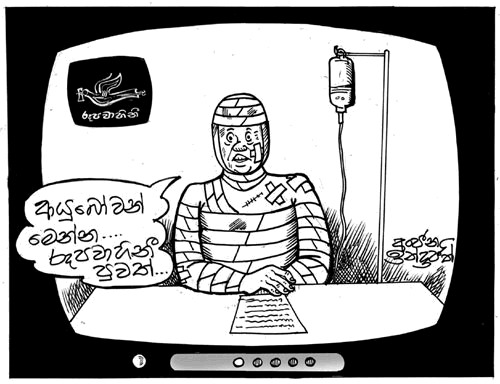
rupavahini.gifWith so much attention to China’s response to Tibetan protesters and the recent repression in Myanmar, there seems to be a blind spot when it comes to the media intimidation story in Sri Lanka. Five workers at the state television station, Rupavahini, have been attacked as the cartoon depicts.

It’s not funny. The methodical attacks follow a situation last December. Separately, journalists have being jailed without trial. Just a handful of organizations like the BBC and Reporters Without Borders are following the story. There are some indications that citizen journalists such as GroundViews will fill the void.

How digital marries analog in social media

Nothing crystallizes an idea like doodles and notes in a notebook. I tend to have a lot of them, in all shapes and for a variety of purposes.

But I never realized how a humble notebook/sketchbook might fit my “think digital, act analog” mantra. Until I saw this, from a Milwaukee, Wisconsin-based designer and blogger Mike Rohde.

Rohde condensed the events he attended at SXSWi, in Austin Texas, into sketches and notes in a moleskin sketchbook. Says Rhodes, “while sketchnotes capture concentrated concepts for each session well, I think they’re even better at awakening ideas stored in the minds of session attendees.”

The fact that he’s scanned the pages and made them available online on his blog, and on Flickr takes it a step further by sharing his experience, to “awaken” ideas in those who couldn’t be there. Analog and digital aren’t mutually exclusive as many make it seem. Meeting reminders in Microsoft Outlook won’t reduce our love of sticky notes. I really like JJot and ToDoPub but none of these digital tools will make me abandon the simple, inspiring spiral-bound notebook.

Quotes for the week ending 15 March, 2008

“This is the wrong image, folks.”

Josh Bernoff, of Forrester, complaining (“People are not bees”) about the gross misuse of the bee image among advocates of social activity

“Each of Spitzer’s words was accompanied by a rush of camera clicks.”

Report on the resignation over a prostitution scandal, of New York governor, Elliot Spitzer.

“Airborne is basically an overpriced, run-of-the-mill vitamin pill that’s been cleverly, but deceptively, marketed.”

David Schardt, Center for Science in the Public Interest on Airborne’s $ 23.5 million settlement with the FTC for false advertising.

“The usual way for a newspaper writer to weasel out of such a request is to say that it is not a “local” issue.”

E. J. Montini, in The Arizona Republic, on a reader asking him to display the nine zeros in $12,000,000,000 (when referencing the amount the US spends on two wars each month) and why he complied.

“Try doing what I do for a living … It’s not that easy.”

Journalist Sarah Lacy, in an all downhill interview with Facebook founder Mark Zuckerberg at South By Southwest convention in Austin, Texas. The audience started heckling her, some started dancing.

“I now see myself as The Curator of Conversations.”

Businessweek writer Bruce Nussbaum, commenting on how his approach to journalism has changed. He was commenting on the Sarah Lacy incident.

How not to interview a rockstar

Saturday’s unfortunate interview at the South By Southwest Interactive technology summit in Austin, Texas may go down as one of the most Twittered incidents. But it will also be remembered as one of the dumbest ways to interview a rock star CEO.

Sarah Lacy seems to have done her homework on the interviewee, Facebook CEO Mark Zuckerberg, but didn’t get a good reading of the audience. Going by several reports, she:

  • Inserted herself into the story
  • Annoyed the interviewee
  • Annoyed the audience
  • Seemed uncertain of her facts
  • Alluded to the wisdom of the crowds (Digg) as “mob rule”
  • Exceeded her time

All this from someone who fully understands what the Web 2.0 is all about. (Her book on silicon Valley and the rise of Web 2.0 will be out shortly.)

Bruce Nussbaum of Businessweek summed up the incident well -pointing out to Lacy making the fatal error of “playing an old, traditional, mainstream journalist role” when talking to someone in an entirely new media space. Maybe this interview technique would have worked with a Steve Ballmer, but definitely not with Mr. Facebook.

To be fair, Lacy’s interview with Digg founders later on was totally different. But there was no audience to heckle her –she did the interview strolling along downtown Austin.

Southwest Airline keeps up the conversation

With apologies to T.S. Eliot, March is the cruelest month of the year.

One week before the other Eliot stepped down in the middle of a scandal, and Geraldine Ferraro played an “accidental” race card,” Southwest Airlines put three employees on paid leave and grounded 41 planes. With such an inspired management team, it has never needed to get to this level of damage control. At the Southwest blog, Nuts About Southwest, they have done an admirable job of addressing unflattering issues in the past. They are one of the few companies that allow employees and not just the marketing or PR types to be the voice of the organization. But on this issue, the lawyers seem to have been dragged in and scuttled the bloggers to the back of the plane.

Last week’s post “We take safety seriously” (about a voluntary disclosure by the airline of cracks in 2007) began with “Friends…” but had language that was more lawyered than the usual blog talk from pilots, ground staff and flight crew. This week the blog was a cut-and-paste outlet for its press releases.

Through all this, one thing they are doing a great job of is allowing readers/passengers to leave comments, many of them unflattering. Some readers have challenged the critics, but at least there is a conversation going on.

IABC Phoenix Social Media Seminar

IABC Phoenix is bringing back Shel Holtz for another jam-packed session on social media. I attended the last one in 2006, so I highly recommend this.

Shel isn’t just an authority on social media, he’s a hands-on user. If you read his blog, or listen to his podcast (co-hosted with Neville Hobson also an IABC member) you’ll see. Things move way to fast in the social media space. You’ll learn to not just keep up with all those flavors of social media -the RSS, the wikis, the avatars –but how put some of them to good use.

The Topic: Communications & Social Media: Next Steps

When: April 8th, 2008

Cost: $40 for IABC members  ($125 for non members)

Register: Here 

My Social Bookmarking project

In the last two weeks I have been adding Del.icio.us tags at a rapid clip for my work at ASU’s Decision Theater. The initial purpose was selfish. I read a lot, and access content at a variety of locations –a laptop at work, at the library, at home, and very often at someone else’s workstation. I have grown tired of telling people to “send me a link to that article.” Tired because people sometimes forget, which then means a lot of back and forth emails etc.

Social bookmarking solves a lot if this. The quick easy was would be for me use and encourage other communicators across our four campuses to use my delicious tag “decisiontheater” when they see something. (Yes they could use others like Newsvine, StumbleUpon, Redditt and Technorati etc.) That way it shows up when I login to Delicious from any location, and I don’t have to look up different lists of Favorites on different browsers. Reciprocally, I have been asking colleagues to tell me what tag they use, so that I too could be their eyes and ears, and create social bookmarks for their school, business unit, faculty etc.

There are other movements attempting to formalize the business of link-sharing. Publish2 is one of them. It’s mission is:

“to bring all of the world’s journalists onto one common web platform and community, one that empowers journalists to discover, organize, and rank the most important news — to benefit your own reporting, your newsroom, and all news consumers on the web.”

The project is still in beta, and it will be more than Digg or Delicious. I like the crowdsourcing flavor it brings. Which is what my mini project is all about –tapping into the wisdom of the ASU Communication crowd, so to speak.